*This post contains affiliate links. If you use these links to buy something we may earn a commission at no extra cost to you.
There is a moment in every echoey room where you finally decide to do something about it. You look up acoustic panels, and then you close the tab, because everything you find looks like the inside of a budget recording booth. Gray foam pyramids. Black wedge tiles. The aesthetic equivalent of giving up.
That is a genuine problem, because the rooms that echo the most are usually the ones you care about most. Open-plan living rooms, high-ceilinged bedrooms, home offices where you take calls, dining spaces with hard floors. You want them quieter, but you do not want them to look like a DIY podcast setup.
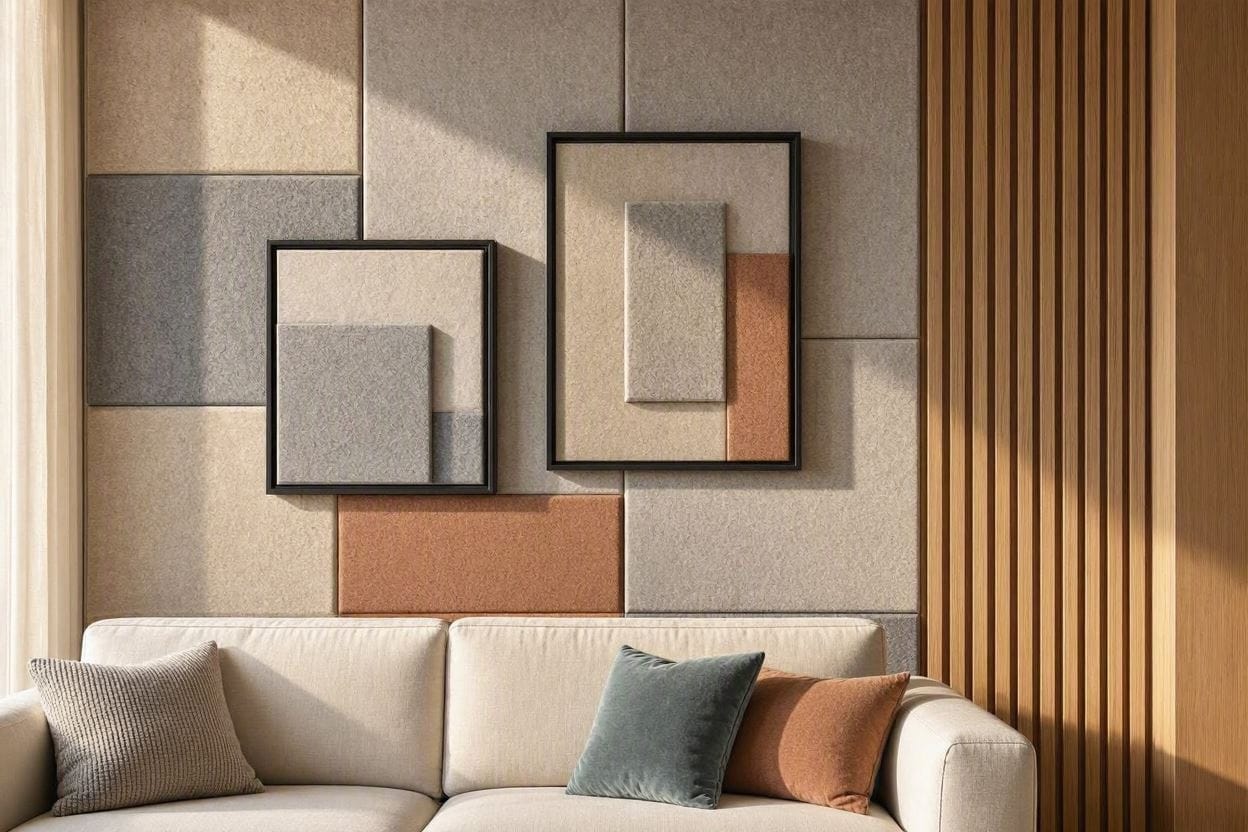
The good news is that this problem is basically solved. Sound-absorbing decor has become a real design category, and the best options now look like deliberate interior choices rather than acoustic hardware. Modern manufacturers build decorative panels with acoustic-grade cores, felt-backed slat systems, printed acoustic art, and textile wall hangings that absorb sound while functioning as legitimate decor. acoustic art panels combine professional-grade sound absorption with printed artwork
Here are the best sound-absorbing decor options in 2026 that you would actually want on your wall.
First: What Actually Absorbs Sound (And What Just Looks Like It Might)
Before buying anything, it is worth understanding one distinction that trips up most shoppers: decorative is not the same as acoustic.
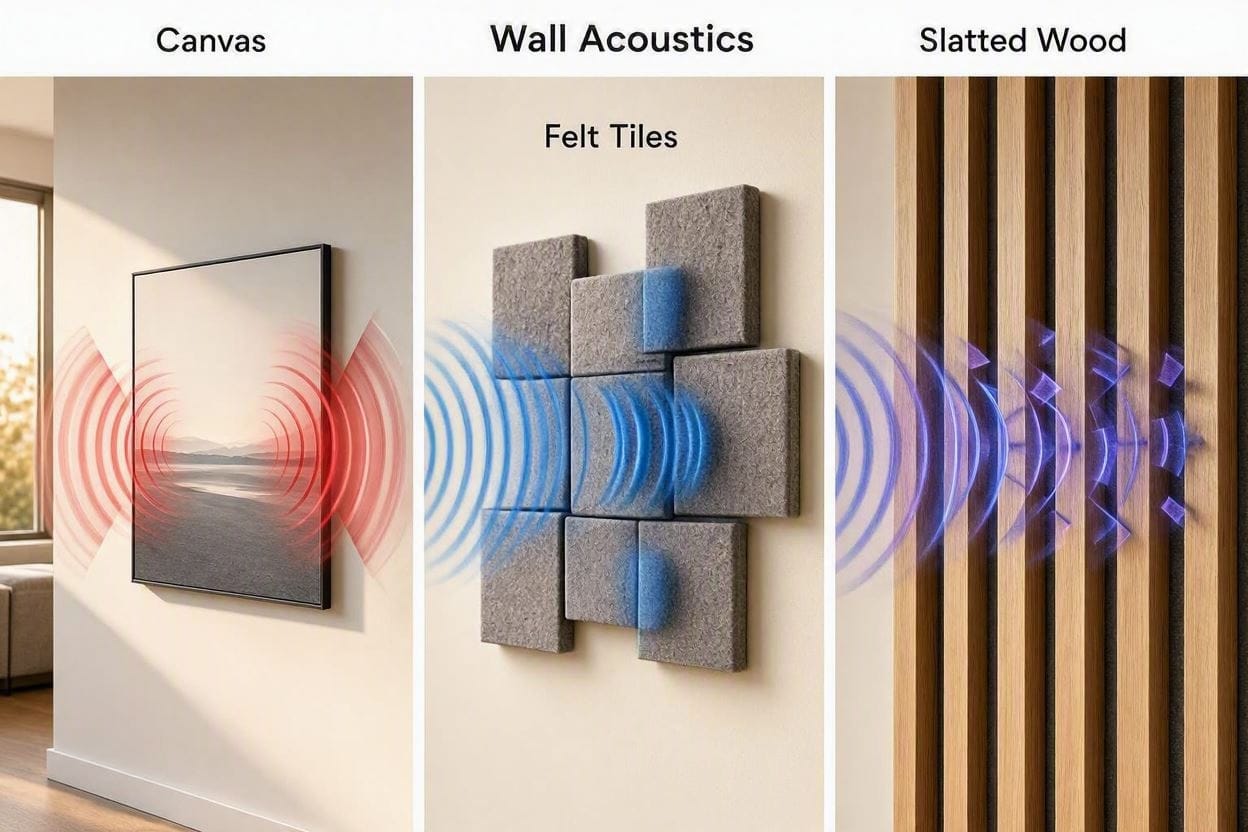
A solid-faced decorative panel may look identical to an acoustic panel and absorb almost nothing, because it has no porous layer for sound to enter. Decorative panels are solid and reflect sound; acoustic panels have an absorptive core that traps acoustic energy and converts it to tiny amounts of heat. This distinction is specifically called out by manufacturers and acoustic suppliers alike.
What actually absorbs sound in decor products:
- PET felt – dense recycled plastic felt, often with an NRC rating around 0.35, meaning it absorbs roughly 35 percent of ambient sound
- Fabric-wrapped panels with mineral wool, rockwool, or fiberglass cores
- Textiles – heavy curtains, wall hangings, upholstered surfaces
- Slatted wood with felt backing – the gaps expose an absorptive layer behind the slats
- Rugs and carpet – the largest soft surface most rooms can add
What generally does not absorb meaningfully:
- Standard canvas prints – the fabric is too tightly stretched and too thin
- Framed glass art – glass reflects
- Solid decorative panels with no absorptive core
- Cheap foam tiles – they absorb some high frequencies but look like a budget fix and often lack fire ratings
That last point is worth stressing. Consumer foam is frequently not Class A fire rated, which is one of several reasons the decorative case for it collapses. It does not look like a design decision, and it is not the best performing option either.
1. Felt Wall Tiles (The Most Flexible Option)
Acoustic felt tiles are the easiest way to get real sound absorption into a room without any commitment to a permanent look. They are made from high-density PET felt, typically with a soft wool-like texture and chamfered edges that give them a dimensional, finished appearance rather than a flat foam-panel look.
What makes them so practical is the format. You buy tiles, not a single large panel, which means you can build a geometric arrangement, a subtle accent cluster, a full wall feature, or something that echoes the shape of your furniture. They come in dozens of colors and multiple shapes, and most are renter-friendly and removable.
Acoustically, felt tiles are genuinely effective at reducing mid and high-frequency echo, which is exactly the range that makes speech sound harsh and rooms feel hollow. A standard felt tile carries an NRC rating around 0.35, meaning it absorbs roughly a third of the sound energy that hits it.
Best for: Bedrooms, nurseries, home offices, hallways, and anyone renting who wants a reversible fix.
What we like: Looks like intentional wall art, installs without tools in many cases, and scales to whatever coverage you need.
Acoustic Felt Wall Tiles
- Absorption type: Porous PET felt, effective on mid to high frequencies
- Key feature: Modular tiles in many shapes and colors for custom arrangements
- Best for: Renters and anyone wanting flexible, reversible acoustic decor
2. Slatted Wood Acoustic Panels (The Premium Design Choice)
Slatted wood panels with felt backing have become the default answer to the “I want acoustic treatment that looks expensive” problem. On the surface they read as a warm, contemporary wood feature wall. Underneath, the felt backing does the actual acoustic work, absorbing mid and high-frequency energy that would otherwise bounce around the room.
The mechanism is simple and clever: the gaps between slats expose the absorptive felt layer behind them, so sound can actually reach the material that absorbs it. This is why slat spacing matters. Wider gaps mean more exposed felt and more absorption.
You can also increase performance further by mounting the panels on battens with insulation behind them, which raises absorption considerably. Manufacturer guidance suggests that adding rockwool behind panels mounted on timber battens achieves Class A sound absorption.
Best for: Living rooms, home offices, feature walls behind a sofa or TV, and open-plan spaces.
What we like: It genuinely looks like a design upgrade while doing measurable acoustic work.
Slatted Wood Acoustic Panels with Felt Backing
- Absorption type: Felt backing exposed through slat gaps, handling mid to high frequencies
- Key feature: Available in natural oak, smoked oak, walnut, and combined felt finishes
- Best for: Feature walls in living rooms, offices, and open-plan spaces
3. Acoustic Art Panels (Printed Absorption)
This is the category that finally closes the gap between professional acoustic treatment and things you would actually hang in a home. Acoustic art panels use a real absorptive core, usually mineral wool or similar acoustic-grade material, wrapped with a printed fabric face so the finished product reads as framed artwork or a canvas print.
Instead of choosing between a picture you love and a panel that works, you get both. Companies in this space print custom designs onto panels built with acoustic material like Owens Corning 703 or rockwool, delivering real absorption alongside the visual.
These are particularly strong for home offices where you take a lot of calls, and for living rooms where a large blank wall is causing the worst of the echo. If you have already read our guide to how to reduce echo in a living room, this is the premium version of the wall treatment step.
Best for: Home offices, living rooms, dining rooms, and anyone who wants absorption without changing their decor style.
What we like: Actual acoustic-grade cores, custom printing, and a look indistinguishable from normal wall art.
Acoustic Art Panels
- Absorption type: Printed fabric face over acoustic-grade mineral wool or rockwool core
- Key feature: Custom printed designs so the panel matches your existing decor
- Best for: Home offices, living rooms, and large bare walls where echo is worst
4. Sound-Absorbing Wall Hangings (The Textile Route)
The oldest domestic acoustic solution is also one of the most aesthetically forgiving: textiles. Wall hangings, tapestries, woven panels, and heavy fabric art have been softening rooms for centuries, and modern versions are explicitly engineered to reduce echo while functioning as genuine decor.
Textiles work because they are porous and irregular. Sound waves enter the fibers rather than bouncing off a hard surface, and the energy dissipates through friction. Denser weaves and thicker constructions absorb more, especially in the mid and high frequencies that make rooms feel harsh.
This route is especially good if you already like texture in your interiors or if your style leans toward warmth and softness. It is also a useful option for renters, since hangings are typically no more invasive to install than a picture frame.
If you want the fuller picture on textile-based absorption, our article on whether soundproof blankets actually work covers the same material science with a different product, and it is worth reading before you buy anything fabric-based.
Best for: Bedrooms, living rooms, renters, and rooms where you want warmth rather than hard panels.
What we like: Genuinely effective, visually soft, and available in a huge range of styles.
Sound-Absorbing Wall Hangings
- Absorption type: Porous woven textile, effective across mid and high frequencies
- Key feature: Functional decor that reduces noise and adds visual warmth
- Best for: Bedrooms, living rooms, and anyone wanting a soft alternative to panels
5. Acoustic Curtains (The Double-Duty Option)
Curtains deserve a place here because they solve two problems at once and most people already have the hardware installed. Heavy, densely woven curtains absorb sound while also softening one of the most reflective surfaces in any room: the window.
The key is mass and coverage. Thin decorative sheers look lovely and do almost nothing acoustically. Velvet, heavy linen blends, layered drapery, and insulated blackout curtains with real body are what actually make a difference, especially when they cover the full window rather than a decorative slice of it.
We have covered this in depth in our roundups of soundproof curtains and curtains for blocking street noise. If you want a single purchase that improves both echo and outside noise intrusion, this is usually the highest-value one.
Best for: Any room with a large window, especially bedrooms, offices, and living rooms facing the street.
What we like: It is the least effort of any absorption upgrade, since most people already have a curtain rod.
Heavy Acoustic Curtains
- Absorption type: Dense woven textile with real mass, reducing reflections at the window
- Key feature: Improves echo and outside noise intrusion at the same time
- Best for: Bedrooms, home offices, and street-facing rooms
6. Sound-Absorbing Rugs and Rug Pads
Technically floor decor rather than wall decor, but no list of sound-absorbing decor would be complete without it. Floors are one of the largest reflective surfaces in any room, and a rug covers a significant portion of that surface with porous material.
Thickness matters more than pattern. A dense wool rug with a quality pad does real acoustic work. A thin flat-weave in a small size does very little. If you are choosing a rug specifically for sound, go larger and denser than you otherwise would.
This is covered thoroughly in our guides to rug pads for soundproofing and sound-absorbing rug pads for hardwood floors.
How To Choose Between Them
The right choice depends mostly on how much change you want to make and how permanent it should be.
| If you want… | Choose |
|---|---|
| Renter-friendly and reversible | Felt tiles or wall hangings |
| A permanent design upgrade | Slatted wood acoustic panels |
| Art you would hang anyway | Acoustic art panels |
| One purchase that also blocks outside noise | Heavy acoustic curtains |
| Biggest improvement for the money | A large dense rug with a good pad |
What To Look For Before You Buy
- Look for an NRC rating. Noise Reduction Coefficient tells you how much sound the material actually absorbs. 0.35 is decent for felt; higher is better.
- Check the core material. Mineral wool, rockwool, and PET felt absorb well. Solid-faced boards do not.
- Confirm it is acoustic, not just decorative. Many attractive panels on the market are purely visual.
- Check fire ratings for anything mounted on a wall, especially foam-based products.
- Cover enough surface. A single small panel in a large echoey room will disappoint you. Coverage matters as much as material.
- Place it where sound actually hits. First reflection points, large bare walls, and areas behind where you sit or speak are the highest-value spots.
One note on expectations: these products reduce echo and reverberation inside a room. They are not soundproofing, and they will not meaningfully block noise coming through a wall from a neighbor. That is a different problem, and it is covered in soundproofing vs. sound absorption.
Final Verdict
If you want the most flexible and renter-friendly option, start with felt wall tiles. They install easily, look like intentional design, and handle the mid and high-frequency echo that makes rooms feel harsh.
If you are willing to make a more permanent upgrade to a space you own, slatted wood acoustic panels with felt backing deliver the best combination of real acoustic performance and genuine visual improvement.
And if you want something that looks like art rather than acoustic treatment, printed acoustic art panels give you absorption with a custom printed face, which means the acoustic upgrade disappears into your existing decor instead of announcing itself.
Whichever route you take, the principle stays the same. Studio foam was never the only option. It was just the most obvious one, and the market has moved well past it.
Frequently Asked Questions
Do Decorative Acoustic Panels Actually Work?
Real acoustic panels do, but decorative-only panels do not. The difference is whether the panel has a porous absorptive core. Solid-faced panels reflect sound regardless of how nice they look.
What is the Most Attractive Sound-Absorbing Decor?
Printed acoustic art panels and slatted wood panels with felt backing are generally considered the most design-friendly options. Felt tiles are also popular because you can arrange them as wall art.
How Many Panels Do I Need to Reduce Echo?
It depends on room size, but coverage matters more than panel count. A single small panel in a large echoey room will have little effect. Treating the main bare walls and first reflection points gives the best results.
Will Acoustic Decor block Noise From Neighbors?
No. Acoustic decor absorbs sound inside your room and reduces echo. Blocking noise from neighbors requires mass, sealing, and structural changes, which is soundproofing rather than absorption.
Are Felt Acoustic Tiles Safe to Put on Walls?
Quality PET felt tiles from reputable brands are designed for wall installation and are typically made from recycled material. Check the manufacturer’s fire rating information before mounting anything on a wall.

Ememobong is the lead researcher and editor at Quiet Dwelling. As a professional technical writer, he specializes in breaking down complex acoustic engineering concepts into simple, actionable steps. His goal is to help people build distraction-free environments for better sleep and deep work.