

*This post contains affiliate links. If you use these links to buy something we may earn a commission at no extra cost to you.
Having a private balcony in an apartment is a massive luxury, but that luxury is quickly ruined if your outdoor space overlooks a busy highway, a loud intersection, or a courtyard full of screaming children. When traffic noise constantly exceeds 70 decibels, your peaceful morning coffee turns into an exercise in acoustic endurance.
Before we dive into the solutions, we have to establish a hard rule of audio physics: You cannot completely soundproof an open-air environment. Soundproofing requires an airtight, decoupled structure, which defeats the entire purpose of being outside.
However, you can drastically manipulate the acoustics of your patio through a combination of deflection, absorption, and acoustic masking. According to the World Health Organization (WHO), chronic exposure to environmental noise significantly raises stress levels. By implementing these three steps, you can reclaim your balcony and create a peaceful urban oasis.
Step 1: Block the Line of Sight (Acoustic Deflection)
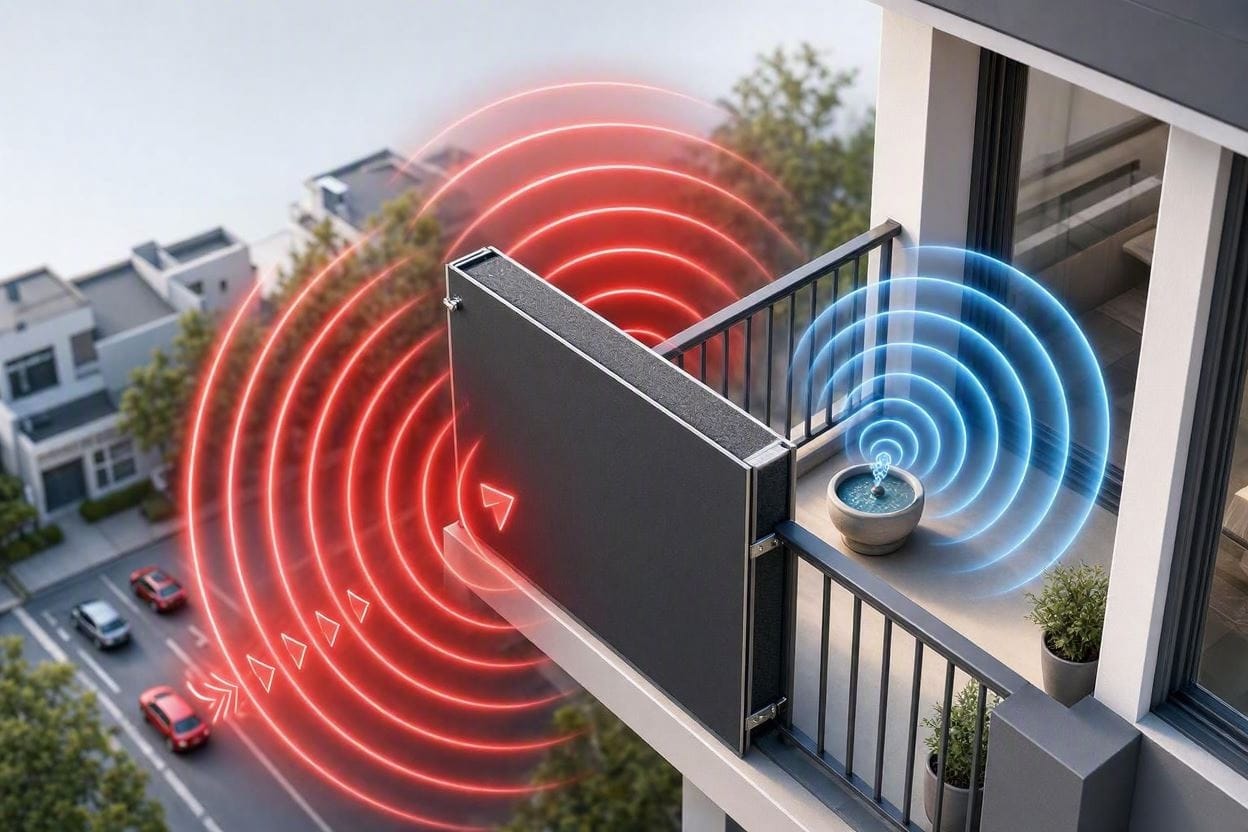
In acoustics, there is a general rule of thumb: If you can see the noise source, you can hear it clearly. High-frequency sounds (like sirens, tire squeals, and voices) travel in straight, directional lines. If your balcony has an open wrought-iron railing or glass panels with massive gaps, sound waves will pour straight into your seating area.
To stop this, you need to add mass to your railing to deflect the sound waves back toward the street.
Heavy-Duty Balcony Privacy Screen (High-Density Polyethylene)
While standard fabric screens only block UV rays, high-density polyethylene (HDPE) screens possess enough physical mass to disrupt high-frequency sound waves. Zip-tying this tightly to your railing breaks the direct line-of-sight from the street, muffling sharp noises while adding total visual privacy.
Step 2: Soften the Hard Surfaces (Acoustic Absorption)
Most apartment balconies are constructed from concrete, brick, and glass. When street noise enters your balcony, it acts like a pinball, violently ricocheting off these hard surfaces and amplifying the chaotic sound. This is known as structural reverberation, which we explored deeply in our guide on the physics of acoustic transmission.
To deaden this echo, you must introduce soft, porous materials that catch and trap sound waves.
NICETOWN Outdoor Weatherproof Acoustic Curtains
If your balcony has an overhead covering, hanging heavy, weatherproof outdoor curtains on the sides of your patio is a game-changer. Drawing these thick curtains closed creates a soft acoustic boundary that absorbs passing traffic noise before it bounces off your sliding glass door.
Pro Tip: Do not neglect the floor. Laying down a thick, all-weather outdoor rug prevents sound from reflecting directly upward into your seating area. Adding large, dense potted plants (like bamboo or tall ferns) also provides excellent natural sound diffusion.
Step 3: Raise the Noise Floor (Acoustic Masking)
Even with heavy screens and thick curtains, you will still hear the low-frequency rumble of a passing garbage truck or a revving engine. As we have discussed regarding the health effects of low-frequency noise pollution, these heavy bass waves are nearly impossible to block without foot-thick concrete.
The solution is acoustic masking. By introducing a steady, pleasant sound directly next to your seating area, you effectively raise the “noise floor” of your balcony. Your brain will lock onto the pleasant sound and completely tune out the distant hum of traffic.
Alpine Corporation Tabletop Water Fountain
Running water is the ultimate natural white noise generator. A small, plug-in tabletop fountain produces a continuous, random frequency of splashing water that perfectly scrambles and masks the rhythmic thumping of highway traffic or the chatter of neighbors.
Frequently Asked Questions
Will Acoustic Foam Panels Work Outside on a Balcony?
No. Traditional indoor acoustic foam is highly porous and acts like a sponge. If left outside, it will immediately soak up rain and humidity, grow mold, and fall apart. Only use materials specifically rated for outdoor, all-weather use, such as HDPE screens or weatherproof acoustic curtains.
Does Hanging Plants Reduce Balcony Noise?
Yes, but mostly through diffusion rather than absorption. The complex structure of leaves and branches breaks up sound waves and scatters them in different directions, preventing harsh echoes. Thick, evergreen plants with massive leaves offer the best acoustic benefits.
Can I Play a White Noise Machine Outside?
While you can use a portable white noise machine on your balcony while sitting there, most electronics are not rated to be left outside permanently. A dedicated water fountain or a weatherproof outdoor fan is a much safer, permanent masking solution.

Ememobong is the lead researcher and editor at Quiet Dwelling. As a professional technical writer, he specializes in breaking down complex acoustic engineering concepts into simple, actionable steps. His goal is to help people build distraction-free environments for better sleep and deep work.