
*This post contains affiliate links. If you use these links to buy something we may earn a commission at no extra cost to you.
Building the ultimate gaming room usually starts with a high-refresh-rate monitor, an ergonomic chair, and a powerful PC. But the fastest way to ruin a late-night gaming session is by waking up the rest of the house with the rapid-fire clicking of mechanical keyboards, the booming bass of a subwoofer, or a sudden shout during a tense match.
When gamers try to fix this, they almost always buy a massive pack of cheap acoustic foam panels, glue them to the wall, and are shocked when their family can still hear every word they say. This happens because of a fundamental misunderstanding of audio physics.
To fix your gaming room, you have to understand the difference between Soundproofing (keeping noise from escaping the room) and Acoustic Treatment (making your microphone sound professional). Here is exactly what your gaming room actually needs.
The Physics: Isolation vs. Absorption
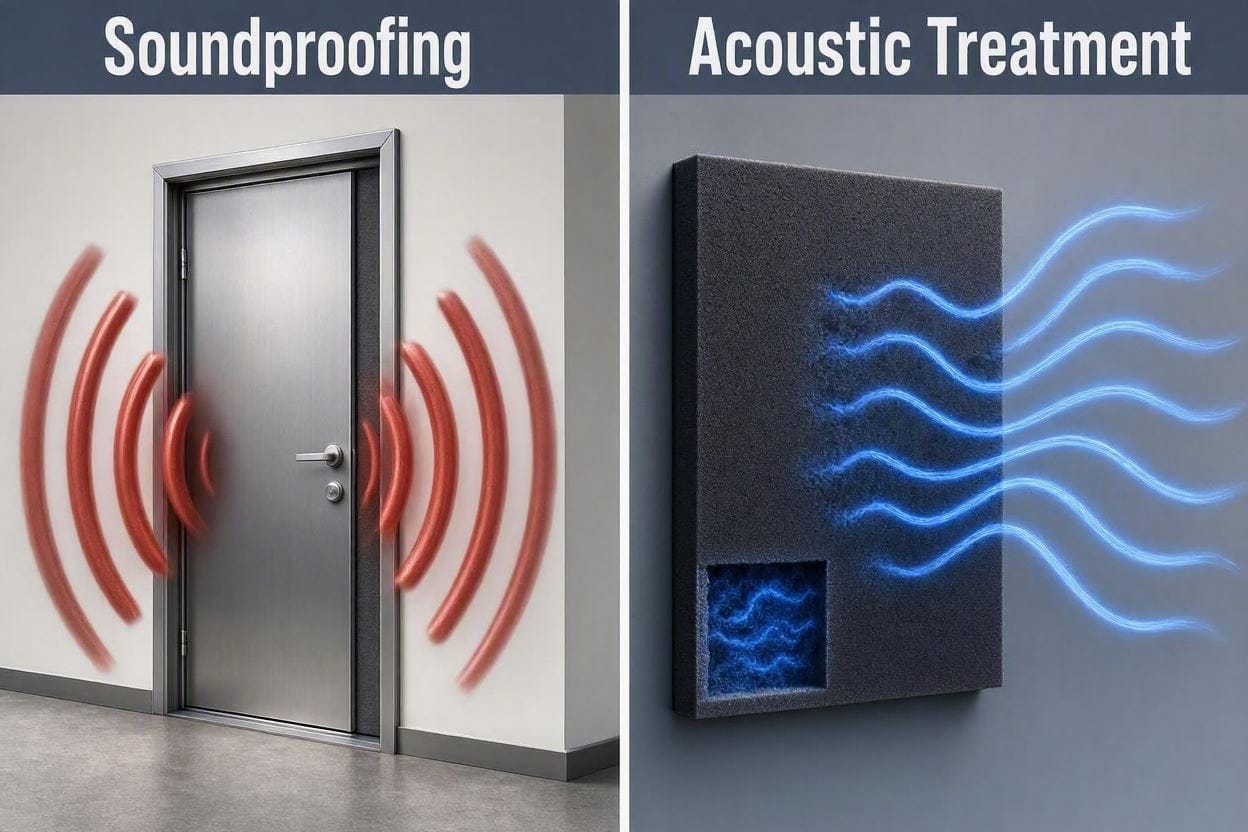
According to the Audio Engineering Society (AES), managing acoustics requires treating two completely different acoustic phenomenons:
- Soundproofing (Decoupling & Mass): This is the process of stopping sound from entering or leaving a space. It requires heavy, dense materials (like solid wood, thick rubber, or drywall) to block sound waves, and airtight seals to prevent noise from leaking through gaps. If your goal is to stop waking up your roommates, you need soundproofing.
- Acoustic Treatment (Absorption): This controls how sound behaves inside the room. When you speak, sound waves bounce off hard drywall and floors, creating a hollow, echoing reverb in your microphone. Soft, porous materials (like acoustic panels and rugs) absorb these reflections. If you want to sound like a professional streamer, you need acoustic treatment.
To create the perfect gaming environment, you realistically need a combination of both.
Phase 1: Soundproofing (Keeping the Peace)
Before you stick anything to your walls, you must address the weakest acoustic link in your gaming room: the door. Most interior doors have a massive air gap at the bottom that allows low-frequency bass and high-frequency shouting to pour right into the hallway.
High-Density Silicone Acoustic Door Sweep
Your first line of defense is sealing the air gap. A dense silicone door sweep adheres to the bottom of your door, creating an airtight seal against the floor to block sound transmission without damaging your carpet or hardwood.
If you have sealed the gap but noise is still escaping, the door itself is the problem. A standard hollow-core door has virtually no mass. You can drastically improve this by reading our guide on how to soundproof a hollow-core door, or by upgrading to a solid wood slab. For late-night sessions, you should also pair your acoustic upgrades with silent peripherals—check out our breakdown of the best quiet gaming mice to eliminate high-pitched clicking.
Phase 2: Acoustic Treatment (For the Streamers)
Once the room is sealed, it is time to kill the “flutter echo.” If you stream on Twitch or Discord, bare drywall will ruin your audio quality, regardless of how expensive your microphone is. You need to introduce porous materials to absorb the reflections.
Hexagon Acoustic Panels (High-Density Polyester)
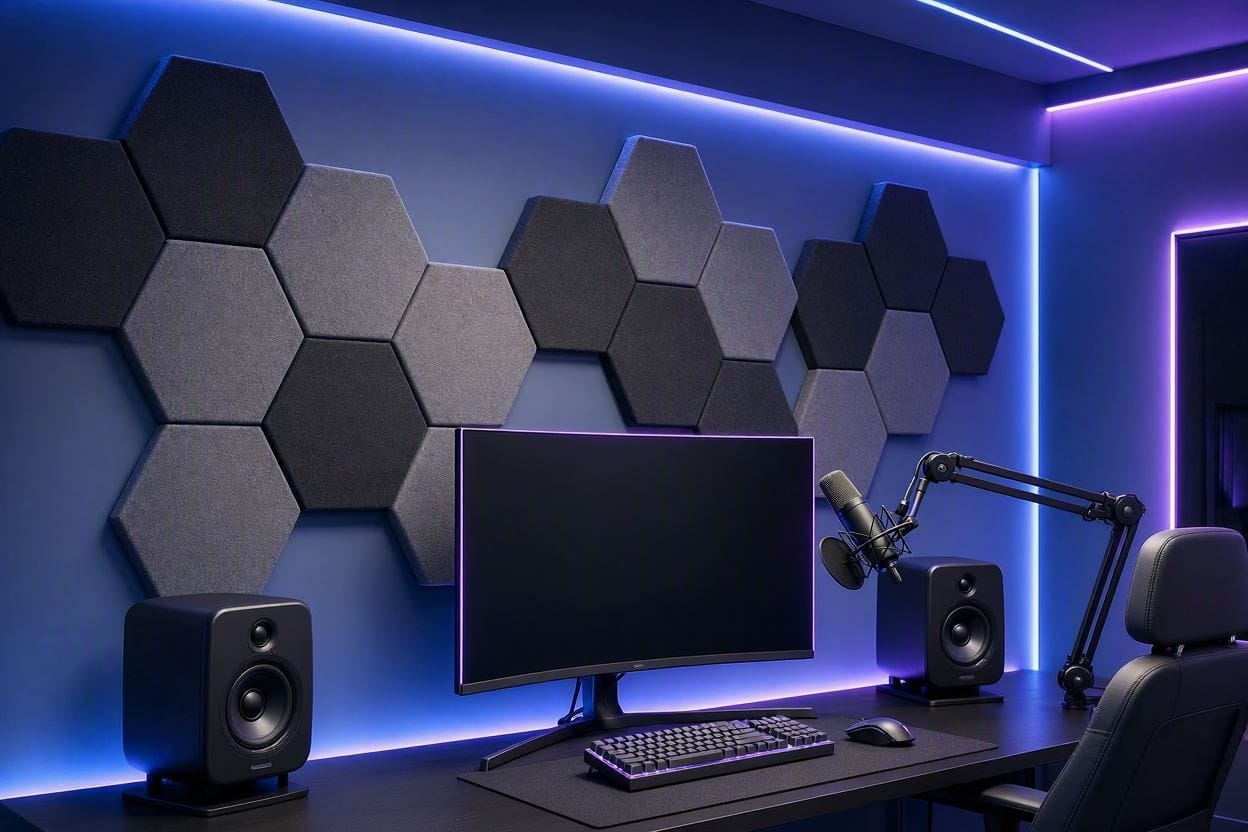
Ditch the cheap, ugly egg-crate foam. These high-density polyester fiber panels absorb mid-to-high frequency vocal reflections while providing a sleek, modern aesthetic that looks incredible on camera.
- NRC (Noise Reduction Coefficient) of 0.92 for excellent vocal clarity.
- Beveled edges for a premium, architectural look.
- Place them directly behind your monitor and on the wall behind your chair.
Corner Bass Traps
If you have a subwoofer or a deep voice, low-frequency sound waves will pool in the 90-degree corners of your room, creating a muddy, booming sound. Thick polyurethane bass traps fit snugly into the corners to absorb these heavy waves.
Frequently Asked Questions
Will Acoustic Foam Panels Keep My Neighbors From Hearing Me Game?
No. This is the most common gaming room myth. Acoustic foam is lightweight and porous; it is designed to absorb internal echo, not block structural sound transmission. To block sound from leaving the room, you must seal air gaps and add heavy mass (like mass-loaded vinyl or thick drywall).
Do I Need to Cover My Entire Wall with Acoustic Panels?
No. For a streaming setup, covering just 15% to 25% of your total wall space is usually enough to kill the flutter echo. Focus on the “reflection points”: the wall immediately behind your monitors, the wall directly behind you, and the ceiling directly above your desk.
What is the Cheapest Way to Treat a Gaming Room?
If you don’t want to buy dedicated acoustic panels, bring in heavy household items. Lay down a thick, high-pile area rug, hang heavy blackout curtains over the windows, and move a fabric sofa or a bookshelf filled with books into the room. These will all absorb echo naturally.

Ememobong is the lead researcher and editor at Quiet Dwelling. As a professional technical writer, he specializes in breaking down complex acoustic engineering concepts into simple, actionable steps. His goal is to help people build distraction-free environments for better sleep and deep work.