This post contains affiliate links. If you use these links to buy something, we may earn a commission.
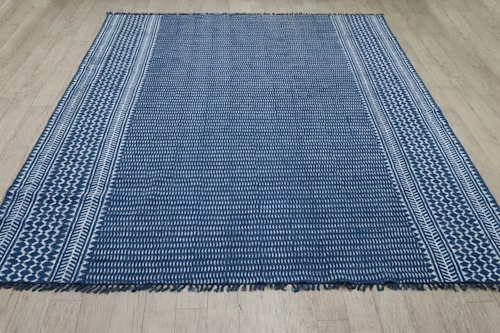
You just bought a thick, fluffy rug for your hardwood floors. It looks great, but there is still a problem: when you walk across it, you can still hear the heavy thud-thud-thud of your footsteps echoing through the house.
And if you live in an apartment, your downstairs neighbor probably hears it even louder. This is a common misconception. People think a rug alone is enough to soundproof a floor.
The Truth: A rug is an absorber (it stops echoes). To actually stop the noise of footsteps (Impact Noise), you need density. You need a Soundproof Rug Pad.
Here is why that hidden layer underneath your rug is actually more important than the rug itself and which material you should buy.
The Science: Impact Noise vs. Airborne Noise
Floors deal with a specific type of sound called Impact Noise.
Unlike a voice or TV (Airborne Noise), which travels through the air, Impact Noise is physical vibration caused by an object striking the floor, like a heel clicking, a chair dragging, or a child jumping.
When your foot hits a hard floor, the floorboard vibrates like a drum skin, sending that sound wave directly into the structure of the house.
A standard rug is too soft to stop this energy; it just gets squished. You need a material that is dense enough to decouple (separate) the impact from the subfloor.
Do You Need a Rug Pad?
If you are asking this question, the answer is almost certainly Yes.
- Scenario A (The Home Office): You are on calls, and your chair rolling on the floor creates a rumble. You need a pad.
- Scenario B (The Upstairs Apartment): Your downstairs neighbor complains about your walking. You need a heavy-duty pad.
- Scenario C (The Echo): The room just sounds “hollow.” A rug alone might be enough, but a pad makes it better. (Related: Soundproofing vs. Sound Absorption: What is the difference?)
Which Material Is Best for Sound?
Not all pads are created equal. The cheap, waffle-patterned rubber mats you buy at the dollar store are for grip (non-slip), not for sound.
For soundproofing, you need Mass and Thickness.
1. Felt Pads
Dense, recycled felt is the best material for soundproofing.
- Why: It is extremely dense (adding mass) but fibrous enough to absorb vibration.
- Thickness: Look for at least 0.375 inch or 0.5 inch thickness.
- Pros: Incredible sound reduction, makes rugs feel luxurious.
- Cons: Can be slippery on smaller rugs (unless it has a rubber backing).
2. Memory Foam
- Why: It absorbs the energy of the footstep effectively.
- Pros: Very soft to walk on.
- Cons: Not as durable as felt; can “bottom out” if it’s too soft.
3. Natural Rubber
- Why: Rubber is dense but usually too thin to provide major soundproofing on its own.
- Best For: Thin runner rugs in hallways where you just need to stop the “clicking” of shoes.
Conclusion: What Should You Buy?
If your main goal is Silence, skip the waffle mats.
Go for a 100% Felt Rug Pad that is at least 0.5 inches thick. It will act as a shock absorber for your entire room, extending the life of your rug and keeping your neighbors happy.
It is the single most effective invisible upgrade you can make to a room. Thank you for reading!