*This post contains affiliate links. If you use these links to buy something we may earn a commission at no extra cost to you.
We all know the game. It is 2:00 AM, the house is perfectly silent, and you are warming up a late-night snack. You stand frozen in front of the microwave, staring intensely at the glowing digital countdown. As it hits 0:02… 0:01… you violently stab the “Cancel” button to stop the timer.
If you fail, a piercing, high-frequency BEEP-BEEP-BEEP echoes through the entire house, waking up your partner, the dog, and the baby. And even if you succeed in stopping the beep, you still have to deal with the loud, metallic CLACK of yanking the door latch open, and the rattling roar of the motor.
If you live in an apartment, share a home with light sleepers, or have a kitchen near a bedroom, a standard microwave is an acoustic nightmare.
You shouldn’t have to play bomb-defusal just to heat up a cup of coffee. I’ve tested the top kitchen appliances on the market to find models that are actually engineered for stealth. By prioritizing dedicated mute buttons, soft-close doors, and inverter technology, you can completely silence your kitchen. Here are the best quiet microwaves that won’t ruin your peace.
The Science of the Screech: What Makes Them So Loud?
When analyzing kitchen acoustics, a microwave is uniquely terrible because it produces two completely different types of disruptive noise: electronic noise (the beep) and mechanical noise (the motor and door).
1. Electronic Impulsive Noise (The Beeper)
That piercing beep isn’t just annoying; it is biologically designed to stress you out. According to the National Institute on Deafness and Other Communication Disorders (NIDCD), sudden, high-frequency acoustic spikes (known as impulsive noises) easily bypass standard physical barriers like walls and doors. When these sharp sounds hit your ears in a quiet house, they trigger your brain’s startle reflex, flooding your body with cortisol.
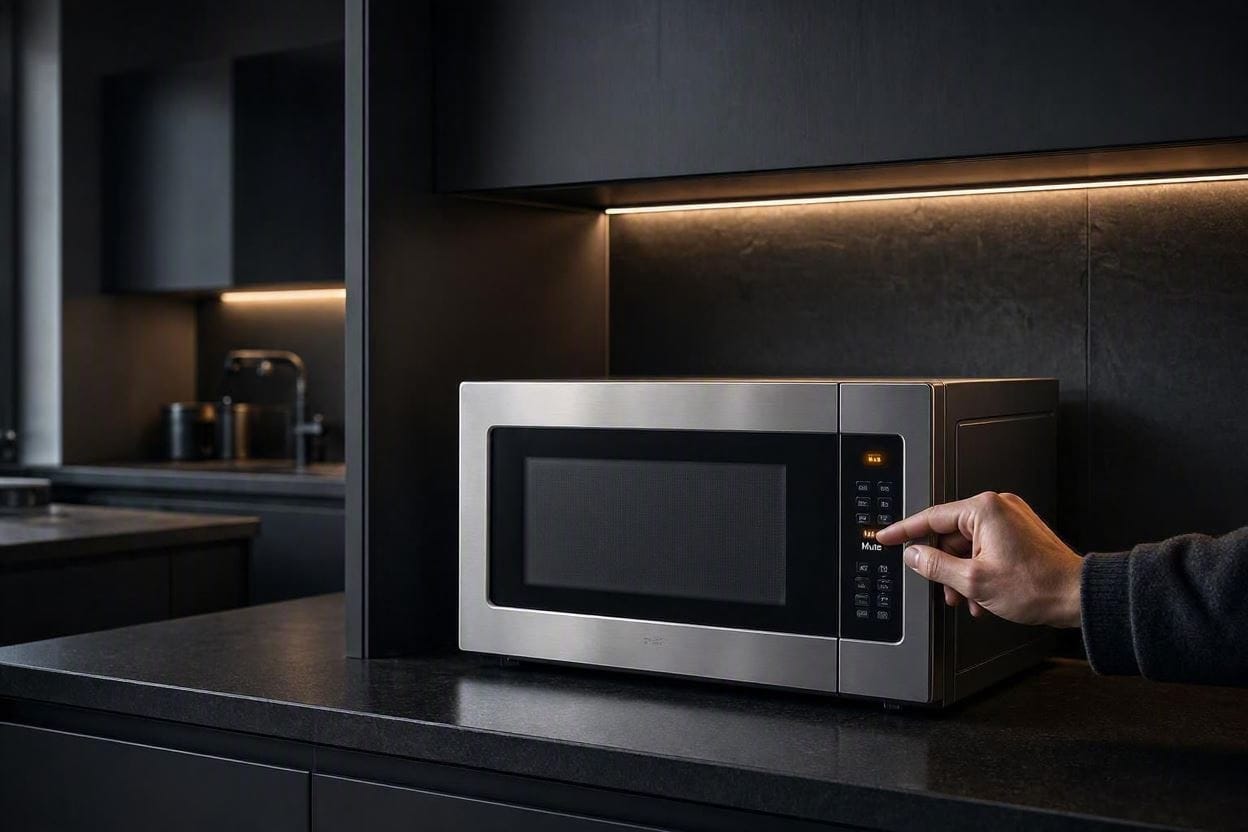
To fix this, you must buy a microwave with a dedicated “Mute” or “Sound Off” button. Do not assume you can turn the sound off via a hidden menu on standard models—if the manufacturer doesn’t advertise a mute function, the piezo buzzer is usually hardwired to the motherboard and cannot be silenced.
2. Mechanical Noise (Inverters vs. Transformers)
Have you ever microwaved something at 50% power? You hear the machine run quietly for a few seconds, then emit a violent, vibrating RUUUUMBLE, then quiet down, then rumble again.
Standard microwaves use a heavy magnetic transformer that only has two modes: 100% ON or completely OFF. When you ask for 50% power, the machine literally slams the heavy motor on and off repeatedly. This jarring vibration creates a massive amount of low-frequency noise.
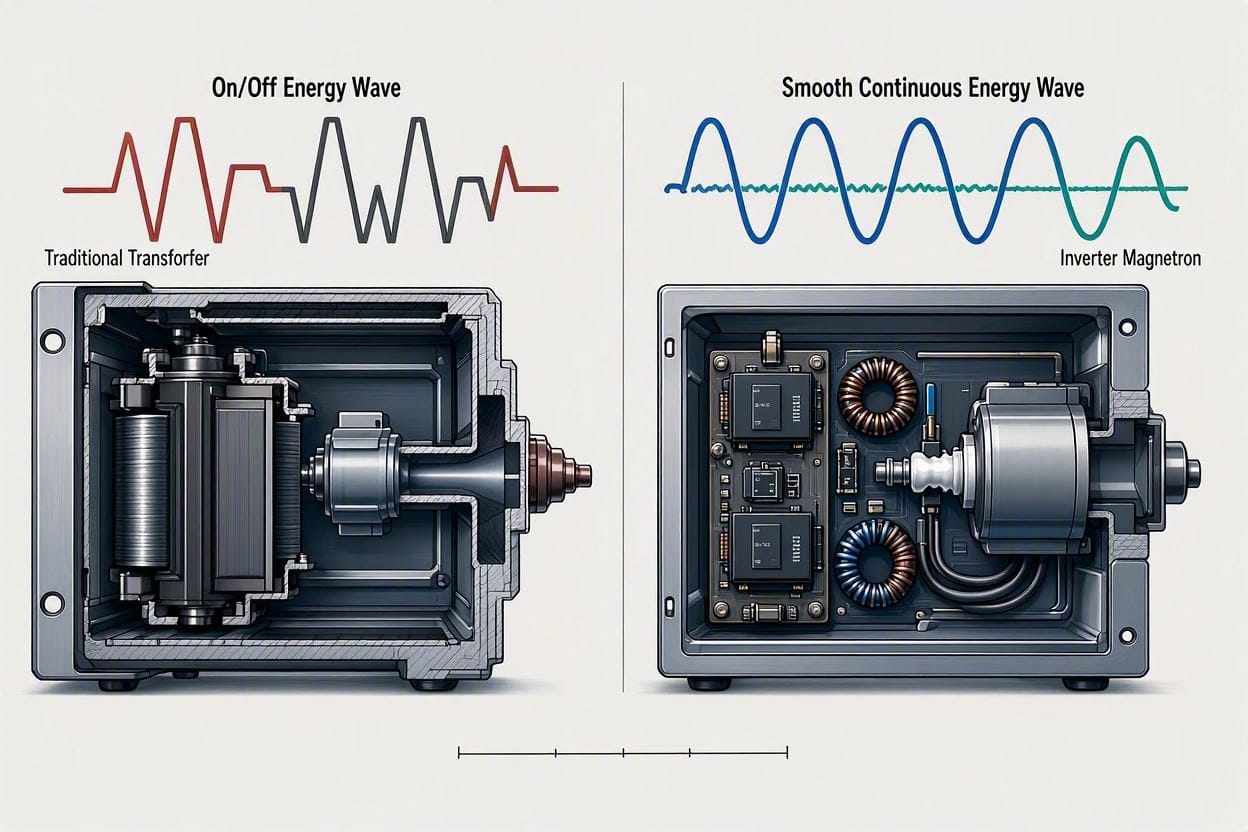
Premium quiet microwaves use Inverter Technology. An inverter delivers a steady, continuous stream of lower power. It completely eliminates the violent on/off cycling, resulting in a smooth, continuous, low-decibel hum that is far less disruptive to the human ear.
1. Toshiba EM131A5C (The Best Overall)
If you just want a reliable, powerful microwave that won’t wake up the baby, Toshiba completely understood the assignment. This model is a massive favorite in the quiet-dwelling community because of one simple, glorious feature: the “8” key.
The number 8 on the keypad doubles as a dedicated “Sound On/Off” button. By holding it down for three seconds, you completely mute the keypad beeps and the end-of-cycle alarm. It is incredibly easy to toggle on and off depending on who is sleeping in the house.
Aside from the silence, it features a smart humidity sensor that automatically detects when your food is perfectly heated to prevent overcooking.
The Pros
- Dedicated, one-touch mute button completely kills all electronic noise.
- Large interior capacity easily fits a 12-inch dinner plate.
- Very well-balanced chassis reduces turntable rattling.
The Cons
- Uses a standard transformer (not an inverter), so it still hums noticeably.
- The door latch is a standard mechanical push-button, which clicks loudly.
2. Breville Smooth Wave (The Premium Acoustic Masterpiece)
If you have an unlimited budget and want the absolute quietest kitchen appliance possible, Breville engineered the Smooth Wave specifically for acoustic comfort.
First, it utilizes true Inverter Technology. The motor hum is incredibly smooth and quiet without that jarring on/off cycling rumble. Second, the settings dial allows you to easily adjust the beep volume or mute it entirely.
But the real acoustic star is the Soft-Close door. Instead of a cheap metal latch that you have to slam shut, the Breville uses a dampened, hydraulic hinge. It catches the door and pulls it shut silently, completely eliminating the metallic clack that plagues 99% of microwaves. It is pure kitchen luxury.
The Pros
- Soft-close door eliminates the loudest part of microwaving (the slam).
- Inverter motor provides a smooth, low-decibel, continuous hum.
- Gorgeous stainless-steel aesthetic looks great in modern kitchens.
The Cons
- Highly expensive premium price tag.
- The menu dial system has a bit of a learning curve compared to standard keypads.
3. COMFEE’ EM720CPL (The Best Budget/Dorm Pick)
If you are outfitting a tiny college dorm, a small office cubicle, or simply don’t have the budget for a high-end Breville, the COMFEE’ is an absolute acoustic steal.
It is incredibly compact (0.7 cubic feet), making it perfect for tight spaces. More importantly, it features an explicit “Sound On/Off” button directly on the front keypad. For under $100, finding a microwave that lets you kill the beep instantly is rare. While the internal motor isn’t quite as perfectly balanced as a high-end inverter, the ability to silence the electronic alarms at this price point makes it a lifesaver for roommates.
The Pros
- Unbeatable value for a true mute-button microwave.
- Compact footprint slides easily under low cabinets or onto desks.
- Eco-mode turns off the LED display at night to reduce light pollution.
The Cons
- Only 700 Watts, so heating food takes noticeably longer.
- Too small to fit large, oversized dinner plates.
4. Panasonic NN-SN936B (Best High-Power Inverter)
If you frequently cook large family meals, defrost thick cuts of meat, or just want your food heated incredibly fast, you need a high-wattage machine. However, heavy power usually means heavy noise.
Panasonic is the absolute pioneer of Inverter Technology. This massive 1250-watt unit heats food rapidly and evenly, completely eliminating the “frozen center/lava edges” problem. Because it utilizes a premium inverter, the internal fan and transformer operate with a smooth, low-decibel hum rather than a violent clatter.
Note: It does not have a dedicated one-touch mute button on the keypad like the Toshiba, but the overall mechanical noise reduction makes it one of the quietest running motors on the market for its size. You can turn the beep off via the internal programming menu.
The Rubber Pad Hack: Stopping Impact Vibration
Even if you buy the ultra-smooth Breville or Panasonic, you might turn it on and hear a deep, structural rumbling noise echoing through your kitchen cabinets. This is rarely the microwave’s fault; it is caused by Impact Noise.
When a heavy motorized appliance sits directly on a hard granite, tile, or laminate countertop, the microscopic vibrations from the motor transfer directly into the wood of the cabinetry below. The hollow cabinets act exactly like the body of an acoustic guitar, amplifying the vibration into a loud, booming bass note that travels easily through walls.
We detail the physics of this phenomenon heavily in our guide on Airborne vs. Impact Noise.
The 5-Minute Fix: You must apply structural decoupling. Buy a set of four thick, heavy-duty vulcanized rubber anti-vibration pads (often sold for washing machines) or place a thick neoprene mat underneath the microwave. The dense rubber acts as a shock absorber, trapping the kinetic vibration before it can enter the hard countertop. The booming rumble will instantly disappear.
Complete Your Silent Kitchen: A quiet microwave is a massive victory, but if you want the ultimate acoustic sanctuary, you need to treat the other major culprits. Check out our guides to the best quiet refrigerators and the quietest morning coffee makers to build a truly peaceful home!
Who This Is NOT For (Over-The-Range Units)
If you are looking for an Over-The-Range (OTR) microwave to mount above your stove, I want to manage your expectations: they are inherently much louder than countertop models.
An OTR microwave is not just heating food; it also houses a massive exhaust fan designed to pull smoke and grease off your stovetop. Moving hundreds of cubic feet of air per minute requires a heavy, high-RPM fan that will always create wind-shear noise. While premium brands like GE Profile make great OTR units, if your ultimate goal is absolute kitchen silence, you are far better off buying a countertop microwave and pairing it with one of our top-rated stealthy quiet range hoods.
Frequently Asked Questions (FAQ)
Do all Microwaves Have a Hidden Mute Function?
No. A very common internet myth is that holding down the “0”, “1”, or “2” key on any microwave will silence it. While this works on some older Whirlpool or GE models, the vast majority of modern microwaves have the piezo buzzer hardwired to the board without a software bypass. If you want silence, you must explicitly buy a model that advertises a mute feature.
Does Higher Wattage Mean the Microwave Will Be Louder?
Not necessarily. While a 1250W transformer is physically larger than a 700W transformer, premium high-wattage microwaves (like the Panasonic Inverter) use far better acoustic insulation and smoother electrical delivery. A cheap, low-wattage microwave struggling to heat food will often rattle and buzz much louder than a powerful, well-built machine.
Why Does the Glass Turntable Rattle So Loudly?
If your microwave rumbles rhythmically as the plate spins, the plastic roller ring underneath the glass tray is likely misaligned or dirty. Food crumbs or grease build up on the plastic wheels, causing them to “jump” as they roll over the track. Take the glass plate out, wash the plastic roller ring in warm soapy water, and ensure it is perfectly seated in the center groove.

Ememobong is the lead researcher and editor at Quiet Dwelling. As a professional technical writer, he specializes in breaking down complex acoustic engineering concepts into simple, actionable steps. His goal is to help people build distraction-free environments for better sleep and deep work.