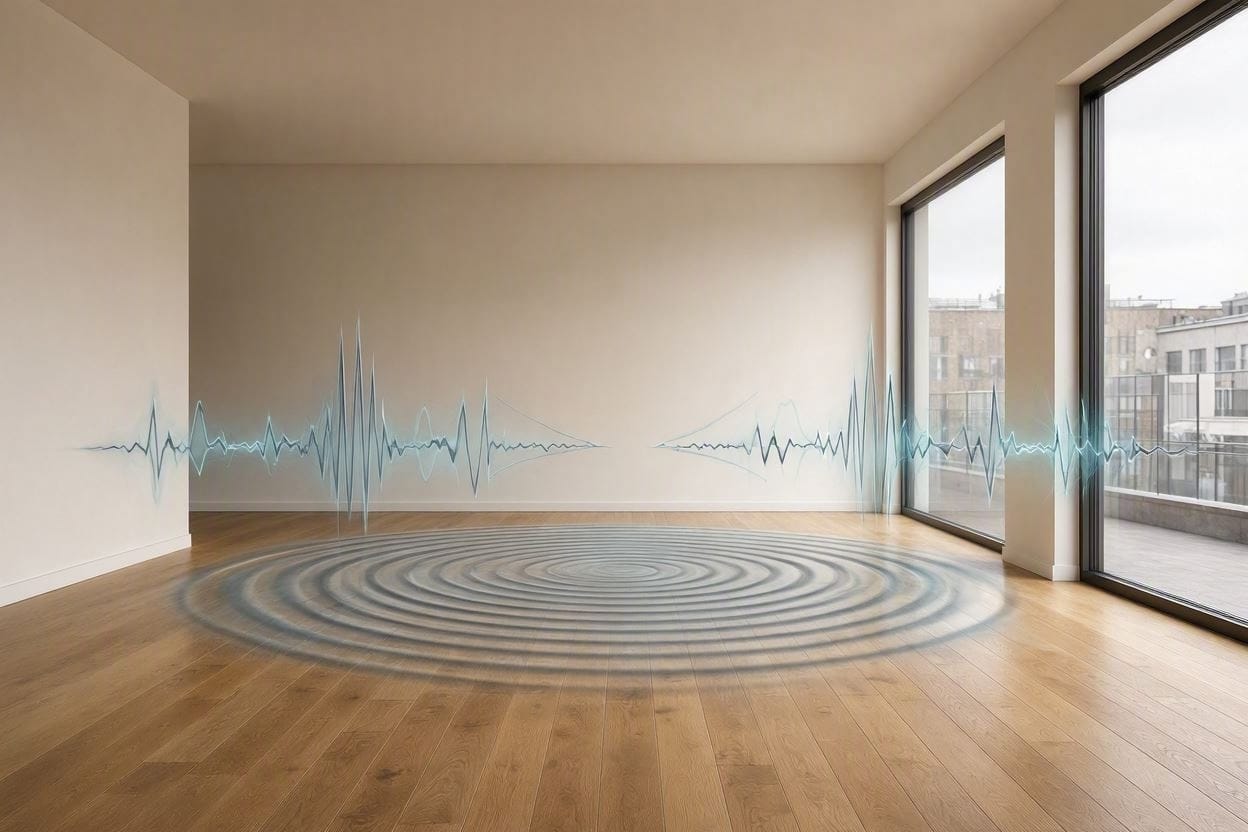
If you have ever walked into a newly built home, a freshly painted apartment, or a room that has just been cleared out for renovation, you already know the sound. Your footsteps click louder than they should. Your voice sounds sharp and hollow. A door closing down the hallway feels like it happened inside your own head. The room is not actually louder than any other space, but it feels like every sound has been turned up and stretched out.
That is the unmistakable signature of an empty room, and it happens for a very specific reason. Sound is a wave, and like any wave, it travels until it hits something. In a furnished room, it hits soft things: fabric, cushions, curtains, rugs, your body. In an empty room, it hits hard, flat, rigid things: drywall, glass, tile, wood, concrete. Those hard surfaces do not absorb the sound. They reflect it. And when sound keeps reflecting instead of dying out, you get echo and reverberation.
This is not just a subjective feeling. Acoustic science confirms that hard surfaces like concrete, glass, and tile can reflect up to 95 to 99 percent of sound energy back into the room. hard surfaces can reflect the vast majority of sound energy back into the room That means almost none of the sound gets absorbed. It just keeps bouncing.
What Actually Happens When Sound Hits a Hard Surface
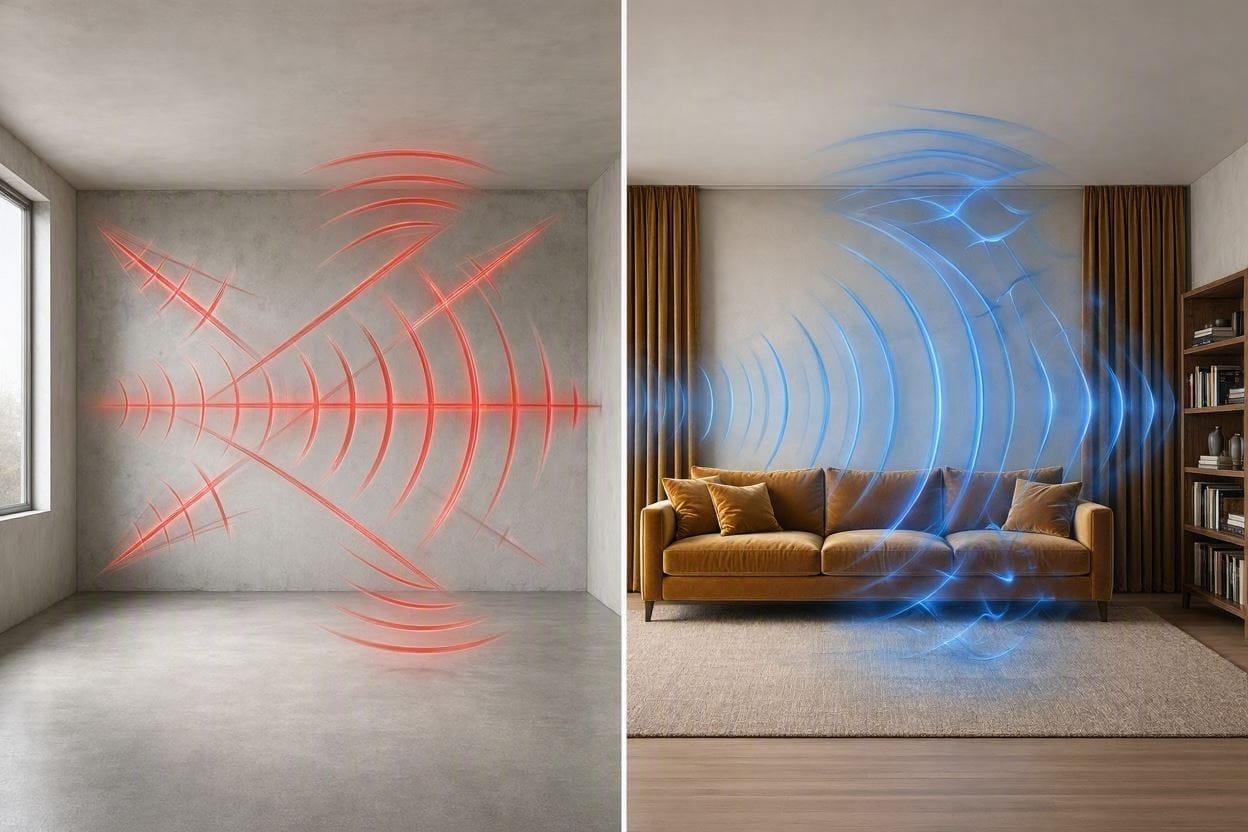
To understand why empty rooms echo, it helps to think about what sound actually is. Sound is a pressure wave moving through air. When that wave encounters a surface, three things can happen:
- Reflection: The wave bounces off the surface and continues traveling in a new direction.
- Absorption: The surface takes in some of the wave’s energy and converts it into tiny amounts of heat.
- Transmission: The wave passes through the surface and continues on the other side.
In a typical room, all three happen at once, but the balance between them determines how the room sounds. Hard, dense, non-porous materials like glass, painted drywall, polished concrete, and ceramic tile are terrible at absorption. They reflect almost everything. That is why they behave like acoustic mirrors.
Soft, porous, irregular materials like fabric, carpet, foam, and even human bodies are much better at absorption. When sound hits them, the wave enters the material, gets trapped in tiny fibers and air pockets, and loses energy through friction. The sound dies out instead of bouncing back.
This basic principle is why acoustic treatment guides consistently point to soft surfaces as the antidote to echo. echo occurs when sound waves bounce off hard surfaces like walls, ceilings, and floors
The Difference Between Echo and Reverberation
People often use these words interchangeably, but they are not exactly the same thing.
An echo is a distinct, delayed repetition of a sound. You clap, you wait, you hear the clap again. That is an echo. It usually happens in very large spaces like canyons, cathedrals, or long empty hallways where the sound has enough distance to travel before bouncing back to your ears as a separate event.
Reverberation is different. It is the dense, overlapping collection of thousands of tiny reflections happening so fast that your ear cannot separate them individually. Instead of hearing one delayed clap, you hear a wash of sound that lingers and gradually fades. That is what happens in most normal rooms. It is not a single echo. It is a cloud of echoes, all happening at once.
Acoustic professionals measure this with a metric called RT60, which stands for reverberation time. Specifically, it measures how long it takes for a sound to decay by 60 decibels after the source stops. RT60 measures how long sound energy takes to decrease by 60 decibels after the source stops In practical terms, RT60 tells you how long a room “rings” after a sound is made.
Empty rooms almost always have a longer RT60 than furnished rooms because there is nothing inside to absorb the energy and speed up that decay. RT60 is the amount of time it takes for sound to decay by 60 decibels in a space
Why Room Size and Shape Matter
It is not just about what is in the room. The room itself matters too.
Larger rooms tend to have longer reverberation times because sound has more space to travel before hitting a surface, and more total air volume to keep the reflections going. That is why grand atriums, empty gyms, and unfinished basements can sound so dramatically echoey even before you factor in the hard materials.
High ceilings make the problem worse because they add another large reflective surface and increase the total volume of the space. Sound that bounces off the ceiling has farther to travel, which creates more delayed reflections and a more pronounced sense of hollowness. high ceilings increase the distance sound travels before dissipating
Long, narrow rooms can also create a specific problem called flutter echo, where sound bounces rapidly back and forth between two parallel walls. Your ear perceives this as a buzzing, ringing quality that makes the room feel especially harsh.
Smaller rooms are not automatically immune either. A tiny bathroom with tile walls, a glass shower, and a hard floor can sound surprisingly bright and sharp because every surface is reflective and the sound has nowhere to go.
Why Furniture Changes Everything
This is where the empty room problem becomes solvable. Every piece of furniture, textile, and soft object you add to a room helps break up the reflection paths and absorb some of the sound energy.
A sofa does not just look good. It introduces a large, soft, irregular surface that scatters and absorbs sound waves. A rug does not just feel nice underfoot. It covers one of the biggest hard surfaces in the room and prevents floor-level reflections from contributing to the reverberant wash. Curtains do not just frame a window. They add porous fabric in front of one of the most reflective surfaces in the entire house. rigid reflective surfaces cause sound to linger and form echoes when no absorption is present
Even your own body helps. A room full of people sounds very different from the same room when it is empty, because human bodies are soft, irregular, and highly absorbent at speech frequencies. That is why concert halls sound different during rehearsal than during a performance, and why your living room feels calmer when people are in it.
Occupancy and furnishings directly affect RT60 because they increase the total absorption in the room, which shortens the time it takes for sound to die out.
Why This Matters Beyond Annoyance
Echo and reverberation are not just aesthetic problems. They have real practical consequences.
In a highly reverberant room, speech becomes harder to understand because the lingering reflections overlap with the next syllable. This is why conference calls in empty rooms sound muddy and distant. It is also why restaurants with too many hard surfaces become exhausting places to have a conversation.
For music, reverberation can be beautiful or destructive depending on the context. A concert hall is designed with carefully controlled reverberation because it adds warmth and depth to orchestral sound. But a recording studio or home theater needs much less reverberation because clarity and precision matter more than lushness.
In a home, the ideal is usually somewhere in the middle. You want enough softness that the room does not feel like a parking garage, but not so much absorption that it feels unnaturally dead. Acoustic guides often describe this as finding the right balance between clarity and warmth. too much reverb leads to muddled sound, while too little can make a space feel unnatural
The Fastest Way To Fix an Empty Room
If you are dealing with an echoey space, the solution is almost always the same: add soft, porous, irregular materials until the sound starts behaving better.
The most effective changes, in order of impact:
- Add a large rug on hard flooring
- Hang heavy curtains over windows
- Bring in upholstered furniture with fabric rather than leather or hard surfaces
- Add bookshelves, wall art, or textiles to break up flat wall surfaces
- Consider acoustic panels if the room is still too live after furnishing
We covered this exact sequence in more detail in How To Reduce Echo In A Living Room Without Making It Ugly, and the same logic applies to bedrooms, offices, dining rooms, or any other space that feels acoustically harsh when empty.
Final Thoughts
Empty rooms echo because sound has nothing soft to land on. Every wave you produce bounces off hard surfaces, joins thousands of other bouncing waves, and creates the dense, lingering wash of sound we call reverberation. The more hard surfaces and empty space you have, the longer that wash persists.
Furniture fixes this not by magic, but by simple physics. Every rug, curtain, cushion, and upholstered chair adds absorption, breaks up reflection paths, and helps the sound die out faster. That is why the same room can feel completely different before and after you move in.
The echo is not a flaw in your hearing. It is the room telling you it needs more soft things.
Frequently Asked Questions
Why Do Empty Rooms Sound Echoey?
Empty rooms have mostly hard, flat surfaces like walls, floors, and ceilings that reflect sound instead of absorbing it. Without soft materials to soak up the energy, sound keeps bouncing around and creates echo and reverberation.
What is the Difference Between Echo and Reverberation?
An echo is a single, distinct delayed repetition of a sound. Reverberation is a dense cloud of many overlapping reflections that create a lingering wash of sound after the source stops.
Does Furniture Really Reduce Echo?
Yes. Furniture, rugs, curtains, cushions, and even people add soft, porous, irregular surfaces that absorb sound energy and break up reflection paths. A furnished room almost always sounds calmer than an empty one.
What is RT60?
RT60 is a measurement of reverberation time. It tells you how long it takes for sound to decay by 60 decibels after the source stops. Empty rooms usually have a longer RT60 than furnished rooms.
Do Small Rooms Echo too?
Yes. Even small rooms can echo if every surface is hard and reflective. A tiled bathroom with glass and bare walls is a classic example of a small space that sounds surprisingly sharp and live.

Ememobong is the lead researcher and editor at Quiet Dwelling. As a professional technical writer, he specializes in breaking down complex acoustic engineering concepts into simple, actionable steps. His goal is to help people build distraction-free environments for better sleep and deep work.