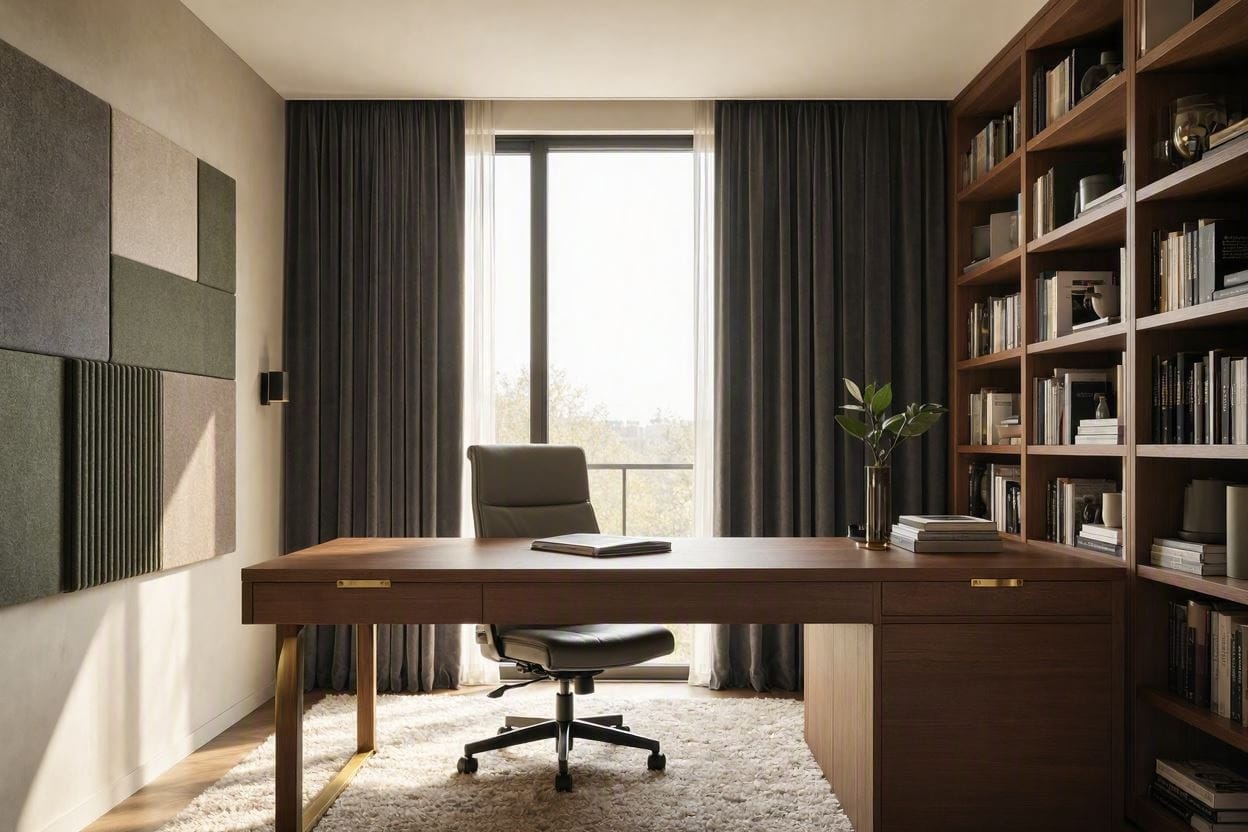
If you have ever tried to take an important call while a leaf blower roars past your window, or struggled to concentrate while traffic noise seeps through what you thought was a solid wall, you already know the problem. A home office that looks professional can still feel acoustically exposed. And once your brain starts tracking every outside sound, focus becomes almost impossible.
The challenge with outside noise is that you usually cannot control the source. You cannot stop the road, the neighbor’s renovation, or the delivery truck. What you can control is how much of that sound actually reaches your ears while you are trying to work. That is what makes home office soundproofing different from studio soundproofing. You are not trying to create a recording environment. You are trying to make a normal room quiet enough for video calls, deep work, and professional presence.
Office soundproofing usually starts with understanding exactly where the noise is getting in. Professional acoustic guidance often emphasizes that identifying the noise path is the essential first step before choosing any treatment. identifying where noise enters is the first step toward optimizing your office environment
Start With the Windows – They Are Usually the Weakest Link
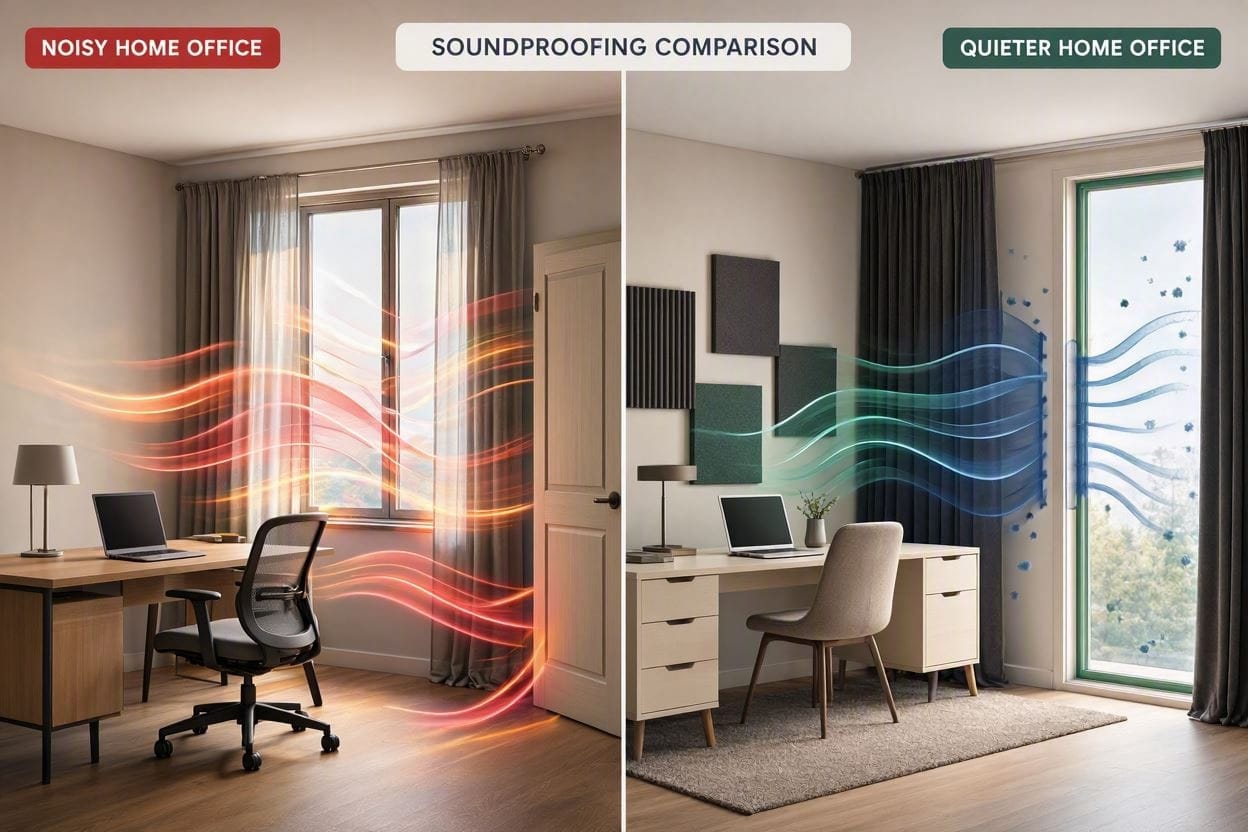
In most home offices, the window is the single biggest acoustic vulnerability. Standard residential windows are thin, they rattle slightly in their frames, and they usually have small air gaps around the sash or trim that let in far more sound than people realize. If your office faces a street, a busy sidewalk, or a shared courtyard, the window is almost certainly doing more harm than the wall itself.
The practical fixes, in order of effectiveness:
- Seal every gap with weatherstripping or acoustic caulk around the window frame, sash, and trim
- Add heavy curtains that cover the entire window and have enough mass to dampen some sound energy
- Consider an acoustic window insert if the noise is severe and you cannot replace the window
- Move your desk away from the window wall whenever possible
Soundproof window specialists consistently point to acoustic inserts and heavy curtains as practical ways to isolate indoor spaces from outside noise. acoustic inserts and heavy window treatments can help isolate rooms from outside noise
If your window situation is truly difficult, you may want to read our more detailed guide on How To Soundproof A Window. But for most home offices, sealing and curtains will do more than most people expect.
Do Not Ignore the Door
After windows, doors are the next most common weak point. Interior doors in homes are usually hollow-core, lightweight, and mounted in frames with visible gaps at the bottom, sides, and top. None of that is accidental – it is just how cheap doors are built. But from an acoustic perspective, a hollow door with a quarter-inch gap underneath is basically a sound tunnel.
If you are trying to block outside noise that is entering through shared walls or hallways, the door deserves attention. The fixes are usually simple:
- Add a door sweep to seal the bottom gap
- Install weatherstripping around the door stop so the door closes snugly
- Consider upgrading to a solid-core door if the noise is persistent
- Use a draft stopper temporarily if you are renting
Interior design-focused soundproofing advice often points to draft stoppers as a first practical step, especially for renters or anyone who does not want to replace a door. draft stoppers and gap sealing help reduce sound intrusion without major construction
We have covered the full door upgrade path in Solid Core vs. Hollow Core Doors and How To Soundproof A Hollow Core Door Without Replacing It.
Soften the Room So Reflections Do Not Make Noise Worse
Once you have addressed the main entry points, the next layer is managing what happens to sound once it is inside the room. Hard floors, empty walls, and minimal furniture create a space where every sound bounces around sharply. That makes outside noise feel more present than it actually is, and it also creates problems for video calls where your voice sounds thin, echoey, or distant.
The most effective softening fixes for a home office are:
- A thick rug on hard flooring to reduce floor-level reflections
- Bookshelves filled with books on the wall behind you for scattering and absorption
- Soft seating or an upholstered chair to break up flat surfaces
- Wall treatments like fabric art, acoustic panels, or decorative slatted panels
Acoustic specialists consistently recommend acoustic panels as an effective way to absorb reflected sound inside offices and workspaces. acoustic panels are a standard recommendation for reducing office reverberation The good news is that modern panels come in attractive designs that look more like curated wall decor than office hardware.
This is exactly the same logic we covered in How To Reduce Echo In A Living Room Without Making It Ugly. Bedrooms, living rooms, and offices all benefit when hard, empty surfaces get replaced or softened.
Separate Your Desk From the Noisiest Wall
This is one of the easiest changes and one of the most overlooked. If your desk is pushed directly against the window wall, your microphone, your ears, and your concentration are all sitting at the exact point where outside noise enters most aggressively.
Whenever the room layout allows it, try to:
- Float your desk a few feet away from the window wall
- Put your back to an interior wall rather than the exterior wall
- Use a bookshelf or storage unit as a partial barrier between you and the window
- Angle your desk slightly so the window is not directly facing your ear position
This matters because distance from the noise source is one of the simplest acoustic improvements available. Even a few extra feet can make traffic hum feel less immediate and less distracting.
Mask What You Cannot Fully Block
Some noise cannot be eliminated, especially if you are renting, on a budget, or dealing with a genuinely loud environment. In those cases, masking can be a practical second layer.
White noise machines, fan sounds, and ambient background audio all work by creating a consistent acoustic floor that makes sudden intrusions less jarring. A motorcycle engine is still audible, but your brain may not react as sharply to it if the room already has a steady, neutral baseline.
For video calls, a directional microphone helps even more. It picks up your voice clearly while rejecting some of the room noise around you. This does not fix the noise for your own concentration, but it does protect your professional presence on calls.
If you want the best masking options for focused work, our noise-canceling earplugs guide and white noise machine roundup are both useful, even though they were written with sleep in mind.
Address the Building Itself If You Own It
If you own the home and the outside noise is severe, you have more options. The most effective structural fixes include:
- Replacing single-pane windows with double or triple-pane glass
- Adding mass-loaded vinyl or resilient channels inside the wall
- Installing acoustic window inserts as a less invasive alternative
- Adding dense insulation in exterior walls during renovation
These are bigger investments, but they are also the only approaches that meaningfully change the building’s acoustic performance instead of just treating the symptoms. Acoustic treatment guides often recommend a full range of soundproofing methods depending on the severity of the problem. a full range of soundproofing methods can help stop external noise from entering your space
We have covered several of these deeper approaches in Green Glue Soundproofing and Understanding STC Ratings.
What About Office Noise Coming From Inside the House?
Sometimes the problem is not traffic or street noise. It is the rest of the household: children, pets, roommates, TV in the next room, or the kitchen directly below your workspace.
In those cases, the fixes shift slightly:
- A solid-core door becomes more important
- Soundproof curtains can be hung in doorways or alcoves to create separation
- Room dividers with acoustic backing can visually and acoustically partition shared spaces
- Scheduling communication with household members about call times
Shared home office setups can benefit from soundproof curtains mounted on rods to screen off the workspace. soundproof curtains help absorb sound and prevent reverberation in shared offices It is not a perfect fix, but it is often the difference between a usable workspace and a chaotic one.
The Best Order To Soundproof Your Home Office
If you want the most improvement without spending unnecessarily, tackle the problem in this order:
- Identify the main noise entry point – window, door, wall, or floor
- Seal all gaps and cracks around windows and doors
- Add heavy curtains and a rug for absorption and mass
- Reposition your desk farther from the worst noise path
- Soften the room with bookshelves, panels, or textiles
- Use masking or a directional microphone for what remains
This sequence works because it addresses the leakiest points first, then layers comfort and focus improvements on top.
Final Thoughts
Soundproofing a home office from outside noise does not have to mean reconstruction, ugly foam panels, or moving to the countryside. In most cases, a quieter workspace comes from a few very specific fixes: seal the gaps, soften the room, move your desk, and mask what you still cannot fully block.
The goal is not total silence. The goal is a room calm enough that you can think, speak, and work without feeling like the outside world is sitting in the chair next to you.
Frequently Asked Questions
What is the Cheapest Way to Soundproof a Home Office?
Seal gaps around windows and doors with weatherstripping, add a draft stopper, hang heavy curtains, and place a thick rug on hard floors. These four changes together cost very little but often make a noticeable difference.
Do Acoustic Panels Block Outside Noise?
No. Acoustic panels absorb reflected sound inside the room, which helps with echo and call clarity. To block outside noise from entering, you need mass, sealing, and window or door improvements.
Does White Noise Help With Office Noise?
Yes. White noise or steady fan sounds create a consistent audio backdrop that makes sudden outside noises less startling and easier to ignore. It does not eliminate noise, but it makes your brain less reactive to it.
Can I Soundproof My Office if I Rent?
Mostly yes. Heavy curtains, rugs, weatherstripping, door sweeps, draft stoppers, and acoustic panels are all renter-friendly. Structural changes like wall modifications or window replacement usually require landlord permission.
Why Does My Office Sound Worse on Video Calls than it Feels in Person?
Microphones pick up room reflections more aggressively than your ears do. If your office is hard and empty, your voice will sound thin, distant, or echoey on calls. Adding soft furnishings and wall treatments usually improves this.

Ememobong is the lead researcher and editor at Quiet Dwelling. As a professional technical writer, he specializes in breaking down complex acoustic engineering concepts into simple, actionable steps. His goal is to help people build distraction-free environments for better sleep and deep work.