
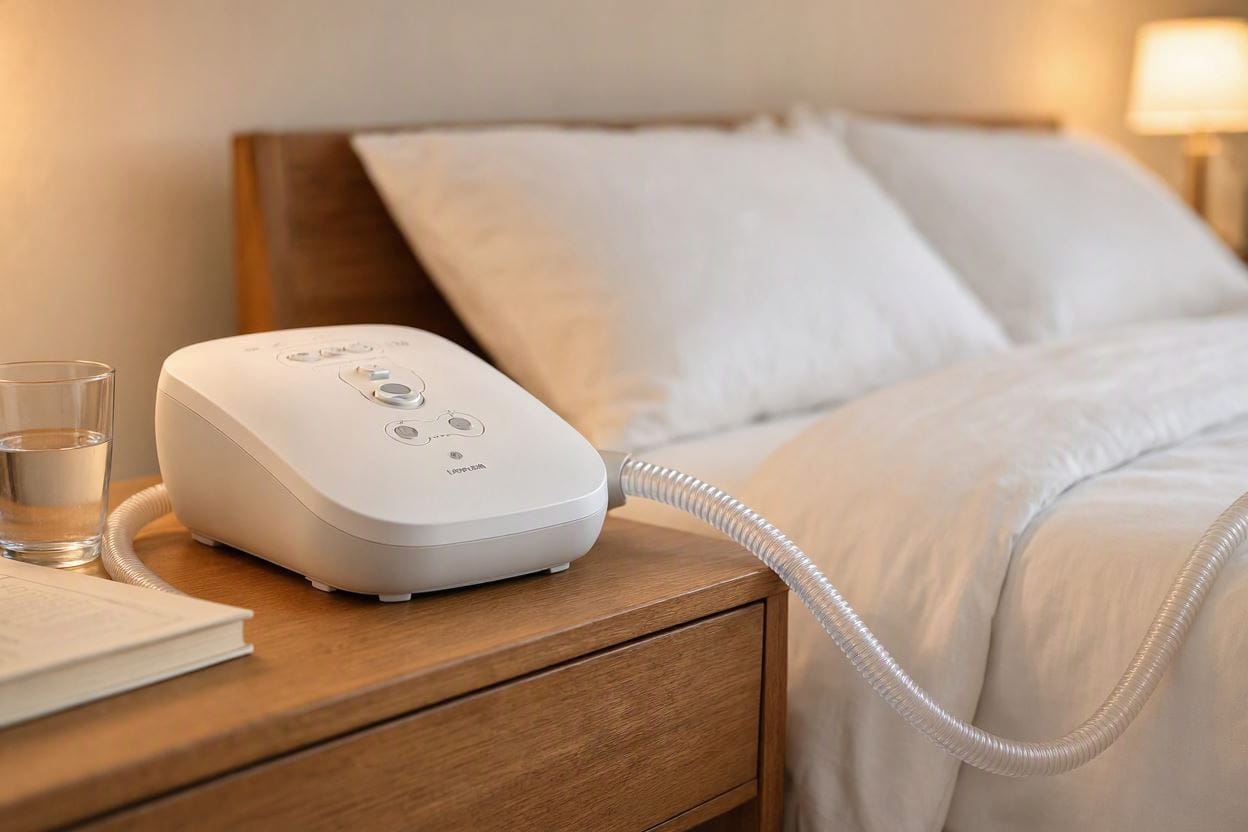
There is a particular cruelty to CPAP noise. The machine exists to give you better sleep. Instead, you lie awake listening to a rhythmic hiss and a faint mechanical whir, wondering whether you are the only person on earth who finds their medical device annoying.
You are not. CPAP noise is one of the most common reasons people abandon therapy — and abandoning therapy is a genuinely serious outcome, because untreated sleep apnoea carries real cardiovascular and cognitive costs. Research on adherence consistently finds that noise from air leaks and the equipment itself is among the key complaints driving people to stop treatment, and long-term adherence in mild cases may be as low as a quarter of patients. Obstructive Sleep Apnea and Adherence to CPAP Treatment Long term adherence to CPAP in mild obstructive sleep apnea
So this is not a cosmetic complaint. A machine you can’t sleep next to is a machine you’ll stop using.
The good news is that CPAP noise is almost entirely solvable, and most of it comes from three sources you can address yourself tonight.
First: What Counts As Normal CPAP Noise
Modern CPAP machines are genuinely quiet. Most current models operate in the region of 25–30 dB — about the same as soft breathing or a whisper, and roughly the ambient noise floor of a typical bedroom. If your machine is brand new, correctly assembled and leak-free, you should barely hear it. SleepApnea.org
For scale, a quiet bedroom at night sits around 30 dB and normal conversation around 60 dB. Our guide to what a decibel is explains why the scale is logarithmic — a 10 dB increase sounds roughly twice as loud, not 10% louder. And on the sleep side, how many decibels is too loud for sleep lays out why quiet matters more than people assume.
So if your machine sounds loud, that is a signal rather than a fact of life. Something is producing noise that shouldn’t be there.
The Four Sources Of CPAP Noise
Almost every CPAP complaint traces to one of these. Diagnosing which one you have tells you exactly what to fix.
1. Mask leak — the whistle and the hiss
By far the most common cause. When the mask seal breaks at the edge of your face, pressurised air escapes through a narrow gap — and air forced through a small opening produces exactly the sound physics predicts: a high-pitched whistle or a steady hiss, often fluctuating with your breathing.
This is turbulence noise, the same phenomenon that makes a nearly-closed tap sing. The narrower the gap, the higher the pitch. It is also the most annoying kind of sound, because it is tonal and intermittent — and intermittent tonal noise is measurably harder to ignore than steady broadband noise.
How to check: mask up, turn the machine on, and run a finger gently around the entire seal. You will feel the leak before you hear it. Common culprits are the bridge of the nose, the creases beside the nostrils, and the point where the cushion meets the cheek.
2. The exhaust vent — the constant draught
Every CPAP mask has a deliberate vent that continuously blows your exhaled air away from the mask. This is a design feature, not a fault, and it does make a soft, constant rushing sound.
Two things go wrong here. First, the vent can be partially blocked by dust or mineral deposits, which changes the airflow and makes it noisier. Second, and more importantly acoustically — the vent can be pointing at your pillow, your duvet, or the wall beside your head. Air hitting a soft surface a few centimetres away produces a much louder hiss than air escaping into open room. Repositioning your head, or the hose, so the vent faces open air is often a startlingly effective fix for free.
3. The motor and airflow path — the hum and the whir
Inside the machine, a blower motor spins at high speed to generate pressures of typically 4–20 cm H₂O. It produces a low, steady hum, and the air path adds a broadband rush.
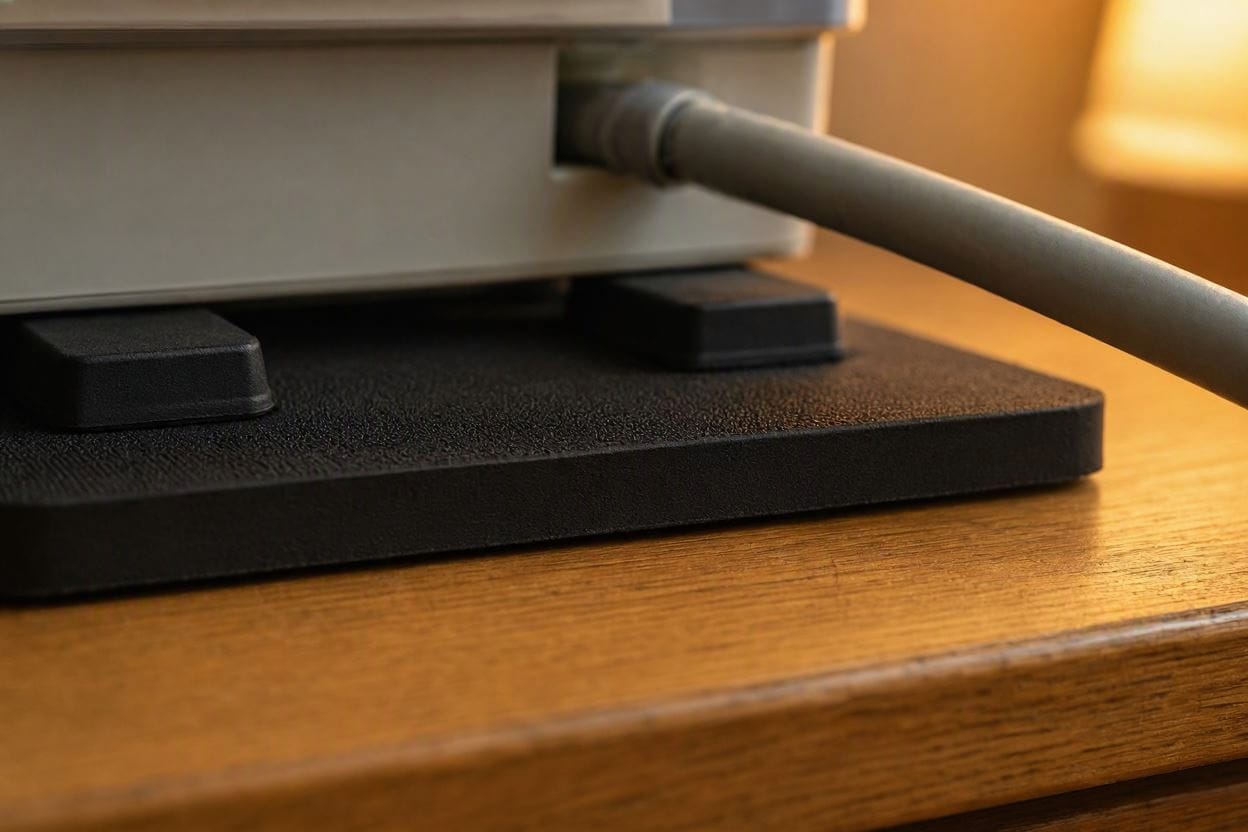
Motor noise is mostly structure-borne as well as airborne. The machine’s rubber feet decouple it from the nightstand, but that decoupling only works if the machine actually sits on its feet on a firm flat surface. Put it on a soft mat, a wobbly shelf, or a hollow nightstand, and the vibrations find their way into a resonant panel that amplifies them — the same mechanism behind the low hum problems we cover in how to block low frequency noise.
Filters matter here too. A clogged intake filter makes the motor work harder and harsher. It is a consumable, and replacing it on schedule is one of the easiest noise wins available.
4. The humidifier — the gurgle, pop and crackle
If you use a heated humidifier, you may hear a soft gurgling or bubbling, especially if the tube runs uphill or the water chamber is overfilled. Condensation collects in the low points of the hose and produces that distinctive pop-pop sound as air pushes through it. This is entirely fixable and has nothing to do with the machine’s quality.
What Usually Does Not Work
Cross these off before spending anything.
- Putting the machine in a drawer or cupboard. Enclosing a CPAP restricts its intake airflow. The motor compensates, runs hotter and harder, and gets louder — plus you risk overheating a medical device. Never do this.
- Wrapping the machine in towels. Same problem, less dramatically, plus it traps heat. See above.
- Putting foam panels on the bedroom walls. Thin acoustic foam absorbs mid and high frequencies. The dominant complaint — low motor hum — passes straight through. This is the absorption-versus-blocking confusion we unpack in soundproofing vs. sound absorption.
- Turning the pressure down to quieten it. Your prescribed pressure is a medical setting. Changing it to reduce noise risks your therapy. Talk to your clinician before touching it.
- Buying a “silent” CPAP to replace a quiet one. If your current machine is a modern model and it is loud, the machine almost certainly is not the problem — the setup is.
The Best Order To Fix CPAP Noise
Work down. The first step solves more complaints than everything below it combined.
Step 1 — Eliminate leaks and re-fit the mask
Reseat the mask on a clean, dry face. Wash the cushion — facial oils degrade the silicone seal over time and a fresh cushion is dramatically quieter than a month-old one. Try a different size cushion if you have one; most masks ship with a sizing guide and most users are on the wrong size. Full-face masks tend to be the noisiest and the most prone to leaking, so if you can tolerate a nasal or nasal-pillow interface, it is often the quieter choice. Comparing mask interfaces and leak
Then check the vent direction. Aim it away from pillows, duvets, and walls. This costs nothing and fixes a surprising number of cases on its own.
Step 2 — Set the machine up properly
- Place it on a firm, flat surface — not a soft mat, not a hollow nightstand, not the floor where it can suck up dust.
- Position it below the level of your head if you use a humidifier. This lets condensation drain back into the chamber instead of pooling in the hose.
- Keep the hose from draping over the bed frame in a way that pulls on the mask. A hose lift or a simple hook takes the tension off, which keeps the seal intact.
- Replace the filter on schedule. Cheap, easy, immediately effective.
- Check the water level — overfilled chambers gurgle.
Step 3 — Decouple the machine from the furniture
The single highest-value paid fix. If the hum is travelling through the nightstand into the floor and the bed frame, isolating the machine breaks that path.
Put the machine on a proper anti-vibration pad — a dense rubber mat or purpose-made isolation feet rated for the machine’s weight. The principle is identical to isolating a compressor or a washing machine: break the mechanical connection and the structure stops transmitting the vibration. This is the same decoupling idea that underpins all effective soundproofing, which we cover in the 4 principles of soundproofing, and damping plays a role too — Green Glue soundproofing explains the viscoelastic principle behind converting vibration into heat rather than letting it travel.
Step 4 — Add masking sound
Here is the counterintuitive part. You will never make a CPAP silent, but you can make it inaudible — by raising the floor around it. Steady, pleasant broadband sound masks the specific frequencies your machine produces, so your brain stops attending to the hum.
This is exactly how pink and brown noise work, and which colour suits you depends on your machine’s pitch: pink noise has more low-frequency energy than white and masks a deep hum better; brown is lower again. Our comparison of pink noise vs. white noise covers the difference, and white, pink and brown noise explained goes deeper on the physics.
If you would rather have a dedicated device, our reviews of white noise machines for deep sleep are the place to start — and if you share a bed with a light sleeper, a quiet bedroom fan doubles as a mask and a comfort source.
Step 5 — Protect your own sleep directly
If masking sound isn’t enough or your partner objects, blocking the sound at your ear is a legitimate final layer. The challenge is that side sleepers and CPAP wearers often can’t tolerate standard earplugs — so look for low-profile options. Our guide to earplugs for sleeping covers side-sleeper-friendly designs that sit flush and don’t press into the pillow.
A Note If You Share a Bed
Most CPAP noise complaints come from the bed partner, not the user. That changes the diagnosis slightly: leak whistle and vent hiss are directional, so they hit the other pillow harder than your own ears. Research on CPAP adherence that specifically involved partners found that the key issue for both patients and their bed partners was the noise associated with air leaks and the equipment itself. Sleep Apnea and CPAP Adherence: Partners
Two simple moves help enormously — point the vent away from your partner’s side, and consider a hose lift so the tube isn’t dragging across the shared space. Masking sound works on both of you at once, which is why a single white noise source in the room is often the most efficient fix for a couple’s sleep.
If your building itself is the problem, our apartment soundproofing guide covers what renters can realistically do without touching the structure.
The Honest Caveat
If your machine is producing a new grinding, rattling or intermittent clunking that wasn’t there before, stop troubleshooting and get it serviced. That is a mechanical fault, not an acoustic one, and no amount of isolation or masking fixes a failing blower. CPAP machines are medical devices — anything that sounds mechanical should go to your supplier or clinician rather than being quietly lived with.
And if you are abandoning therapy because of noise, tell your clinician that specifically. It is an extremely common reason for non-adherence, and there are usually mask and machine options available that you haven’t been offered yet.
Frequently Asked Questions
Why is My CPAP So Loud all of a Sudden?
A sudden increase in noise almost always means a change in one of four things: the mask seal has degraded or shifted, the filter is clogged, the humidifier is overfilled or the hose is pooling condensation, or the machine has developed a mechanical fault. A gradual increase over weeks usually points to a worn cushion or a dirty filter; an abrupt new rattle or grind points to a fault and needs servicing.
How Many Decibels is a Normal CPAP Machine?
Most current models operate in the region of 25–30 dB, which is roughly the level of soft breathing or a whisper. For context, a quiet bedroom at night is around 30 dB, so a properly functioning modern CPAP should be no louder than the room it sits in. If yours is clearly the loudest thing in the bedroom, something in the setup is producing noise it shouldn’t be.
How Do I Stop the Whistling Sound From My CPAP?
The whistle is a leak. Pressurised air escaping through a narrow gap at the mask edge produces a tonal sound, and the pitch rises as the gap narrows. Reseat the mask on a clean, dry face, wash the cushion to remove oils, check the fit around the nose bridge and cheeks, and try a different cushion size. Run a finger around the seal with the machine running — you will feel the escape before you hear it.
Can I Put My CPAP Machine in a Drawer to Muffle it?
No. Enclosing a CPAP restricts its air intake, which makes the motor work harder and run hotter — so it typically gets louder, not quieter, and you risk overheating a medical device. If you need to reduce noise, isolate the machine from the furniture with a vibration pad and add masking sound in the room instead.
Why Does My CPAP Make a Gurgling or Popping Noise?
Condensation. If you use a heated humidifier, water vapour can condense in the low points of the hose and bubble as air passes through it, producing that characteristic pop-pop-pop. Position the machine below the level of your head so water drains back into the chamber, check you haven’t overfilled it, and consider a heated tube if the problem persists in a cold room.
Will a White Noise Machine Help With CPAP Noise?
Often, yes — it is one of the most effective fixes available, because it doesn’t try to remove the sound but raises the ambient floor so your brain stops attending to it. Pink or brown noise generally works better than white for a low machine hum, because they carry more low-frequency energy and mask a deep tone more effectively.
My Partner Complains about My CPAP. What Can I Do?
Three things, in order of effort. Point the exhaust vent away from your partner’s side of the bed — vent hiss is directional and hits the other pillow harder than your own ears. Add a hose lift so the tube isn’t dragging across the shared space and pulling on the mask. Then add a single white noise source in the room, which masks the machine for both of you at once.

Ememobong is the lead researcher and editor at Quiet Dwelling. As a professional technical writer, he specializes in breaking down complex acoustic engineering concepts into simple, actionable steps. His goal is to help people build distraction-free environments for better sleep and deep work.