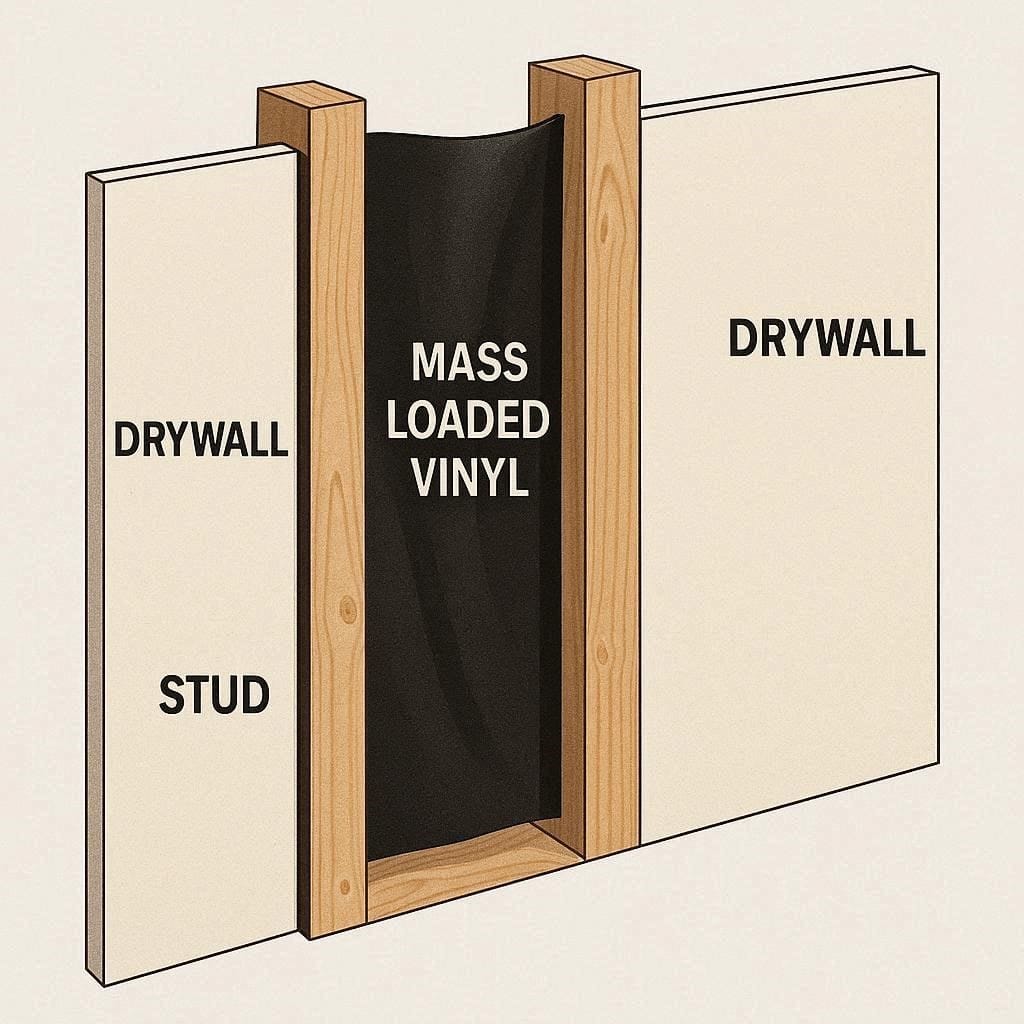
If you have ever researched how to soundproof a wall, ceiling, or home theater, you have undoubtedly run into a heavy, black, rubber-like material known as Mass Loaded Vinyl (often abbreviated as MLV).
Professional acousticians refer to MLV as soundproofing’s “secret weapon.” It is incredibly thin—typically only 1/8-inch thick—yet it can block as much sound as a solid sheet of standard drywall.
But what actually is Mass Loaded Vinyl, and how can a material so thin have such a massive impact on sound transmission?
In this guide, we will break down the physical science behind MLV, explain the acoustic concept of “limp mass,” and show you exactly how to apply it to reclaim peace and quiet in your home.
What is Mass Loaded Vinyl (MLV)?
Mass Loaded Vinyl is a high-density, flexible membrane engineered specifically to block the transmission of airborne sound waves.
Unlike standard vinyl used in household flooring or siding, MLV is “loaded” during manufacturing with heavy, non-reactive mineral compounds—typically calcium carbonate or barium sulfate. These minerals give the material immense physical density.
A standard 1/8-inch thick roll of MLV weighs exactly 1 pound per square foot (4.88 kg/m²). This unique ratio of extreme weight to minimal thickness makes it the perfect soundproofing barrier for spaces where adding thick construction materials is structurally impossible or undesirable.
The Physics of “Limp Mass”: How MLV Blocks Sound
To understand why MLV is so effective, we must look at how sound waves interact with physical structures.
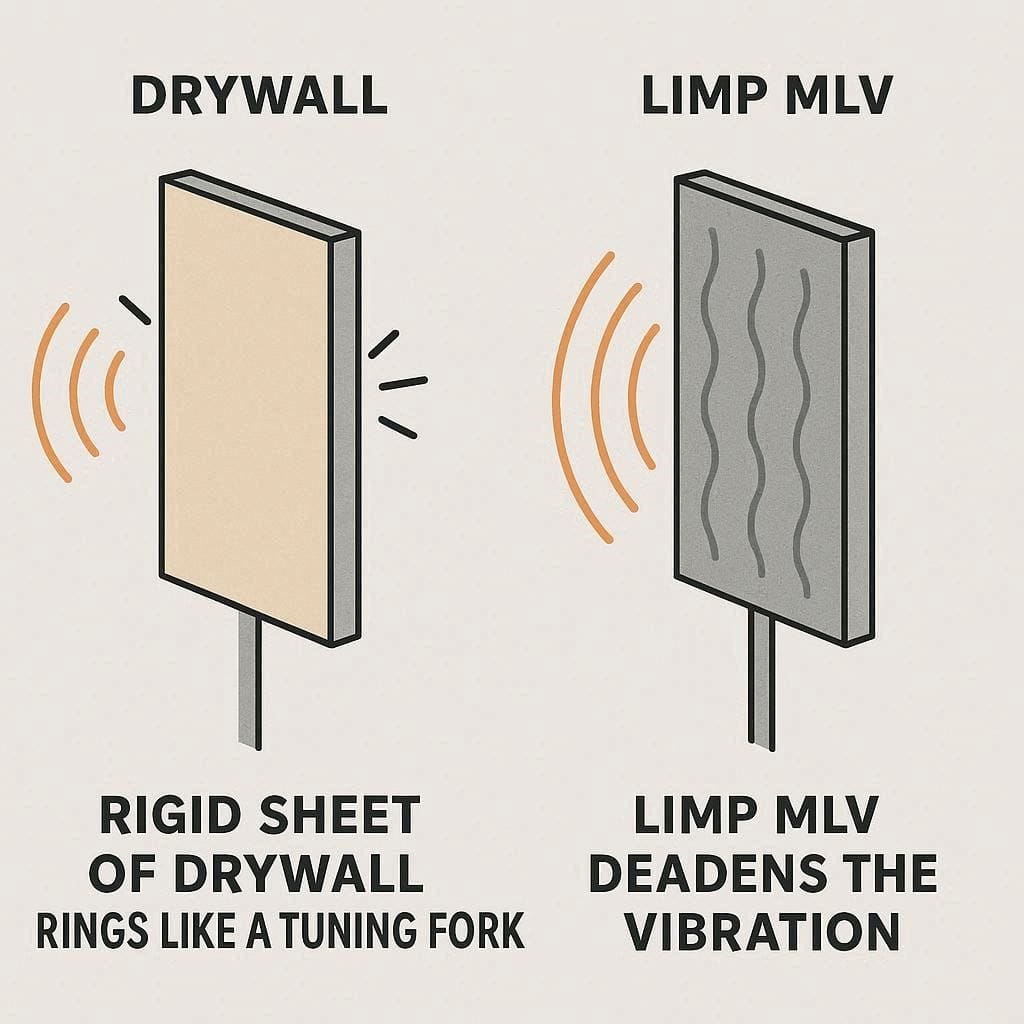
When sound waves strike a rigid wall partition (like wood, brick, or standard drywall), they force that partition to physically vibrate. Because these materials are stiff, they act like a drumhead or a tuning fork—they vibrate at their natural resonance frequency, effectively transmitting the sound directly into the adjacent room.
This is where the law of mass comes in. In architectural acoustics, adding heavy density is the primary way to block sound. You can read more about how density stops sound waves in our comprehensive guide on the four principles of soundproofing.
However, simply adding more rigid mass has diminishing returns. This is because rigid sheets of drywall will still ring.
Mass Loaded Vinyl solves this through “Limp Mass” physics.
Because MLV is highly flexible and completely limp, it cannot easily vibrate or ring. When a sound wave strikes a sheet of MLV, the limp material absorbs the kinetic energy of the sound wave and instantly deadens it, preventing the physical vibration from transferring to the structural framing of your home. It acts as an acoustic dead weight, converting the sound energy into trace amounts of thermal energy.
How MLV Boosts Your Wall’s STC Rating
Because MLV is highly efficient at absorbing and blocking sound waves, it is one of the most reliable ways to increase a partition’s Sound Transmission Class (STC) rating.
STC ratings measure how many decibels of airborne noise a partition blocks. A standard interior wood-stud wall with a single sheet of drywall on both sides usually achieves a poor rating of STC 33 to 35, allowing you to easily understand normal speech through the wall.
By simply draping a single layer of 1-pound MLV over the studs before screwing on your drywall, you can increase that partition’s performance by 5 to 12 STC points. According to acoustic laboratory testing standards established by ASTM International, an increase of 10 STC points is perceived by the human brain as cutting the volume of the incoming sound exactly in half.
To see a full breakdown of how these ratings translate to real-world privacy in your bedroom, read our guide to understanding STC ratings.
Common Applications for Mass Loaded Vinyl
Because MLV is thin and flexible, it is incredibly versatile. Here are the most effective ways to apply it in residential soundproofing:
- Stud Wall Assemblies: MLV is tacked directly to wood or metal framing before drywall is installed, adding massive internal density to the wall cavity.
- Ceiling and Floor Retrofits: Sandwiching a layer of MLV beneath a carpet pad, floating subfloor, or between layers of ceiling drywall is highly effective at deadening mid-to-high frequency airborne noises from upstairs neighbors.
- Wrapping HVAC Ducts and Pipes: Rigid metal ductwork behaves like a megaphone, carrying sound waves from one room to the next. Wrapping ducts in MLV deadens the metal walls, preventing sound from “telegraphing” through the vents.
Wrapping these ducts is highly effective at stopping sound from bypassing your soundproofed walls. To understand how sound waves slip through these secondary paths, read our guide to understanding flanking noise.
Best Practices for Installing MLV
Mass Loaded Vinyl is heavy and floppy, which can make installation challenging. To ensure you get the maximum acoustic benefit, follow these strict installation guidelines:
- Use Mechanical Fasteners: Do not rely on glue or tape to hold MLV up. It is too heavy. Use wide-head roofing nails, heavy-duty staples, or screws with washers to secure it directly to the wall studs.
- Seal All Seams Airtight: Sound behaves exactly like water; it will find the path of least resistance. Overlap your MLV seams by at least 2 inches, and seal every joint using heavy-duty vinyl seam tape and a non-hardening acoustical caulk.
- Never Over-Compress the Material: To preserve its “limp mass” properties, MLV needs a tiny bit of flexibility. Never sandwich it so tightly between two rigid, heavily screwed layers of drywall that it loses its ability to drape and deaden vibrations.
Frequently Asked Questions (FAQ)
Is Mass Loaded Vinyl Safe To Use Inside My Home?
Yes. High-quality MLV products manufactured today are made from stable, non-toxic PVC and natural minerals. They do not contain lead, formaldehyde, or volatile organic compounds (VOCs). Ensure you buy from reputable manufacturers to avoid low-grade recycled industrial plastics that may emit a strong rubbery odor when first unrolled.
Can I Use MLV as a Finished Wall Covering?
Generally, no. MLV is heavy, industrial-looking, and has a flat, black rubber appearance that cannot be painted or textured. It is designed to be installed as an internal component behind drywall, beneath flooring, or inside acoustic panel assemblies.
Does MLV Block Impact Noise, Like Heavy Footsteps From Above?
While MLV is fantastic at blocking airborne noises (like speaking, televisions, or music), it is less effective against structural impact noise (like heavy footsteps or dragging furniture) on its own. Impact noise requires structural decoupling and cushioning. For a complete guide on how to treat footstep thuds, read our comparative guide on airborne vs. impact noise.

Ememobong is the lead researcher and editor at Quiet Dwelling. As a professional technical writer, he specializes in breaking down complex acoustic engineering concepts into simple, actionable steps. His goal is to help people build distraction-free environments for better sleep and deep work.