
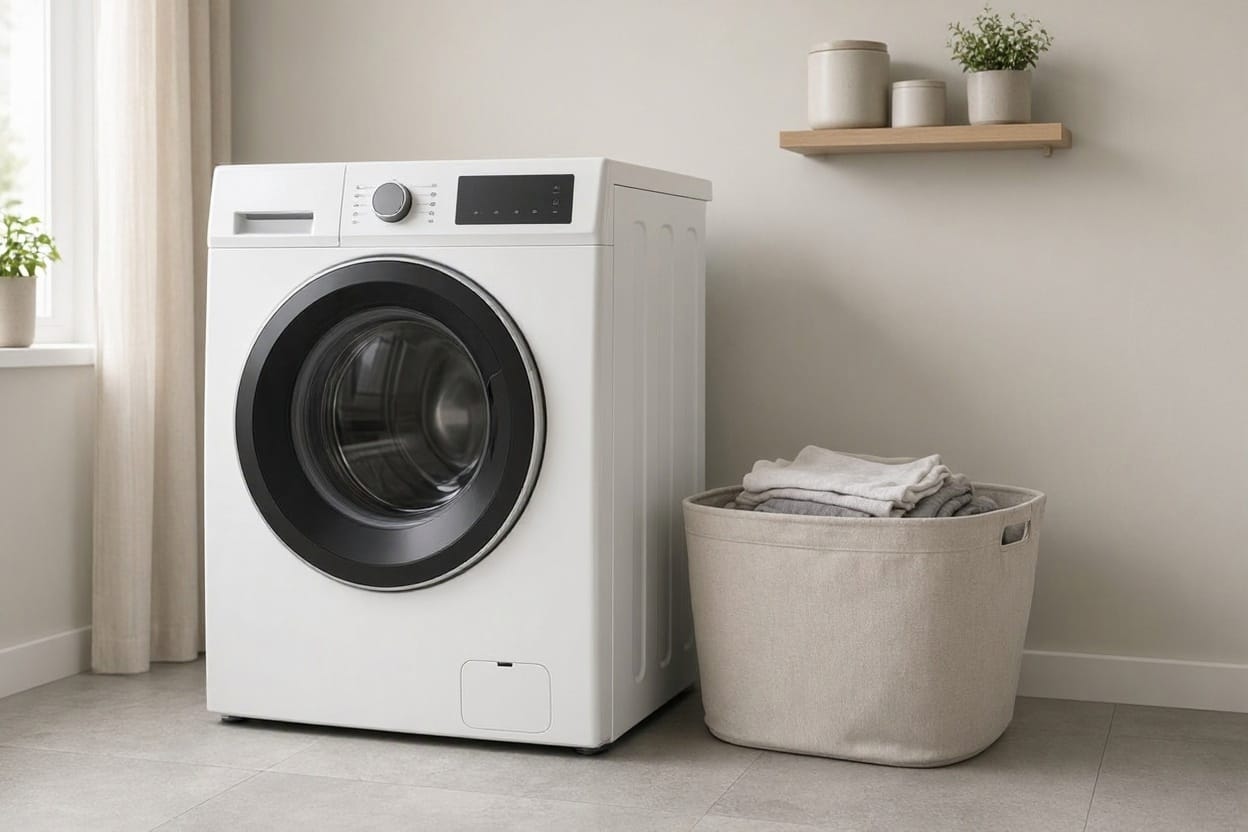
A washing machine is the loudest appliance most people own, and it is also the one that gets a pass. Nobody expects a dishwasher to be silent, but a washing machine spinning at the end of a cycle is treated as simply how washing machines are — even when it is audible throughout the house and clearly through the wall of the room next door.
The honest answer is that yes, they are loud, but not uniformly so. A washing machine produces three distinctly different sounds across a single cycle, and the one that causes the most trouble is neither the loudest nor the most obvious.
Understanding which phase of the cycle is bothering you changes what you should actually do about it.
The Three Sounds A Washing Machine Makes
They are acoustically unrelated, and each responds to different treatment.
The wash phase — water and gentle mechanical noise. Tumbling clothes in a part-filled drum produces a soft sloshing and a low mechanical hum from the motor turning the drum slowly. This is the quietest phase and almost nobody complains about it. It is airborne noise, and it fades with distance the ordinary way.
The drain phase — a short, sharp event. The pump runs to empty the drum, producing a brief droning or gurgling that lasts under a minute. It is intermittent and tonal, which makes it more noticeable than its volume suggests, but it passes quickly.
The spin cycle — the real problem. Spinning a heavy wet load at high speed rotates a large mass off-balance by nature, and the resulting vibration passes through the drum, the drum bearings, the machine frame, its feet, and into the floor. That vibration then travels through the building structure and radiates into other rooms as a low rumble or a rhythmic thud.
That last mechanism is the crux. Spin noise is dominated by low-frequency, structure-borne vibration rather than airborne sound, which is why it behaves so differently from everything else. It passes through solid structure rather than air — the same pathway we break down in what is flanking noise, and the reason bass is a structural problem rather than a wall-thickness problem in how to block low frequency noise.
That distinction matters because the two behave differently: the World Health Organization’s systematic review on environmental noise and sleep found that nocturnal noise exposure has stronger associations with negative health consequences than daytime exposure, which is why spin noise at night is a different problem from spin noise at midday. WHO Environmental Noise Guidelines: Systematic Review on Noise and Effects on Sleep
The practical consequence: the pump and the motor bother you, and the spin cycle bothers everyone else. Soft materials barely touch it, because the energy never travels through the air in the first place.
How Loud Is A Washing Machine?
Published figures vary widely between machines, and the honest reason is that spin noise depends heavily on load balance, floor construction and installation quality — none of which a specification sheet can capture.
| Phase | What It Sounds Like |
|---|---|
| Wash / tumble | Soft sloshing and a low motor hum. Rarely intrusive. |
| Drain / pump | A short droning or gurgle under a minute. Tonal and noticeable, but brief. |
| Spin | A rising drone, then a low rumble with rhythmic thudding. The loudest phase, and the one heard in other rooms. |
What matters more than any single figure is that spin noise is rhythmic and intermittent. Even at moderate volume, a repeating thud is much harder to ignore than a continuous tone of the same loudness — the same reason a dripping tap keeps people awake while a fan does not.
For calibration on what the numbers mean, our guide to what a decibel is explains the logarithmic scale, and how many decibels is too loud for sleep gives the practical overnight threshold.
What Usually Does Not Work
- A thin foam mat. The most common purchase and the most commonly disappointing one. Thin foam compresses under the weight of a loaded drum and does very little for a vibrating mass of water and fabric. Isolation needs firm, dense material rated for the load, or a proper decoupling layer.
- Acoustic panels on the laundry walls. Panels absorb mid and high frequencies inside the room. Spin vibration travels through the floor structure, not the air, so panels address a different problem entirely — see soundproofing vs. sound absorption.
- Buying a quieter machine without addressing installation. A quieter motor reduces what you hear in the kitchen. It does not change what the next room hears, because their complaint is structural vibration from the spin cycle.
- Putting it on carpet and assuming that is enough. Carpet helps marginally, but a machine on a suspended timber floor still transmits. Carpet is not a decoupling layer.
- Overloading to finish faster. An overloaded or unbalanced drum is the single biggest cause of violent spin vibration, and it is louder and worse for the machine.
What Actually Works, In Order
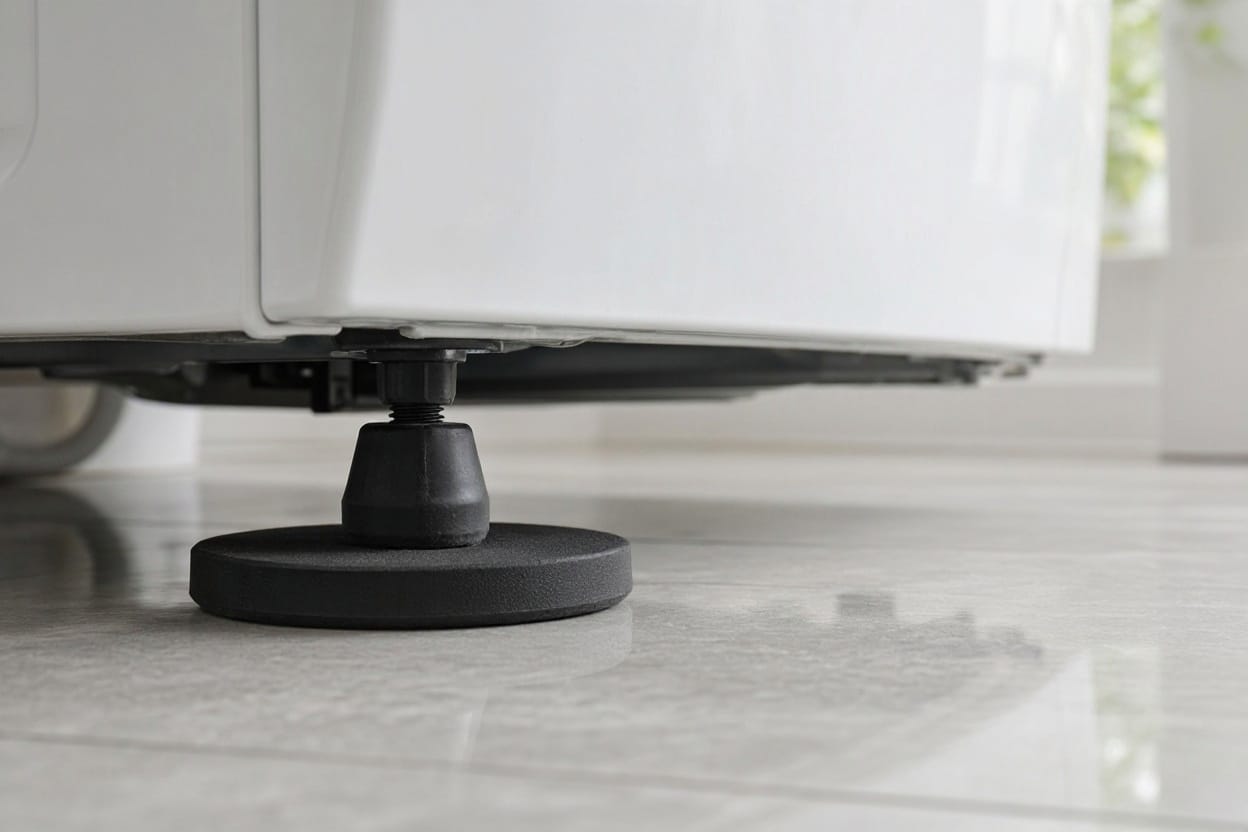
- Level the machine properly. The highest-value free fix and the one most often skipped. A machine that is not level rests unevenly on its feet, rocks, and transmits far more. Use a spirit level on top of the machine and adjust the threaded feet until it sits firm with no movement — our step-by-step walkthrough in how to stop a washing machine from shaking covers the whole process.
- Decouple the feet from the floor. Firm, dense anti-vibration pads or purpose-made appliance isolators rated for the machine’s weight, under each foot. This interrupts the mechanical path into the floor structure. Our explainer on the 4 principles of soundproofing covers why decoupling does what softness cannot, and Green Glue soundproofing explains the damping half — converting vibration into a small amount of heat rather than letting it travel.
- Check for transport bolts still fitted. If the machine has never been fully de-transported, it will shake violently and permanently. This is a genuine and surprisingly common cause, and removing them costs nothing.
- Balance the load. Mixed small and large items, or an overloaded drum, produce the worst vibration. A reasonably full, mixed load spins more smoothly than a heavy single item or a very light wash.
- Look at the floor beneath it. A suspended timber floor behaves like a drum. If the machine sits on joists, a rigid board under the machine spreads the load across more joists and reduces the transmitted rumble considerably.
- Move it away from shared and bedroom walls. Placement costs nothing and matters more than most products. A machine against a wall shared with a bedroom sends its vibration straight into that structure — the same pathway we describe in what is flanking noise.
- Reduce the spin speed. Most machines allow a lower maximum spin. You trade a little drying efficiency for a substantial drop in vibration, which is often the right trade for anyone with a neighbour or a bedroom adjacent.
- Run it when it matters least. Free and highly effective. Delayed-start functions exist on most modern machines specifically so you can wash overnight or while you are out rather than during the hours anyone is trying to rest.
If The Machine Shares A Wall
This is where washing machine noise causes the most friction, and it deserves a direct answer.
- Isolation first, room treatment second. Order matters. Fixing the mechanical path into the floor and resolving any imbalance is where the gain is. Wall treatments come after, if at all.
- If it shares a wall with a bedroom, the door is often the weak point. A hollow core laundry door does very little acoustically — see soundproofing a hollow core door for what a solid replacement buys you, and whether weatherstripping blocks noise for the physics of gaps, which matters more than most people expect.
- Masking is the practical final layer. If the residual rumble still reaches you at night, raising the floor with steady broadband sound helps. Pink or brown noise suits a low continuous rumble better than white — see pink noise vs. white noise for which character fits which noise.
- Talk to the neighbour before they raise it. A short conversation about when you run your machine usually does more for the relationship than any amount of rubber, and it costs nothing.
If You Are Buying
- Check the spin-speed rating alongside the decibel figure. A machine rated at 1400 rpm produces far more vibration energy than one at 1200, regardless of how quiet its motor is.
- Look at the suspension system. Better drum suspension absorbs imbalance before it reaches the frame — which is the noise that travels.
- A heavier machine is usually a quieter one. More mass means less of the drum’s energy reaches the floor. Weight is doing acoustic work.
- Check whether the feet are adjustable. Levelling is the highest-value free fix, and a machine with poor adjustment options makes it harder.
- Confirm the delay-start feature. Not acoustic on paper, but it is how most people actually solve this problem in practice.
The Honest Caveat
A washing machine cannot be made silent, and specifically the spin cycle cannot be made inaudible through a suspended floor. Spinning several kilograms of waterlogged fabric generates real mechanical energy, and the only question is how much of it reaches the next room. Proper levelling and isolation can reduce that substantially. It cannot remove it.
Two things worth saying plainly. If your machine has become dramatically louder — particularly a rhythmic banging or grinding during spin — that is a mechanical fault, usually worn drum bearings, a failed suspension spring, or a foreign object in the drum. That needs a repair, not acoustic treatment. And if you have checked everything and the machine still walks across the floor, transport bolts are the first thing to look at.
Frequently Asked Questions
Are Washing Machines Loud?
Yes — they are generally the loudest appliance in most homes, but not uniformly. The wash phase is quiet and the pump is a brief drone, while the spin cycle produces a low rumble and rhythmic thudding that travels through the building structure. The spin cycle is the phase that bothers neighbours and disrupts sleep.
Why is the Spin Cycle So Much Louder than the Rest?
Because it rotates a heavy, unbalanced mass of water and fabric at high speed, generating vibration that passes through the drum, frame, feet and floor into the building structure. That is structure-borne noise rather than airborne sound, so it travels through solid materials and radiates into other rooms — which is why it seems disproportionately loud and hard to contain.
How Do I Make My Washing Machine Quieter?
Level it first — this is free and often the largest single improvement. Then decouple the feet from the floor with firm, dense anti-vibration pads rated for the machine’s weight. After that, check the load is balanced, confirm transport bolts are removed, and consider a lower spin speed. Soft foam mats do very little; the key is firm isolation and correct levelling.
Do Anti-Vibration Pads actually Work on Washing Machines?
Yes, if they are firm and dense rather than soft. Purpose-made appliance isolators rated for the machine’s weight interrupt the mechanical path from the machine’s feet into the floor, which is where most of the transmitted noise originates. Thin foam mats compress under load and achieve far less.
Why is My Washing Machine Suddenly So Loud?
An abrupt change is usually mechanical. Common causes are worn drum bearings, a failed or detached suspension spring, a foreign object such as a bra wire trapped between the drum and the outer tub, or transport bolts that were never removed. Check these before spending anything on acoustic treatment.
Does a Washing Machine need to be Level to be Quiet?
Yes, and this is the most overlooked point in the whole subject. A machine that is not level rests unevenly on its feet, rocks during spin, and transmits significantly more vibration into the floor. Adjusting the threaded feet until it sits firm and level is free, takes minutes, and frequently beats any product you could buy.
Can My Neighbour Hear My Washing Machine?
Almost certainly during the spin cycle, if you share a floor or wall structure. Spin vibration travels through the building and is heard as a low rumble or rhythmic thud rather than as a wash sound. Levelling, isolation and a reduced spin speed all help; running the machine during daytime hours helps more than most people expect.
Will Acoustic Panels Stop the Noise Travelling through the Wall?
No. Acoustic panels absorb mid and high frequencies inside the room, which reduces echo but does nothing for low-frequency vibration travelling through the structure. If your problem is spin noise heard in another room, isolation at the machine is the right fix, not wall treatment.

Ememobong is the lead researcher and editor at Quiet Dwelling. As a professional technical writer, he specializes in breaking down complex acoustic engineering concepts into simple, actionable steps. His goal is to help people build distraction-free environments for better sleep and deep work.