This post contains affiliate links. If you use these links to buy something, we may earn a commission.
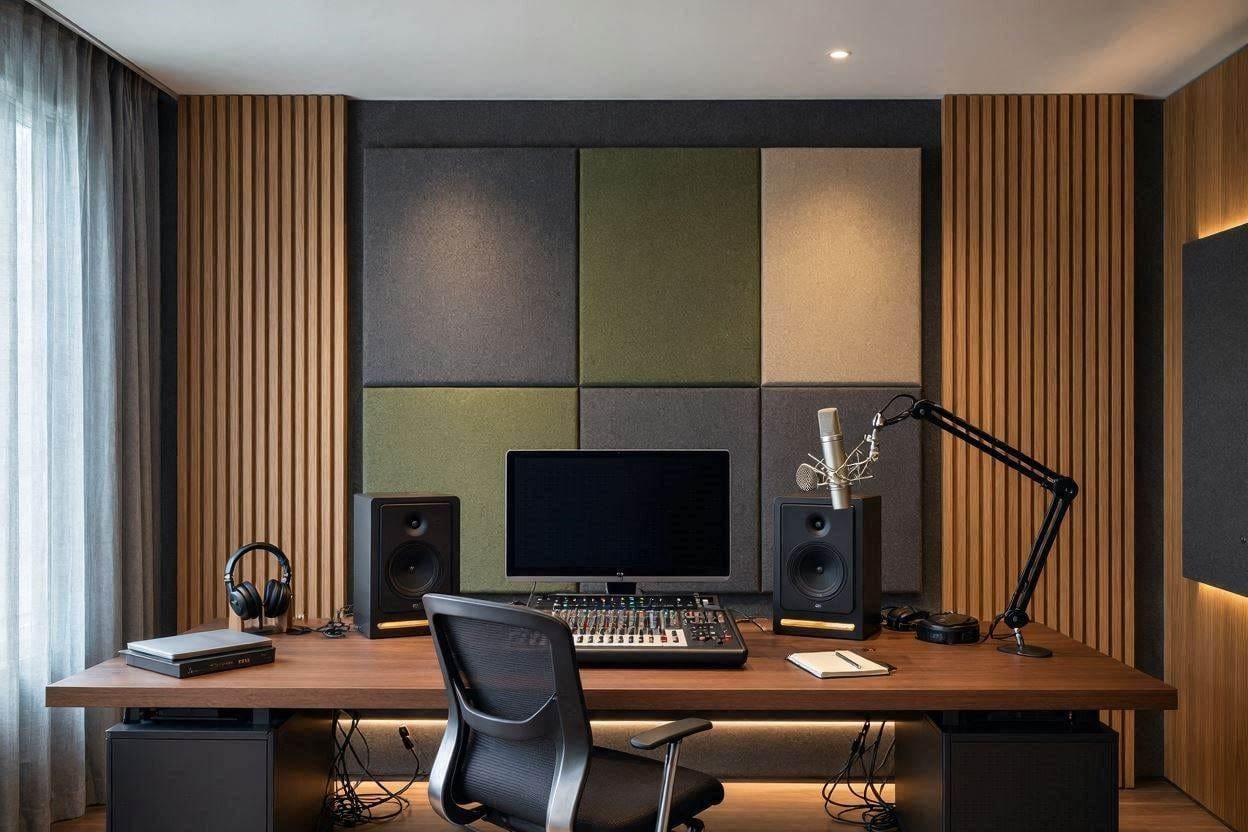
We need to have an honest conversation about the state of home studios. If you are setting up a room for podcasting, YouTube, or music production, your first instinct is usually to go on Amazon, buy a 50-pack of cheap, dark-grey “egg-crate” foam squares, and spray-glue them to your walls.
I know this because I did exactly that five years ago. And here is what happened: Within three months, half the foam squares started peeling off. The glue permanently ruined my drywall. But worst of all? The room still sounded terrible. It looked like a teenager’s gaming bunker, and my audio still had a muddy, boxed-in echo.
Treating your room acoustics is the single most important upgrade you can make for your audio quality, even more important than upgrading your microphone (a point we touched on in our Blue Yeti vs. AT2020 comparison). But in 2026, you do not have to sacrifice the interior design of your home to get broadcast-quality sound.
I’ve tested the modern wave of acoustic treatments. From rigid fiberglass wrapped in premium linen to high-density PET felt, here are the absolute best acoustic panels that will make your studio sound dead-quiet and look like a million bucks.
🎯 The Quick Verdict
The Overall Best: ATS Acoustics Rigid Fiberglass Panels. They offer true, professional-grade broad-spectrum absorption wrapped in gorgeous, customizable burlap fabrics.
The Best Modern Aesthetic: TroyStudio Acoustic Art Panels. Made of high-density felt, they look like minimalist modern art, absorb high frequencies beautifully, and double as a pinboard for your office.
The Science: Why Cheap Foam Fails
Before you spend any money, you need to understand how sound absorption actually works. As we covered in our master guide on Soundproofing vs. Sound Absorption, treating a room means trapping bouncing sound waves using friction.
According to acoustic physics principles published by the Acoustical Society of America, when you buy cheap, 1-inch thick polyurethane foam, you are buying a product that is almost entirely made of air. It has a very low NRC (Noise Reduction Coefficient) for anything other than the highest, most piercing frequencies. It will stop the sound of a handclap, but it does absolutely nothing to stop the low-mid frequencies of the human voice. This leaves your room sounding “boomy” and unnatural.
To capture the full spectrum of the human voice, an acoustic panel needs density and depth. The panels below utilize compressed fiberglass, mineral wool, or high-density PET felt, which literally forces the acoustic energy to navigate a thick maze of fibers, converting the echo into trace heat and leaving your microphone with pure, clean audio.
1. ATS Acoustics Rigid Fiberglass Panels (Best Overall)
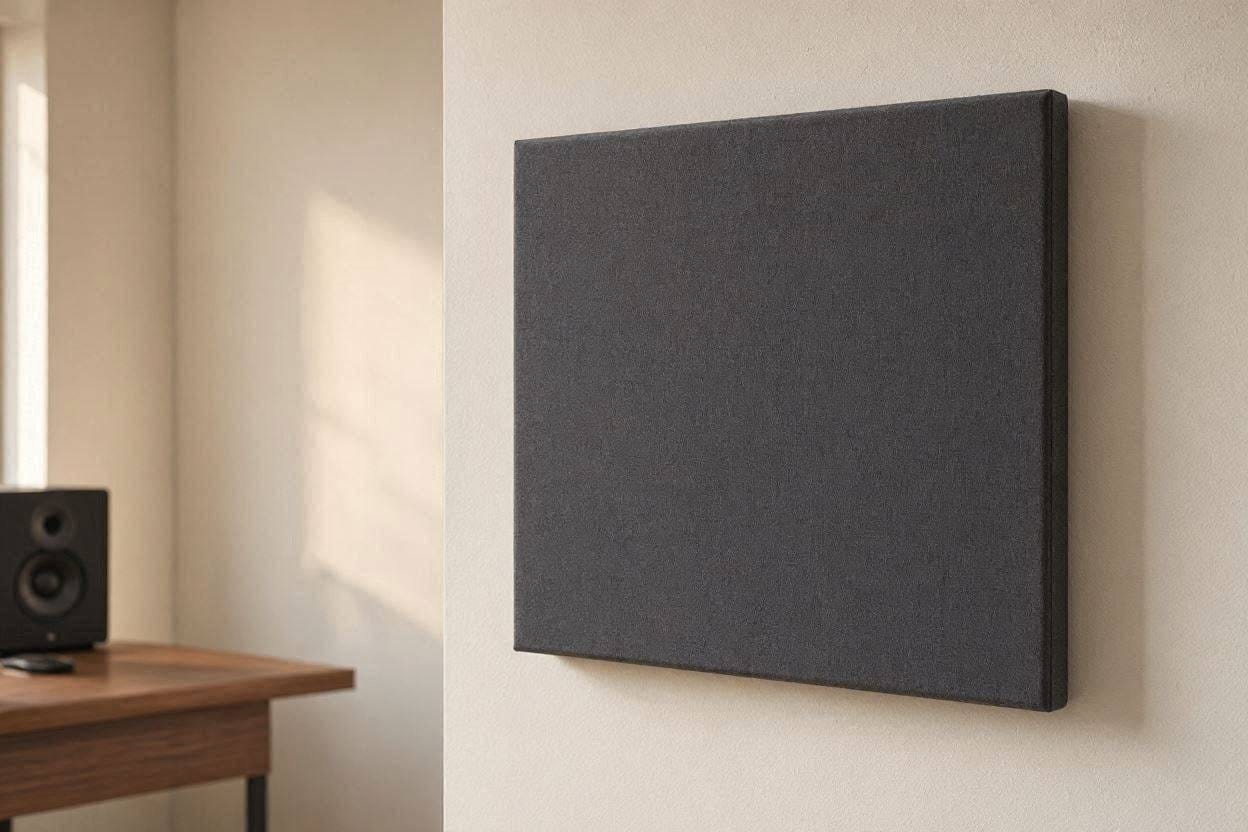
If you walk into a professional, million-dollar recording studio, you won’t see foam. You will see fabric-wrapped fiberglass. ATS Acoustics brings this exact professional standard into the home office. These panels feature a solid wood frame packed with dense Owens Corning 703 fiberglass, wrapped in a beautiful, textured jute/burlap fabric.
Because they are 2 inches thick and incredibly dense, they offer an elite NRC rating of 1.0. This means they absorb 100% of the sound waves that hit them across the human vocal spectrum. Mounting them is as easy as hanging a heavy picture frame, meaning you won’t destroy your drywall with spray adhesive.
Pros
- True studio-grade fiberglass absorption (1.0 NRC)
- Looks like premium canvas wall art
- Available in dozens of tasteful, muted colors
- Easy, damage-free installation
Cons
- They are heavy (roughly 10 lbs per panel)
- More expensive than foam alternatives
2. TroyStudio Acoustic Art Panels (Best Modern Minimalist)
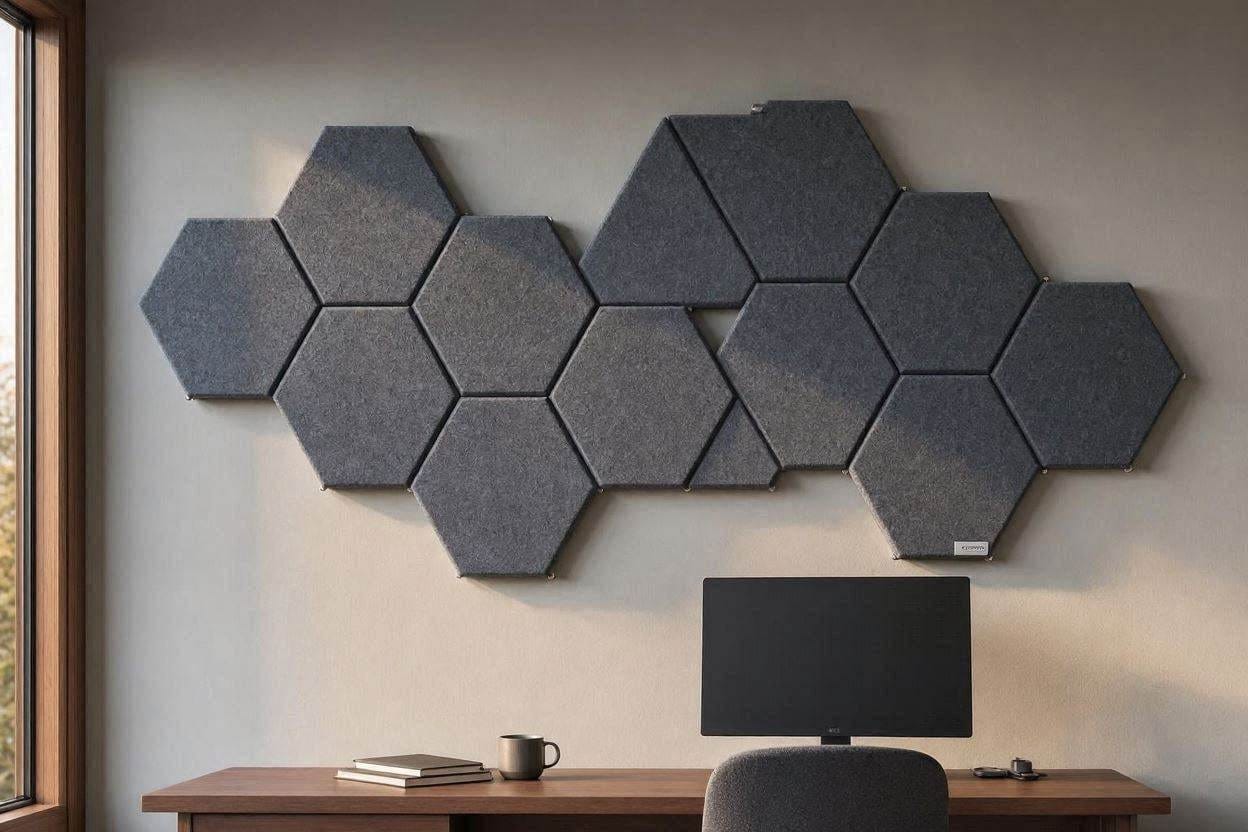
If the fabric-wrapped wooden frames of the ATS panels feel a bit too “bulky” for your sleek home office, TroyStudio offers a brilliant, budget-friendly alternative. These panels are made from 100% high-density polyester fiber (PET felt). They feature beautifully beveled edges, allowing you to arrange them in geometric, modern patterns on your wall.
They are incredibly thin (usually about 0.4 inches), but because the material is so dense, they do an excellent job of taming the flutter echo of a small, square bedroom. As an added bonus, because they are made of dense felt, they double perfectly as a push-pin board for your home office notes and photos.
Pros
- Sleek, beveled, modern aesthetic
- Extremely lightweight (easy to hang with Command strips)
- Doubles as a functional pinboard
- Budget-friendly pricing
Cons
- Too thin to absorb low-end bass frequencies
- Requires buying your own double-sided mounting tape
3. BXI Wood Slat Acoustic Panels (Best for Video Backgrounds)
If you are a YouTuber or Twitch streamer, your acoustic treatment isn’t just about sound—it’s part of your set design. Vertical wood slats are the hottest interior design trend of the decade. We broke down the exact physics of this trend in our guide, Do Acoustic Wood Panels Work?, but the short answer is: Yes, they are incredible for internal acoustics.
The rigid wooden slats act as diffusers, taking incoming sound waves and scattering them in dozens of directions to break up harsh echoes. The gaps between the wood expose a backing of dense acoustic felt, which absorbs the scattered noise. It provides a highly balanced, natural sound to your room while looking like a million-dollar architectural upgrade.
Pros
- Combines diffusion and absorption perfectly
- The ultimate, premium video background aesthetic
- Leaves the room sounding “natural,” not overly dead
Cons
- Very heavy and highly expensive to cover a full wall
- Requires drilling directly into wall studs
How to Place Your Panels (The Mirror Trick)
Buying beautiful acoustic panels is only half the battle. If you place them in the wrong spots, you are wasting your money. You don’t need to cover your entire wall; you only need to cover the First Reflection Points.
Sound leaves your mouth (or your studio monitors), hits the wall, and bounces directly into the microphone. To find exactly where that bounce happens, use the Mirror Trick:
- Sit in your normal recording chair.
- Have a friend hold a flat mirror flat against the wall to your left, sliding it slowly along the wall.
- The exact moment you can see your studio monitors (or your own mouth) in the mirror, yell “Stop!”
- Mark that spot. That is your primary reflection point. Hang an acoustic panel directly over that mark. Repeat this for the right wall and the ceiling above you.
Frequently Asked Questions (FAQs)
Will Acoustic Panels Block Out My Loud Neighbors?
No. Acoustic panels are designed for sound absorption (improving the audio inside the room). They have practically zero ability to physically block noise from entering or leaving a room. If you need to stop heavy street traffic or loud neighbors, you need to rely on the 4 principles of structural soundproofing, utilizing heavy mass like thick drywall or mass-loaded vinyl.
Do I need to Put Acoustic Panels Behind My Microphone?
It depends on the microphone pattern. If you are using a standard cardioid microphone (which most podcasters use), the mic rejects sound from the rear. Placing a panel directly behind the mic doesn’t do much. You actually want to place the panel on the wall behind you (the wall you are facing), because that is where your voice will hit and bounce back into the sensitive front of the microphone.
Are Egg Cartons a Good Budget alternative?
Absolutely not. As we broke down in our guide Do Egg Cartons Work For Soundproofing?, cardboard lacks the porous depth required to trap and absorb sound waves. Furthermore, covering your walls in dry cardboard is a massive, highly dangerous fire hazard. Stick to verified, fire-rated acoustic materials.

Ememobong is the lead researcher and editor at Quiet Dwelling. As a professional technical writer, he specializes in breaking down complex acoustic engineering concepts into simple, actionable steps. His goal is to help people build distraction-free environments for better sleep and deep work.