This post contains affiliate links. If you use these links to buy something, we may earn a commission.
If you live in an apartment, the idea of buying a treadmill is terrifying. You know exactly what happens the second you start jogging: the heavy “thud, thud, thud” of your feet vibrates straight through your floorboards and turns your downstairs neighbor’s ceiling into a booming bass drum. Before you hit your first mile, there is an angry knock at your door (or a broom banging against the floor).
For years, I avoided working out at home purely out of anxiety. The guilt of ruining someone else’s peace and quiet kept me paying for a gym membership I hated using. But home fitness technology has radically shifted over the last few years.
Brands finally realized that the majority of their customers don’t have massive, concrete-floored basement gyms. They live in second-floor condos and shared apartment buildings. By utilizing advanced deck suspension systems and brushless DC motors, the newest generation of treadmills has essentially solved the noise problem.
I have spent weeks analyzing acoustic performance, motor hum, and shock absorption to find the machines that actually respect the unwritten rules of apartment living. Here are the best quiet treadmills that will keep you fit—and keep you from getting evicted.
🎯 The Quick Verdict
The Overall Best for Runners: Horizon Fitness T101. Features a brilliant 3-zone variable cushioning deck that absorbs the heavy impact of heel strikes, combined with a whisper-quiet 2.5 CHP motor.
The Best for Heavy Impact/Joints: Sole F63. Their patented “Cushion Flex” deck is proven to reduce joint impact (and floor vibration) by 40% compared to running on asphalt.
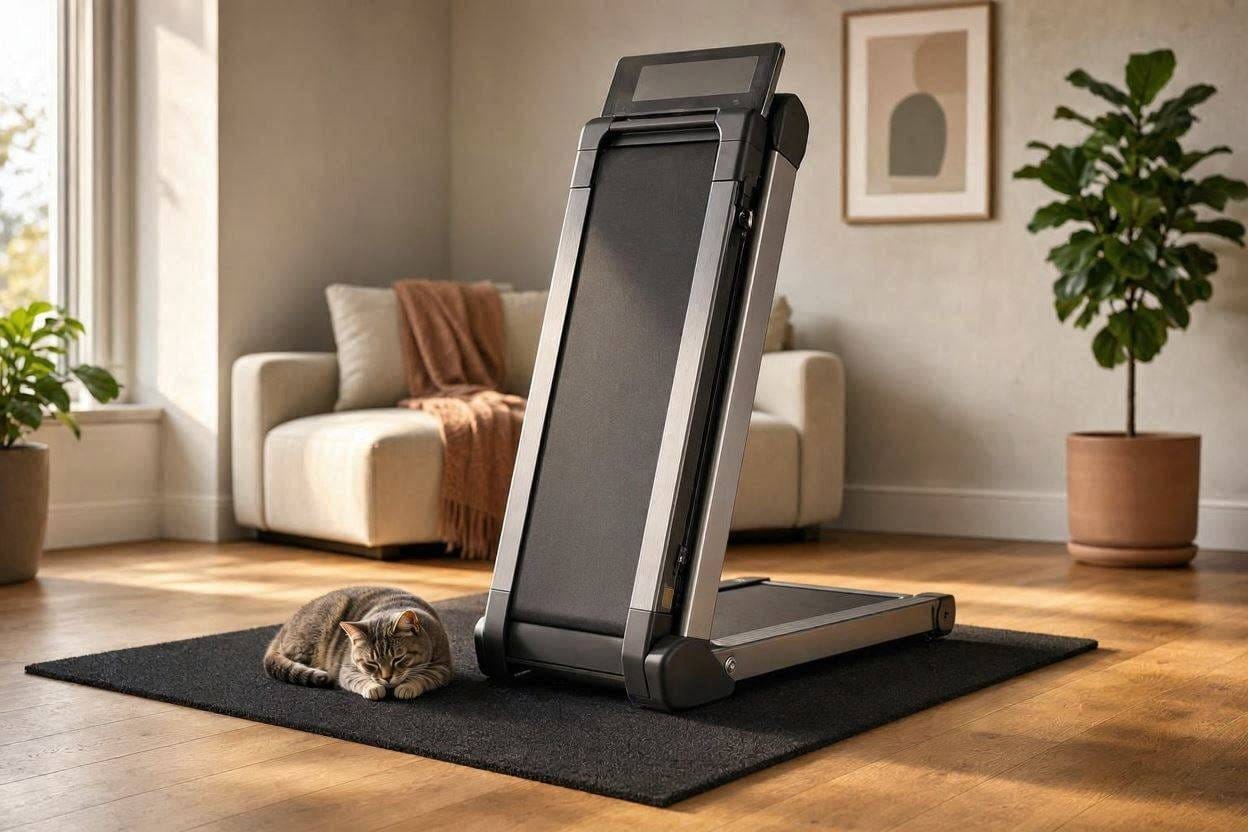
The Best for Walking/Under-Desk: WalkingPad C2 Mini. A beautifully sleek, foldable walking pad with a brushless motor that produces virtually zero mechanical noise.
The Science: Airborne Whine vs. Impact Thud
Before you spend a thousand dollars on a machine, you have to understand exactly what kind of noise you are trying to stop. Treadmills produce two completely different types of acoustic energy.
- Airborne Noise (The Motor): This is the high-pitched mechanical whine of the electric motor and the friction of the belt sliding over the rollers. It travels through the air. A good solid-core door or an ambient air purifier will easily block or mask this noise from reaching your roommate in the next room.
- Impact Noise (The Foot Strike): This is your actual enemy. When your heel hits the treadmill deck, you inject massive kinetic energy into the frame of the machine. That vibration travels straight down the legs of the treadmill into your floor joists. As we explored in our deep-dive on Airborne vs. Impact Noise, structural vibrations easily bypass walls and floors entirely.
According to acoustic researchers at the Acoustical Society of America, to stop impact noise, you must have mechanical decoupling. You cannot just buy a treadmill with a “quiet motor.” If the deck doesn’t have premium shock absorbers to soak up the kinetic energy of your foot, your downstairs neighbor will hear every single step.
1. Horizon Fitness T101 (Best Overall for Apartments)
The Horizon T101 is legendary in the apartment-gym community, and it comes down to one specific, highly engineered feature: the 3-Zone Variable Response Cushioning.
Horizon realized that your foot needs different levels of support during a stride. The front of the treadmill deck (where your foot lands) has incredibly soft, flexible shock absorbers to instantly kill the impact vibration. The middle is a neutral transition zone, and the back is firm to give you a solid push-off. By trapping the kinetic energy at the front of the deck, the vibration never makes it down to your floorboards.
Paired with an ultra-quiet 2.5 CHP motor that runs at remarkably low RPMs (meaning less high-pitched whining), this machine allows you to jog safely without turning your living room into a construction zone.
Pros
- Elite 3-Zone cushioning drastically reduces floor impact
- Motor runs at lower RPMs to eliminate mechanical whining
- Hydraulic folding mechanism allows for gentle, silent storing
Cons
- Max speed of 10 MPH (not ideal for elite sprinters)
- The built-in speakers are relatively weak
2. Sole F63 (Best for Heavy Runners & Bad Joints)
If you are a heavier runner or you intend to run at higher speeds, the Horizon might bounce a bit too much. The Sole F63 is a heavy-duty tank designed specifically to eat impact.
Sole utilizes their patented “Cushion Flex Whisper Deck.” According to independent testing, this specific suspension system reduces impact up to 40% compared to running on asphalt. That 40% reduction doesn’t just save your knees and ankles; it means 40% less kinetic energy is being driven into the ceiling of the apartment below you.
Furthermore, because the steel frame is so incredibly heavy and rigid, the machine doesn’t squeak, creak, or rattle when you run on it. It stays planted firmly on the ground.
Pros
- Cushion Flex deck absorbs 40% of impact energy
- Incredibly heavy, stable steel frame eliminates plastic rattling
- Powerful 3.0 HP motor handles long runs quietly
Cons
- It is extremely heavy and difficult to move by yourself
- Takes up more footprint space than compact models
3. WalkingPad C2 Mini (Best for Under-Desk & Walking)
If you don’t actually want to sprint, but just want to get your 10,000 steps in while watching Netflix or working at a standing desk, you don’t need a massive commercial treadmill. The WalkingPad C2 is the ultimate stealth device for small apartments.
Walking naturally generates significantly less impact noise than running because both feet rarely leave the ground at the same time. The WalkingPad capitalizes on this by using a high-efficiency brushless motor. Brushless motors lack the internal friction of standard motors, resulting in a smooth, quiet “whoosh” that rarely exceeds 50 decibels (about the volume of a quiet refrigerator). To see how that compares to other household items, check our guide to decibel levels.
Best of all, it folds completely in half and slides silently under your couch when you are done.
Pros
- Brushless motor operates at a near-silent hum
- Zero heavy impact noise because it is restricted to walking speeds
- Folds in half for ultimate apartment space-saving
Cons
- Max speed is only 3.7 MPH (absolutely no running)
- No handrails for balance (though you can buy models with them)
How to Soundproof Your Existing Treadmill (The Rubber Mat Hack)
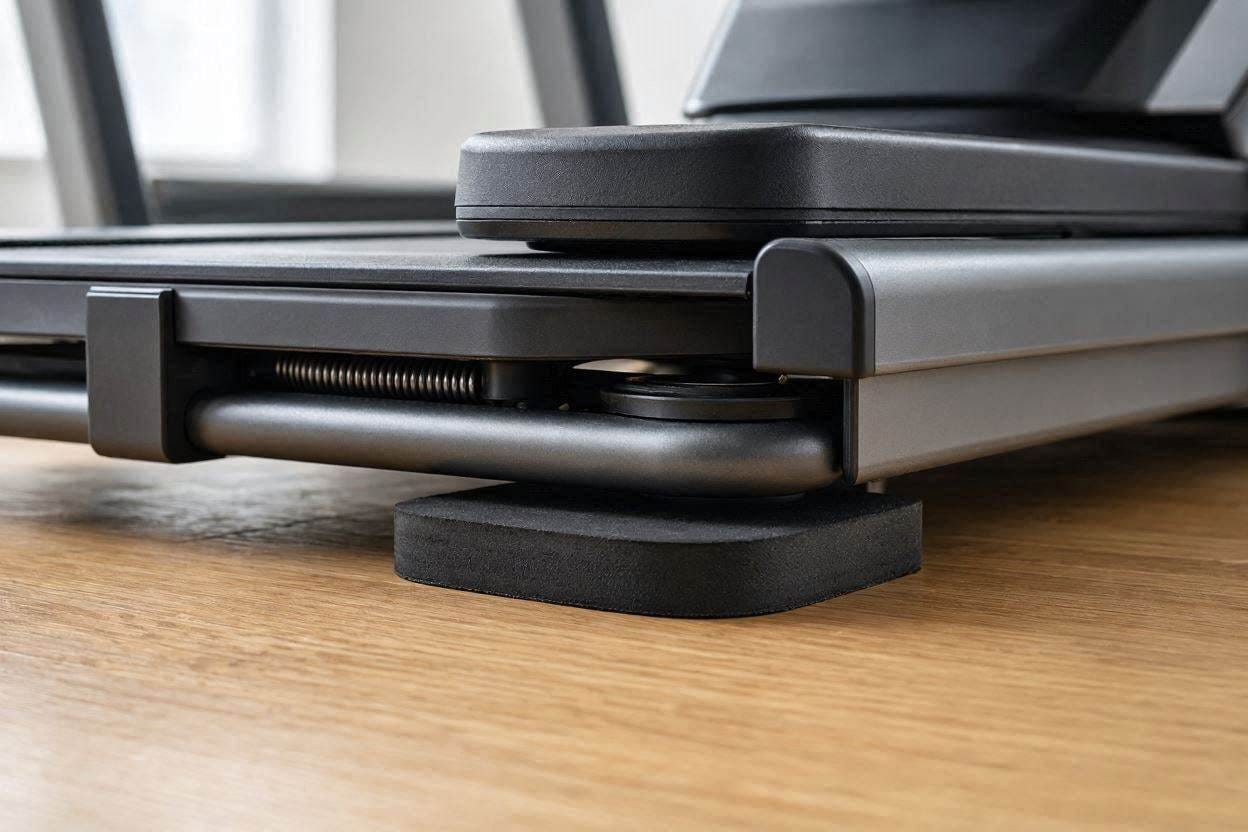
What if you already own a noisy treadmill and cannot afford to replace it? You need to artificially create the mechanical decoupling that your machine lacks.
Do not just put your treadmill on a cheap, thin yoga mat. Yoga mats are made of lightweight foam. As we discussed in our guide on why foam fails at soundproofing, lightweight materials compress instantly under heavy weight, creating a solid physical bridge right back into your floor.
You must buy a heavy-duty, vulcanized rubber acoustic mat (often sold as “horse stall mats” at farm supply stores, or specialized treadmill mats on Amazon). These mats are incredibly dense and heavy. Place one under the entire footprint of your treadmill. For extra safety, place thick anti-vibration washing machine pads under the actual feet of the machine. The heavy rubber will absorb the kinetic energy of your foot strikes, effectively cutting the impact vibrations transferring to the apartment below by up to 50%.
Frequently Asked Questions (FAQ)
Can My Downstairs Neighbor Hear Me Walking on a Treadmill?
If you don’t use a rubber isolation mat, yes. Even walking generates roughly 1.5 times your body weight in downward kinetic force. In a standard wood-framed apartment building, that force travels directly into the floor joists. Always use a high-density rubber mat to decouple the machine.
Why Does My Treadmill Squeak When I Run?
Squeaking is almost always caused by a loose frame. When you run, the impact twists the metal frame slightly. If the bolts aren’t perfectly tight, the metal rubs against the plastic housing. Go over every single bolt with a wrench and tighten them down. If the squeak persists, apply a tiny drop of silicone lubricant to the joints.
Is an Incline Treadmill Quieter?
Interestingly, yes! When you run on an incline (even just a 2% or 3% grade), your foot strike mechanics change. You tend to land more softly on your mid-foot rather than slamming your heel down. This naturally reduces the raw impact energy driven into the floor, making your workout noticeably quieter for the neighbors below.

Ememobong is the lead researcher and editor at Quiet Dwelling. As a professional technical writer, he specializes in breaking down complex acoustic engineering concepts into simple, actionable steps. His goal is to help people build distraction-free environments for better sleep and deep work.