
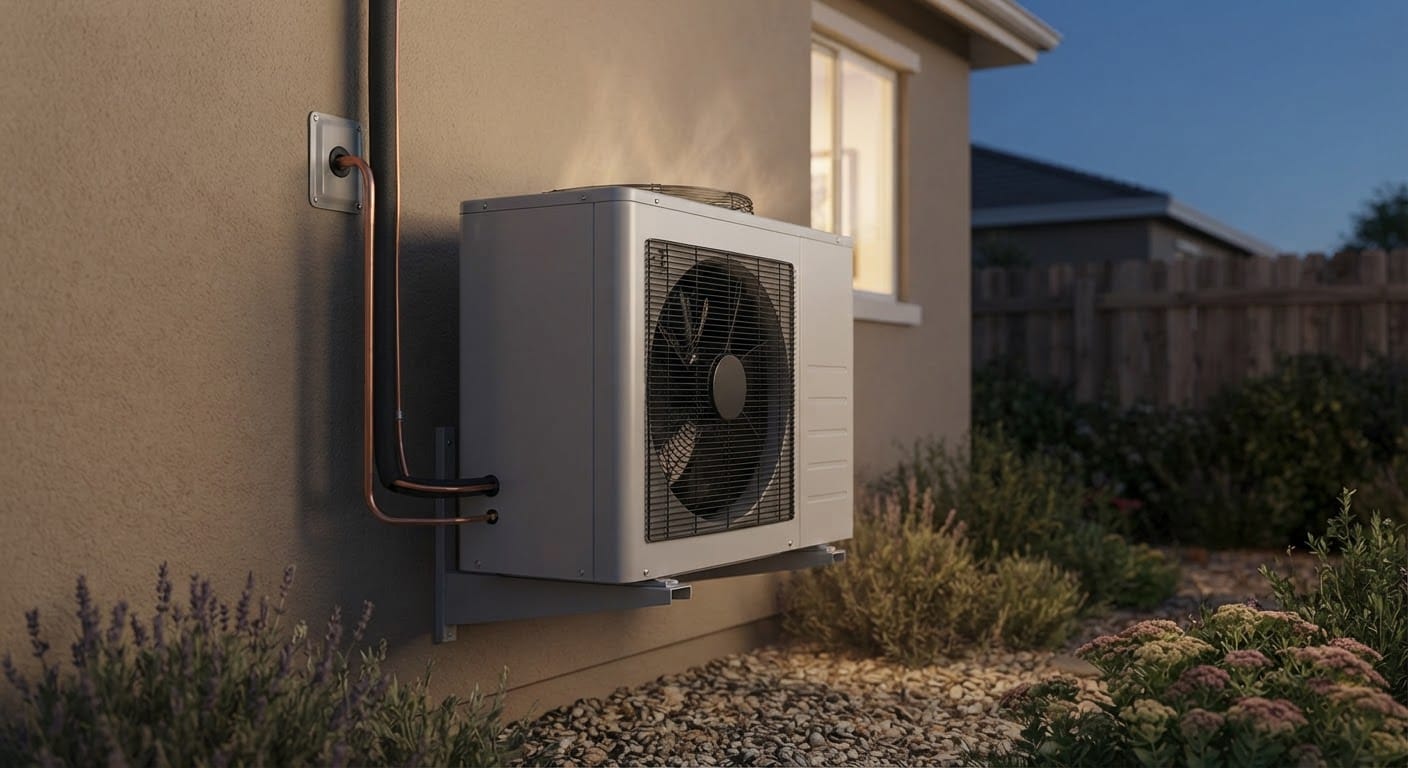
You did the responsible thing. You replaced the old gas boiler with a heat pump, collected the grant, and told yourself you were finally done with noisy heating. And now, every twenty minutes, a low rumble crawls through the bedroom wall. Not loud, exactly. Worse than loud. Present.
This is the frustration heat pump owners describe most often, and the reason is that heat pumps produce a very different noise signature from anything you have lived with before. A boiler fired in short, dramatic bursts somewhere in a cupboard you never visited. A heat pump runs continuously, at lower intensity, for hours — and it usually sits right outside a bedroom wall on a bracket bolted to your house.
The good news is that heat pump noise is unusually well understood acoustically. There are only three sources, and each one has a known set of fixes. This guide walks through all three, in the order that gives the best return.
Why Heat Pumps Sound So Different From Boilers
Three things changed when you moved to a heat pump, and all three matter acoustically.
It runs for hours, not minutes. A boiler is a sprinter. A heat pump is a marathon runner, modulating up and down to hold a steady temperature rather than blasting heat and stopping. That means the noise is not an event you can brace for — it is a background condition. Background conditions are what wear people down, which is why sleep disruption is such a common complaint with heat pumps specifically.
It runs at night. The coldest hours of the day are the ones when your heat pump works hardest. So the loudest operation of the day coincides exactly with the hours you are trying to sleep — the opposite of what your ears want.
Its noise is dominated by low frequency. This is the important one, and the reason ordinary soundproofing advice often fails here. Compressor and fan noise sits heavily in the low-frequency band, and low-frequency sound behaves completely differently from the mid and high frequencies you are used to blocking. It passes through solid structure. It is not stopped by mass alone. It travels farther, and it takes far more distance to fade. This is not a fringe complaint. The World Health Organization’s own guidance on environmental noise identifies sleep disturbance as one of the established health effects of noise exposure, alongside cardiovascular and cognitive impacts — and separates low-frequency noise research remains an active area precisely because it behaves so differently from the rest of the spectrum. World Health Organization
If you want the underlying physics, the same principles we cover in how to block low frequency noise apply directly here: bass is a structural problem, not a wall-thickness problem. There is also a useful distinction between sound bouncing around a space and vibration creeping through the building frame — which we break down in echo vs. reverberation.
The Three Sources Of Heat Pump Noise
Almost everything you hear from a heat pump comes from one of these three places. Identifying which one dominates is the entire diagnosis, and it changes which fix is worth your money.
1. The Compressor — the low rumble
Inside the outdoor unit sits a compressor: a sealed motor-and-pump assembly running at high speed, under pressure, cycling many times a second. Its dominant output is a low, pulsing hum — often in the range where it sets off sympathetic vibration in plasterboard and timber, which amplifies it inside the room rather than outside.
This is the source that travels. When people say “I can hear it through the wall more than outside,” they are almost always describing compressor vibration entering the fabric of the building. That vibration bypasses the air gap that would normally block airborne sound — the same pathway we cover in what is flanking noise, because structurally transmitted vibration is flanking noise in its purest form.
2. The Fan — the broadband whoosh
The fan moves enormous volumes of air across a large coil, and the resulting noise is broadband: a rushing, whooshing sound with a bit of blade-pass tone layered over it. This is mostly airborne noise, which is much easier to beat than compressor vibration. It radiates outward and fades with distance roughly the way normal sound does.
Fan noise is also the source most sensitive to condition. A dirty coil or a bent blade turns a gentle whoosh into a rougher, more irregular sound — a symptom worth checking early, because it is often free to fix.
3. The Line Set And Brackets — the rattle and buzz
The two refrigerant pipes running from the outdoor unit into your house, and the brackets holding the unit itself, are both excellent conductors of vibration. A bracket bolted directly to a brick or rendered wall will faithfully hand every compressor pulse straight into the building’s structure. A copper line resting against a joist or stud can buzz like a tuning fork.
This is the source most people never think to check — and it is frequently the one responsible for the noise being worse inside than outside.
What Usually Does Not Work
Before spending money, cross these off. Each is widely recommended somewhere online and each is close to useless for a heat pump.
- Building a fancy fence around the unit. This is the single most common mistake. A solid enclosure reflects fan noise, restricts airflow, and can cause the unit to work harder — which makes it louder. Heat pumps need free airflow.
- Foam acoustic panels on the outside wall. These absorb mid and high frequencies. Compressor rumble is overwhelmingly low frequency, and thin foam barely touches it. This is the same absorption-versus-blocking confusion we unpack in soundproofing vs. sound absorption.
- Adding more mass to the wall. Extra mass helps with airborne sound but does surprisingly little for vibration arriving through the structure itself. Mass alone is one of the four principles, not all of them — see the 4 principles of soundproofing.
- Turning the system down. Modulating a heat pump lower doesn’t drop the compressor out of the range that bothers people; it just changes the pitch. And it costs you warmth.
- Complaining without data. If you approach an installer or a manufacturer with “it’s too loud,” you will get sympathy and little else. Approach them with a measurement and a time of day and you get a service visit.
The Best Order To Fix Heat Pump Noise
Work down this list. Each step is cheaper and easier than the one below it, and the first two solve the majority of real-world complaints.
Step 1 — Measure it properly, at the right times
You cannot fix what you haven’t characterised, and heat pump noise varies enormously across a cycle. Measure with a decibel meter app at three moments: right after startup (compressor at full tilt), mid-cycle (modulating), and during defrost (the loudest, briefest phase, when the system briefly reverses to melt ice off the coil). Note the readings at the wall inside the bedroom and a metre from the outdoor unit.
For context on what those numbers mean, our guide to what a decibel is covers how the scale works and why a 3 dB change is a doubling of acoustic energy — and for sleep specifically, how many decibels is too loud for sleep sets the practical threshold.
Two things this tells you. First, whether the unit is performing near its rated sound power level or is unusually loud, which is your lever with the installer. Second, whether the problem is worst at the unit or worst at the wall — which tells you whether you are dealing with fan noise (radiating) or compressor vibration (transmitting).
Step 2 — Check the boring things first
Free fixes, in ascending order of effort:
- Clean the coil and fan. A clogged outdoor coil makes the fan strain and the compressor run longer. Rinse the fins, clear any leaf litter from the base, and check the fan blades for damage.
- Level the unit. A unit sitting on a slightly tilted pad will transmit uneven loading into its mounts and can buzz. Check the pad with a spirit level.
- Clear the clearance. Give the manufacturer’s recommended clearance on all sides. Shrubs growing against the coil are a common and easily overlooked cause of extra fan noise.
- Isolate the pipes. Where the refrigerant lines touch joists, studs or each other, separate them and add proper pipe insulation. A line set that is touching timber is a loudspeaker.
- Look for ice or damage. Bent fan blades, damaged grilles, or a unit that is constantly defrosting all need a technician, not a DIY fix.
Step 3 — Decouple the unit from the building
This is the highest-value paid fix, and the one that resolves most “I can hear it through the wall” complaints. The goal is to break the mechanical path between the compressor and the structure of your house.
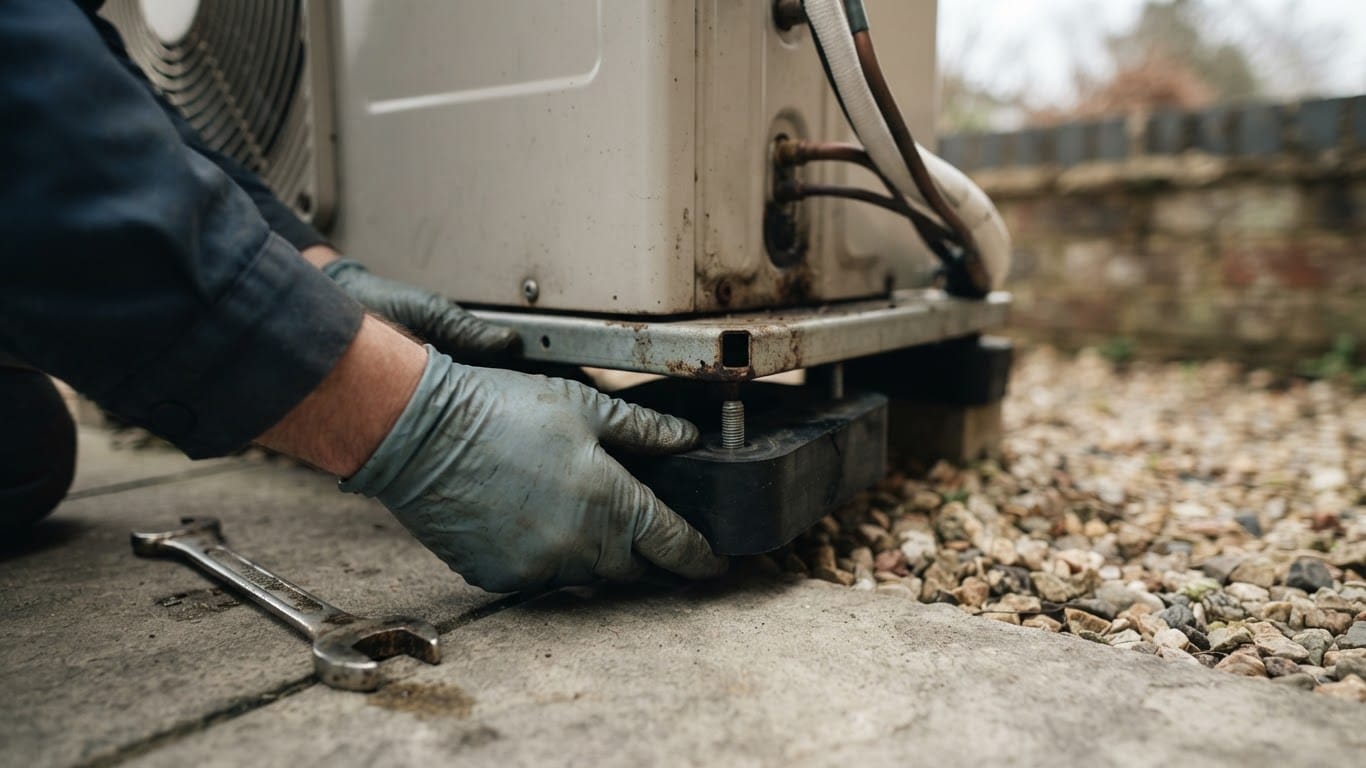
Vibration isolation feet or pads. Replace rigid mounting with purpose-made rubber or spring isolators rated for the unit’s weight. Choose an isolator whose natural frequency sits well below the compressor’s operating frequency — this is the whole trick, and it is why a random slab of rubber often disappoints while a correctly rated isolator works. If the unit is wall-mounted, isolation matters even more, because a wall bracket is a direct mechanical bridge into the room.
This is the same decoupling principle that underpins the most effective soundproofing work everywhere. If you want the fuller picture, mass loaded vinyl covers what the mass half of the equation looks like, and Green Glue soundproofing explains viscoelastic damping — the technique that converts vibration into a tiny amount of heat instead of letting it travel.
The same principle applies indoors: a hollow core door is a classic case of thin, undamped panels resonating with vibration rather than stopping it.
Step 4 — Treat the wall, if you still need to
Only if steps 1–3 haven’t done enough. At this point you are dealing with residual airborne noise, and the standard wall treatments apply: decoupling, mass, and damping in combination. This is a bigger project and usually worth it only when the bedroom wall sits directly against the unit.
Step 5 — Protect the room itself
If the noise is under control but still audible at bedtime, the practical move is to stop it reaching your ears rather than stop it entering the building. Soft furnishings, rugs and textile surface area across the room all help modestly. For the sleep angle specifically, our reviews of earplugs for sleeping and bedroom fans cover options that mask or block the residual hum — and in a lot of homes, a properly isolated unit plus a masking sound is genuinely sufficient.
If You Have Not Bought Yours Yet
Buy the acoustic spec, not just the efficiency rating. Every unit is sold with a rated sound power level in decibels, and the spread between models is larger than most buyers expect — check it, and check it for the outdoor unit specifically rather than trusting a marketing average.
Two architectural points worth more than any model choice. Never mount on a shared or bedroom wall if you have any alternative — a ground-mounted pad on the far side of the house is dramatically quieter inside, for free. And build in distance: fan noise falls with distance in the normal way, and every metre between the unit and your window buys you a real reduction. If you are planning an installation, this is the one decision that is cheap now and expensive to change later.
The Honest Caveat
Heat pump noise cannot be reduced to zero. The compressor moves, and moving machinery makes sound. What you can realistically achieve is a unit you stop noticing — which is a different and much more attainable target than silence. Expect a noticeable reduction from proper isolation, not a disappearance.
And if your diagnosis is ongoing defrost cycling, a failed compressor mount, an undersized unit working flat out, or an installer who has mounted it badly, the correct answer is usually a service visit rather than anything you can do from the garden. Measure first, so you can make that call with evidence.
Frequently Asked Questions
Why is My Heat Pump Louder at Night?
Because that is when it works hardest. Heat pumps modulate their output to meet demand, and the coldest hours of the day create the greatest heating demand and the longest running periods. Cold air is also denser, which slightly increases fan loading. So the loudest operating window of the day lines up with the hours you are trying to sleep.
Why can I Hear My Heat Pump Better Inside than Outside?
That is the signature of compressor vibration rather than fan noise. The vibration enters the building through the mounting bracket, the wall, or the refrigerant line set, and the structure then radiates it into the room — effectively turning your wall into a speaker. Airborne fan noise would sound louder the closer you stood to the unit outdoors.
Does a Heat Pump Make More Noise than a Boiler?
They are different rather than simply louder or quieter. A boiler produces short, loud bursts from inside a cupboard. A heat pump produces a continuous, lower-level sound from an outdoor unit that typically runs for far longer each day. Many people find the heat pump more intrusive overall despite lower peak volume, because continuous noise is harder to ignore than an intermittent one.
Will Acoustic Panels on the Outside Wall Help?
Barely, if your problem is compressor rumble. Thin acoustic panels absorb mid and high frequencies; heat pump noise is dominated by low frequency, which passes through the structure rather than through the air. Panels can help slightly with fan noise radiating toward the wall, but vibration isolation of the unit is a far better use of the same money.
Can I Build an Enclosure around the Outdoor Unit to Quiet it?
Only a purpose-designed acoustic enclosure that preserves the manufacturer’s required airflow clearance — and even then it is a compromise. A solid DIY fence or box traps hot air, reflects fan noise back out, and can force the compressor to run harder. Reduced airflow means reduced efficiency and often more noise, not less.
Why Does My Heat Pump Make a Sudden Loud Noise in Winter?
That is almost certainly a defrost cycle. In cold weather, ice builds up on the outdoor coil, and the system briefly reverses to melt it off. Defrost is the loudest phase of normal operation — a whoosh, clunk or hiss that lasts a few minutes. It is normal. Constant or very frequent defrosting, however, can indicate a fault and is worth a technician’s opinion.
Do Vibration Isolation Pads actually Work for Heat Pumps?
Yes, when they are correctly matched to the unit’s weight and its compressor frequency. That matching is the crux: a random rubber mat does little, while an isolator rated for the load and tuned below the compressor’s operating frequency can substantially reduce structure-borne transmission. This is the single most effective paid fix for noise heard indoors from an outdoor unit.

Ememobong is the lead researcher and editor at Quiet Dwelling. As a professional technical writer, he specializes in breaking down complex acoustic engineering concepts into simple, actionable steps. His goal is to help people build distraction-free environments for better sleep and deep work.