
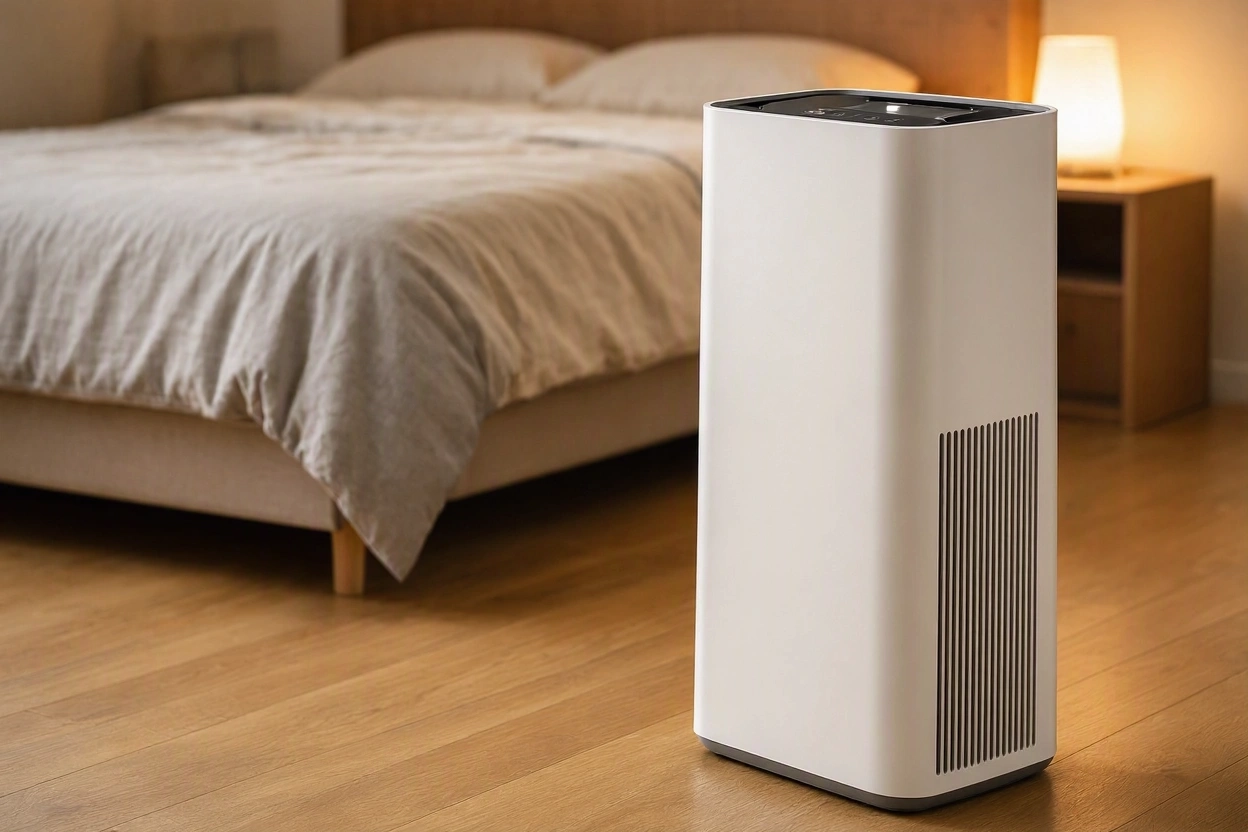
Air purifiers have one of the widest noise ranges of any household appliance. The same category contains units you genuinely cannot hear across a room and units that sound like a small hairdryer running continuously. That spread is why the honest answer to “are air purifiers loud” is: it depends entirely on fan speed, and fan speed is a trade-off you choose every time you press a button.
The good news is that the trade-off is well understood, and the specification that matters is printed on every box. Once you know what to look for, you can tell from the numbers whether a unit will work in a bedroom before you buy it.
Why Air Purifiers Make Noise At All
Three sources, and only one of them is really avoidable.
The fan — and it dominates everything. Air purifiers work by moving large volumes of air through a dense filter. Moving air is the entire point, and moving air makes noise. The fan is responsible for the overwhelming majority of the sound you hear, which is why the same purifier can be near-silent on its lowest setting and intrusive on its highest.
There is a physics relationship worth understanding here: to move a given volume of air, a small fan must spin faster than a large one, and faster fans are louder. This is why large, slow-turning fans are inherently quieter than small, fast ones — the same reason a big ceiling fan is gentler than a small desk fan at the same airflow. It is also the reason a physically larger purifier often sounds calmer than a compact one with a similar rating.
The motor and airflow path. A continuous broadband rush, layered with a low hum from the motor itself. On a well-designed unit this is smooth and unremarkable. On a cheap one it can be tonal and grating.
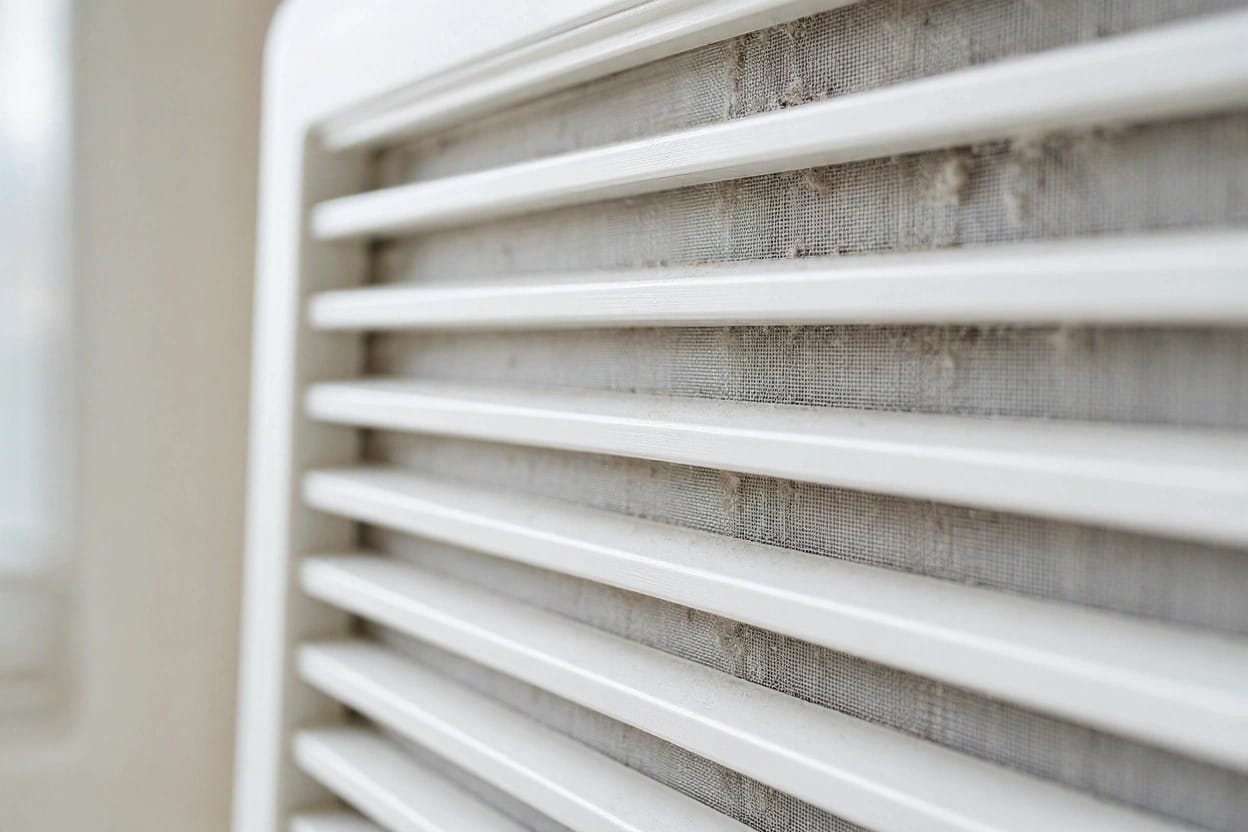
Turbulence and filter loading. Air forced through a dense HEPA filter produces turbulence, which is noisier than smooth flow. As the filter loads with dust, airflow resistance increases and the unit must work harder to maintain the same throughput — so a purifier gets louder over time if you don’t replace the filter. This is the most commonly overlooked cause of a purifier that has become annoying.
How Loud Are Air Purifiers In Decibels?
Here is the range, and it is enormous.
| Setting | Typical Level | What It Sounds Like |
|---|---|---|
| Sleep / lowest | Roughly the low 20s to low 30s dB | Softer than a whisper. Usually inaudible a few metres away. |
| Medium | Roughly the 30s to low 40s dB | A steady, noticeable rush of air. Fine during the day. |
| High / turbo | Roughly the 50s dB and above | Clearly loud. Comparable to a range hood on low, or a hairdryer on its gentlest setting. |
For calibration, our guide to what a decibel is explains why the scale is logarithmic — a 10 dB increase sounds roughly twice as loud, so the gap between a sleep mode and a turbo mode is far bigger than the numbers suggest.
And for the sleep question specifically, how many decibels is too loud for sleep sets out the practical threshold. That is the number to hold in mind while reading any purifier’s spec sheet.
This is a documented problem, not just a marketing quirk. The US EPA’s technical summary on residential air cleaners notes that portable cleaner performance ratings are determined at maximum airflow — and therefore typically at maximum noise — while quantified noise levels are seldom shown on consumer packaging at all, making it genuinely difficult to compare devices on noise. US EPA: Guide to Air Cleaners in the Home
The Specification Trap: Minimum vs Maximum Noise
This is the thing most buyers get wrong, and it costs them a return.
Manufacturers advertise the noise figure that flatters the product. A listing that says “as quiet as 24 dB” is quoting the lowest fan speed — which is true, and also the setting where the unit purifies the least air. A listing that says “54 dB” is quoting the highest.
For calibration, the EPA recommends keeping indoor noise levels below 45 dB, and notes that a rating around 50 dB is roughly the operating noise of a refrigerator. Washington State Department of Health: Choosing a Portable Air Cleaner
Neither number alone tells you whether the purifier will work for you. What you need is both, plus the airflow rating — commonly given as CADR — at each speed.
The question to ask is not “how quiet is it?” but “how much air does it clean at the volume I can tolerate?” A purifier that cleans 300 cubic metres an hour on turbo but only 80 on sleep mode may be the wrong machine for a bedroom, because the mode you can sleep through is the one doing very little.
The practical outcome of this: for a bedroom, buy a purifier that is larger than you think you need. A bigger unit running on low delivers the same clean air as a smaller unit running on high, and it does it far more quietly. Oversizing for noise is the single best buying decision available.
What Usually Does Not Work
- Buying purely on the minimum noise figure. It describes the lowest speed only, where the unit is barely purifying. You need the noise and the airflow at the same setting.
- Running a small purifier on turbo in a bedroom. The correct fix is a larger unit on low, not a small unit on maximum. Same air cleaned, much less noise.
- Putting the purifier in a closed cupboard or behind furniture. This restricts intake and exhaust airflow. The fan strains, the motor runs hotter, and the unit typically gets louder — the same mistake people make with CPAP machines and 3D printers.
- Assuming a higher CADR always means louder. Not so — a larger unit with a bigger fan can achieve a higher CADR more quietly than a compact one, precisely because its fan can turn more slowly.
- Ignoring the filter. A loaded HEPA filter increases resistance and forces the fan to work harder. A purifier that has become louder over months is often simply due for a new filter.
How To Make A Purifier Quieter
- Replace the filter. The most direct and most commonly skipped fix. If the unit has got louder gradually, this is almost certainly why. Check the pre-filter too — many are washable and clog quickly with visible dust.
- Clean the intake and the pre-filter. A restricted intake is the classic cause of a fan that sounds strained rather than smooth. Our guide to quiet bedroom fans covers the same fan mechanics if you want the underlying behaviour.
- Run it on a lower speed and accept a longer duty cycle. Noise falls faster than cleaning speed as you reduce fan speed. Many units run perfectly well continuously on a medium-low setting rather than in bursts on high.
- Increase the clearances. Give the unit the manufacturer’s recommended space on all sides, and get it off soft surfaces and out of corners where intake air recirculates.
- Decouple it from the floor. If the unit is transmitting vibration into a wooden floor or a hollow cabinet, a firm dense pad under its feet breaks the mechanical path — the same decoupling principle we cover in the 4 principles of soundproofing, and the damping half of the equation is explained in Green Glue soundproofing.
- Check for a rattle. A loose filter cover, a misaligned filter, or a cable resting against the housing can buzz in sympathy with the fan. Press gently on the casing while it runs — if the sound changes, you have found a loose panel.
- Move it away from the bed. Sound falls with distance in the ordinary way. A purifier two metres from your head is dramatically less intrusive than one on the nightstand, and its cleaning performance in the room barely changes.
Do Air Purifiers Help With Noise, Or Make It Worse?
A genuinely interesting question, and the answer cuts both ways.
As a noise source: on a high setting, a purifier is one of the louder appliances you can put in a bedroom — clearly louder than a fridge or a modern CPAP. On its lowest setting, it is quieter than almost anything else in the room.
As a masking sound: the broadband rush of a purifier on low is genuinely effective at masking other noise. This is the same principle behind white noise — steady, broadband sound raises the floor so your brain stops attending to specific intrusive sounds. If your problem is traffic, a noisy neighbour or a partner’s snoring, a purifier running gently can help twice over.
Which is worth knowing before you buy one specifically for masking: dedicated white noise devices give you the masking without the filter maintenance, and they are usually quieter at the same perceived masking level. Our comparison of pink noise vs. white noise explains which character of sound suits which kind of noise, and white noise machines for deep sleep covers the dedicated alternative.
Choosing A Quiet One
The specifications that actually matter, in order:
- Noise at each fan speed, not one figure. If a listing gives only one number, assume it is the lowest and treat it accordingly.
- Airflow at the speed you can tolerate. This is the real comparison. A unit cleaning 150 cubic metres an hour at 26 dB beats one cleaning 300 at 50 dB for a bedroom.
- Physical size. Larger fans turn slower for the same airflow. All else being equal, a bigger unit is the quieter route to the same result.
- A genuine sleep mode. Some dim the display and slow the fan; others merely dim the display. Check which.
- Washable pre-filter. Practical rather than acoustic, but it keeps the main filter clean and the fan unstrained for longer.
- Display and light behaviour. Not noise, but a purifier with a permanently lit panel is going to disturb your sleep for a different reason.
For specific recommendations across the category, our guide to quiet air purifiers for sleeping covers models chosen on exactly these criteria.
The Honest Caveat
An air purifier can never be silent on a setting that moves meaningful air. Its whole function is to push a large volume of air through a dense filter, and that produces sound — it is physics, not a manufacturing flaw. What you can realistically achieve is a unit that cleans your room at a noise level you can sleep through, and that comes down to buying larger than you think you need and running it lower than the maximum.
One thing worth taking seriously: if you are buying a purifier because of allergies or respiratory symptoms, do not solve the noise problem by running it on its lowest setting permanently. A purifier barely moving air is barely purifying. The better answer is a bigger unit turned down, not a small unit switched off.
Frequently Asked Questions
Are Air Purifiers Loud?
It depends entirely on fan speed, and the range is enormous. On a sleep or low setting most units are in the low 20s to low 30s decibels — quieter than a whisper and usually inaudible across a room. On turbo or high they can reach the 50s, which is clearly loud. The same purifier can be both.
Can I Sleep With an air Purifier Running?
Yes, and many people do. On its lowest setting a modern purifier is quieter than most other appliances in a bedroom. The catch is that the quietest setting purifies the least air, so if you need real cleaning overnight, choose a larger unit running low rather than a small one running high.
Why is My Air Purifier So Loud?
The most common reason is a loaded filter. As a HEPA filter clogs, airflow resistance rises and the fan has to work harder to maintain throughput, so the unit gets louder over time. Replace the filter and clean the pre-filter first. Other causes are a restricted intake, a loose filter cover rattling, or simply an undersized unit being run on its maximum setting.
What Decibel Level is a Quiet Air Purifier?
Look for a unit that operates in the low 20s to low 30s decibels at a fan speed that still moves meaningful air. The widely used benchmark for bedroom noise is to keep levels below around 30 decibels at night. The trap is manufacturers quoting only the lowest figure, which is the setting where the unit is cleaning the least.
Will a Bigger Air Purifier Be Quieter?
Often, yes — and this is the most useful buying insight in the category. Larger units have larger fans, and a large fan can move the same volume of air while turning more slowly. Running a bigger purifier on low typically produces the same clean air as a small purifier on high, at noticeably lower noise.
Do Air Purifiers Help Mask other Noise?
They can, incidentally. The broadband rush of a purifier on a low setting is the same character of sound used for masking, and it genuinely helps with traffic, neighbours or snoring by raising the ambient floor. If masking is your main goal rather than air quality, a dedicated white noise device gives you the same effect with less maintenance.
Should I Run My Air Purifier All Night?
Running it continuously is generally what it is designed for, and most units are specified for 24-hour operation. The practical question is the setting. If you need it running overnight, choose the lowest speed you find tolerable in a unit sized to clean the room at that speed, rather than running a small unit on maximum through the night.

Ememobong is the lead researcher and editor at Quiet Dwelling. As a professional technical writer, he specializes in breaking down complex acoustic engineering concepts into simple, actionable steps. His goal is to help people build distraction-free environments for better sleep and deep work.