
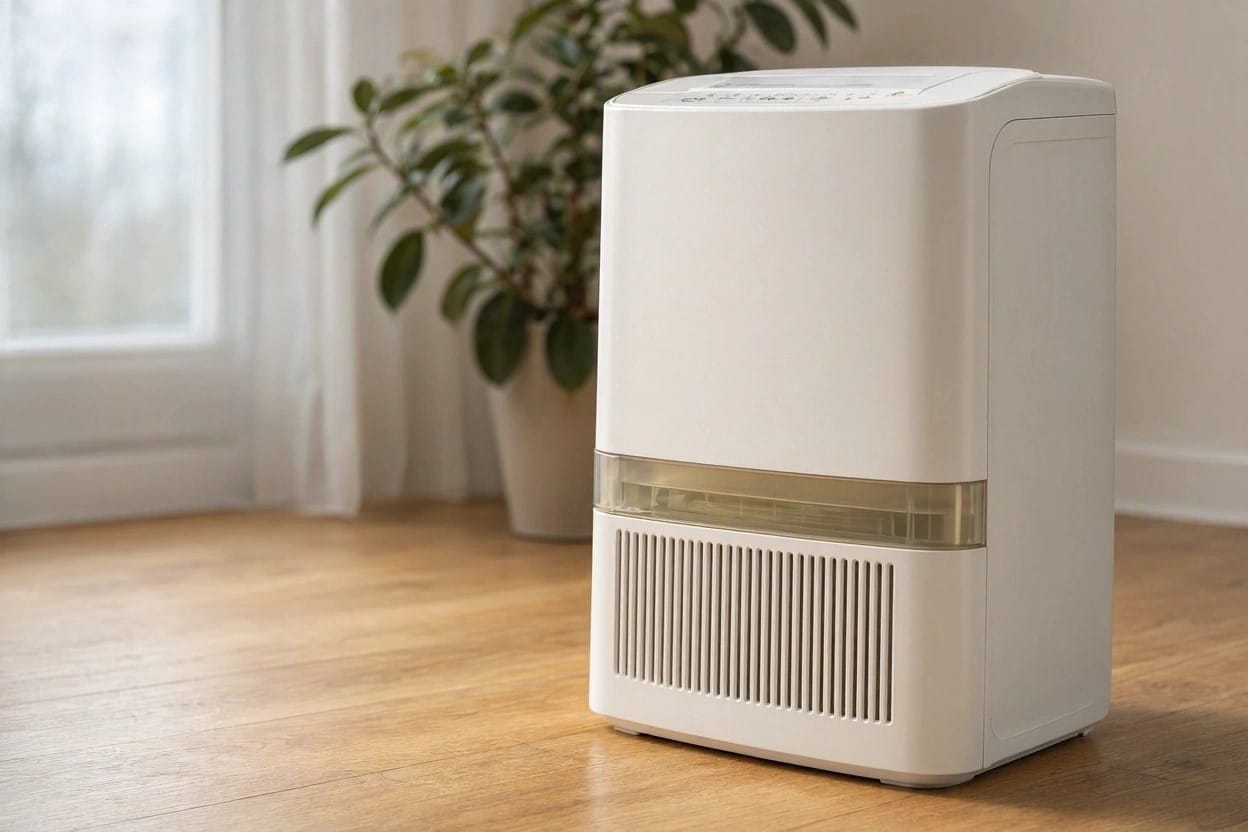
Ask ten dehumidifier owners whether their machine is noisy and you will get two completely different answers. Some will describe a faint background hum they genuinely forget about. Others will describe a compressor that rumbles like a small fridge and a fan that never lets up. Both are describing the same category of appliance.
The reason for the split is that dehumidifier noise depends on two things that vary enormously between models: the type of dehumidifier, and where you put it. Understand those two, and you can predict how loud any machine will be in your home before you buy it.
Why Dehumidifiers Make Noise At All
Three sources, and the first is the one that decides everything.
The compressor, if it has one. Most domestic dehumidifiers use the same mechanism as a fridge: a compressor that compresses refrigerant and cycles it through a coil. This is the dominant noise source, and it is a low-frequency rumble — the exact character of sound that travels through structure rather than air. The compressor also cycles on and off, so you get rumbling bursts rather than one continuous tone.
Because this noise is low frequency, it is the hardest to treat with conventional acoustic materials. That is the same physics we cover in how to block low frequency noise — deep tones pass through walls, floors and furniture rather than being absorbed by them.
The fan. A dehumidifier pulls a large volume of air across its coils and pushes it back out. That produces a continuous broadband rush — the same character as any air mover. It is usually the second loudest source and the easiest to live with, because steady broadband noise is much less irritating than a tonal hum.
As with any fan, size matters: to move a given volume of air, a small fan must spin faster than a large one, and faster fans are louder. That is why physically larger dehumidifiers often sound calmer than compact ones with similar ratings, and it is the same principle behind quiet bedroom fans.
Vibration transmitted into the floor. The compressor’s vibration passes through the machine’s feet into whatever it stands on. Set it on a suspended timber floor and the whole floor becomes a speaker — which is frequently why the machine sounds louder in the room below than in the room it is standing in. This is flanking noise in a domestic setting, and it is the single most overlooked cause of a dehumidifier complaint.
Compressor vs Desiccant: The Biggest Factor In Noise
If noise is your priority, this decision matters more than brand, price or rating.
| Type | Noise Character | Best For |
|---|---|---|
| Compressor (condenser) | Low-frequency rumble, cycling on and off. Clearly audible, and carries through structure. | Warm rooms and general home use. Most efficient above roughly 20 °C. |
| Desiccant | Steady fan-and-heater rush, no compressor thump. Typically perceived as less intrusive despite running continuously. | Cooler spaces — garages, cellars, conservatories. Works below 15 °C where compressors struggle. |
The trade-off is real: a desiccant unit trades a low rumble for a steady air rush, and most people find the second far easier to live and sleep beside. If you are buying specifically for a bedroom or a room above someone else’s, that is the choice that matters.
The noise gap between units is real and measurable. Consumer Reports tests every dehumidifier with a sound pressure meter and found the quietest models reach around 50 dB while the noisiest approach 70 dB — roughly as loud as a shower. Consumer Reports: Quietest Dehumidifiers
Note also that a desiccant dehumidifier adds a small amount of heat and consumes more power for the same extraction. That is the cost of the quieter mechanism.
How Many Decibels Is A Dehumidifier?
Domestic dehumidifiers generally sit somewhere in the region of the mid 30s to low 50s dB, measured at around one metre.
| Level | What It Sounds Like |
|---|---|
| Mid 30s dB | Noticeable but calm. Roughly a quiet conversation at a distance. |
| Low to mid 40s dB | Clearly audible in the room. Fine during the day, intrusive at night. |
| High 40s to low 50s dB | Loud for a domestic appliance. Comparable to a range hood on low. |
Two caveats worth holding onto. First, check the measurement distance — a figure quoted at one metre and one quoted at three metres are not comparable, and manufacturers often choose whichever flatters them. Second, the decibel rating is usually taken at one fan speed, often the quiet one. As with air purifiers, a single number does not tell you what the machine sounds like when it is working hard.
Compressor units typically present two distinct sources — a compressor hum in the region of 50 to 60 dB and a fan — while desiccant units have no compressor at all and run mostly on fan noise in the 35 to 50 dB range. Compressor vs Desiccant Dehumidifiers Compared
For scale, our guide to what a decibel is explains why the scale is logarithmic — a 10 dB rise sounds roughly twice as loud. And for the sleep threshold specifically, how many decibels is too loud for sleep sets the practical limit.
Can You Sleep With A Dehumidifier Running?
Yes, and many people do — but it requires choosing the right machine and placing it properly.
The priorities, in order:
- Choose desiccant over compressor for a bedroom. No cycling compressor rumble, and the steady fan rush is much easier to sleep beside.
- Buy larger than you need and run it lower. A bigger unit working gently is quieter than a small one straining, and it extracts the same water.
- Get it out of the bedroom entirely if you can. A dehumidifier in the hallway or landing with the bedroom door open does most of the work in the bedroom without any noise beside your bed. This is the single most effective solution available, and it costs nothing.
- Put it on a firm surface, not a suspended floor. A stone or concrete floor transmits far less vibration than timber boards.
- Give it clearance. Restricted intake and exhaust air makes the fan strain and the compressor run longer.
What Usually Does Not Work
- Putting it in a cupboard or a closed wardrobe. This is the most common mistake and the worst one. It blocks intake air, traps heat, forces the compressor to run almost continuously, and makes the machine considerably louder. It also risks overheating.
- Wrapping it in anything. A dehumidifier needs airflow to shed heat. Blankets, towels or acoustic covers trap it, and this is a genuine safety issue.
- Putting it on a sponge or a folded towel. Soft materials compress under load, letting the machine rock, and can increase transmitted vibration rather than reduce it. Isolation needs firm, dense material.
- Buying on the lowest decibel figure alone. That figure is usually the quiet mode, where extraction is least. You need the noise and the extraction rate at the same setting.
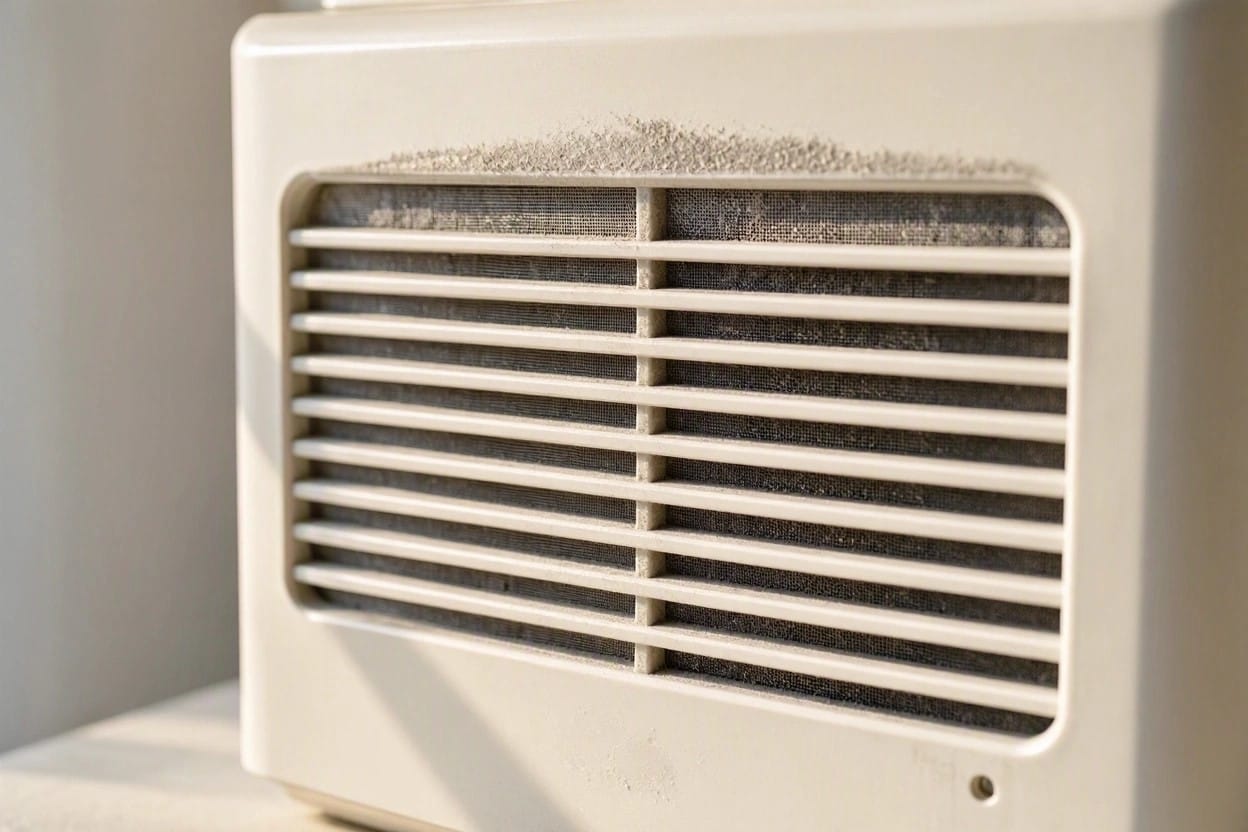
- Ignoring the filter. A clogged intake filter increases airflow resistance, so the fan has to work harder. A dehumidifier that has become louder over months is often simply due for a clean.
How To Make Yours Quieter
- Clean the intake filter. The most direct fix, and the most commonly skipped. Vacuum or wash it as the manufacturer specifies.
- Decouple it from the floor. Set it on a firm, dense anti-vibration pad or purpose-made isolators rated for the machine’s weight. If it sits on a suspended timber floor above a habitable room, this is the highest-value change you can make — see the 4 principles of soundproofing for why breaking the mechanical path works, and Green Glue soundproofing for the damping half of the equation.
- Increase the clearance. Give it the manufacturer’s space on all sides, and get it out of corners where intake air recirculates.
- Run it on a lower setting for longer. Continuous gentle running usually extracts more water over a day than short bursts on maximum, and it is far quieter.
- Check for rattles. Press gently on the casing while it runs. If the sound changes, you have found a loose panel or a filter cover that is vibrating.
- Move it further from your ears. Sound falls with distance in the ordinary way. Across the room is dramatically quieter than beside the bed.
- Mask what remains. A steady broadband sound raises the floor so the compressor hum stops pulling your attention. Pink or brown noise suits a low-frequency rumble better than white — see pink noise vs. white noise for which character fits which noise.
Buying For Quiet
The specifications that actually matter, in order of importance:
- Desiccant or compressor. The mechanism decides the character of everything you will hear.
- Noise at each speed, not a single figure. If only one number is given, assume it is the quiet mode.
- Extraction rate at the volume you can tolerate. Litres per day at 40 dB is a different proposition from litres per day at 50 dB.
- Physical size. Larger fans turn slower for the same airflow, which means less noise for the same drying.
- Auto-defrost and humidistat. Not acoustic features themselves, but a machine that senses when it has finished and switches off runs a great deal less than one cycling endlessly.
- Water tank size or continuous drain option. A larger tank or a hose drain means fewer trips to empty it, and less reason to site it awkwardly.
For specific models chosen on these criteria, our guide to quiet dehumidifiers covers the current options, including the desiccant units that suit bedrooms best.
The Honest Caveat
No dehumidifier is silent. It has to move air across a cold coil and, in most designs, run a compressor to make that coil cold — both produce sound, and neither can be engineered away entirely. What you can realistically achieve is a machine you can sleep beside, and for most people that means a desiccant unit, sized generously, running gently, and ideally standing outside the room.
One thing worth saying plainly: a dehumidifier that has become noticeably louder over weeks is usually telling you something is wrong — a clogged filter, a loose panel, a failing fan bearing, or a compressor on its way out. Diagnose that before you spend anything on acoustic treatment.
Frequently Asked Questions
Are Dehumidifiers Noisy?
They vary enormously, and the type of machine decides it. Compressor dehumidifiers produce a low-frequency rumble that cycles on and off and travels through floors and walls, which many people find intrusive. Desiccant dehumidifiers run continuously with a steady fan rush and no compressor thump, and are generally perceived as far easier to live and sleep beside.
How Many Decibels is a Dehumidifier?
Most domestic units fall somewhere between the mid 30s and low 50s dB, measured at around one metre. Always check the measurement distance before comparing models, because a rating taken further away represents a much quieter machine, and check whether the figure is quoted at the quiet setting or the loud one.
Can I Sleep With a Dehumidifier Running?
Yes, with the right machine and placement. A desiccant unit on a low setting is generally comfortable to sleep beside. Even better, site it in the hallway or landing with the bedroom door open — it will still reduce humidity in the bedroom while producing no noise next to your bed.
Which is Quieter, a Desiccant or Compressor Dehumidifier?
Desiccant is generally the quieter option for a bedroom, because it has no compressor cycling on and off and produces a steady air rush instead of a low rumble. Compressor units are more efficient in warm rooms, so the trade-off is noise and power consumption against running cost and performance at temperature.
Why is My Dehumidifier So Loud?
Common causes, in order: a clogged intake filter making the fan strain, the machine standing on a suspended timber floor and turning it into a speaker, a loose panel or filter cover vibrating, insufficient clearance around the intake, or a failing fan bearing or compressor. A machine that has got louder over weeks is usually signalling one of these rather than being inherently loud.
Can I Put My Dehumidifier in a Cupboard?
No. It restricts intake air and traps heat, which forces the compressor to run almost continuously — making the machine significantly louder and risking overheating. A dehumidifier needs clear airflow on all sides, generally at least the manufacturer’s stated clearance.
Does a Dehumidifier Get Louder Over Time?
It can, and the usual reason is a loaded intake filter. As the filter clogs, airflow resistance rises and the fan has to work harder to move the same air. Clean or replace the filter as the manufacturer specifies — this is the single most common cause of a dehumidifier that has become noisier than it used to be.

Ememobong is the lead researcher and editor at Quiet Dwelling. As a professional technical writer, he specializes in breaking down complex acoustic engineering concepts into simple, actionable steps. His goal is to help people build distraction-free environments for better sleep and deep work.