
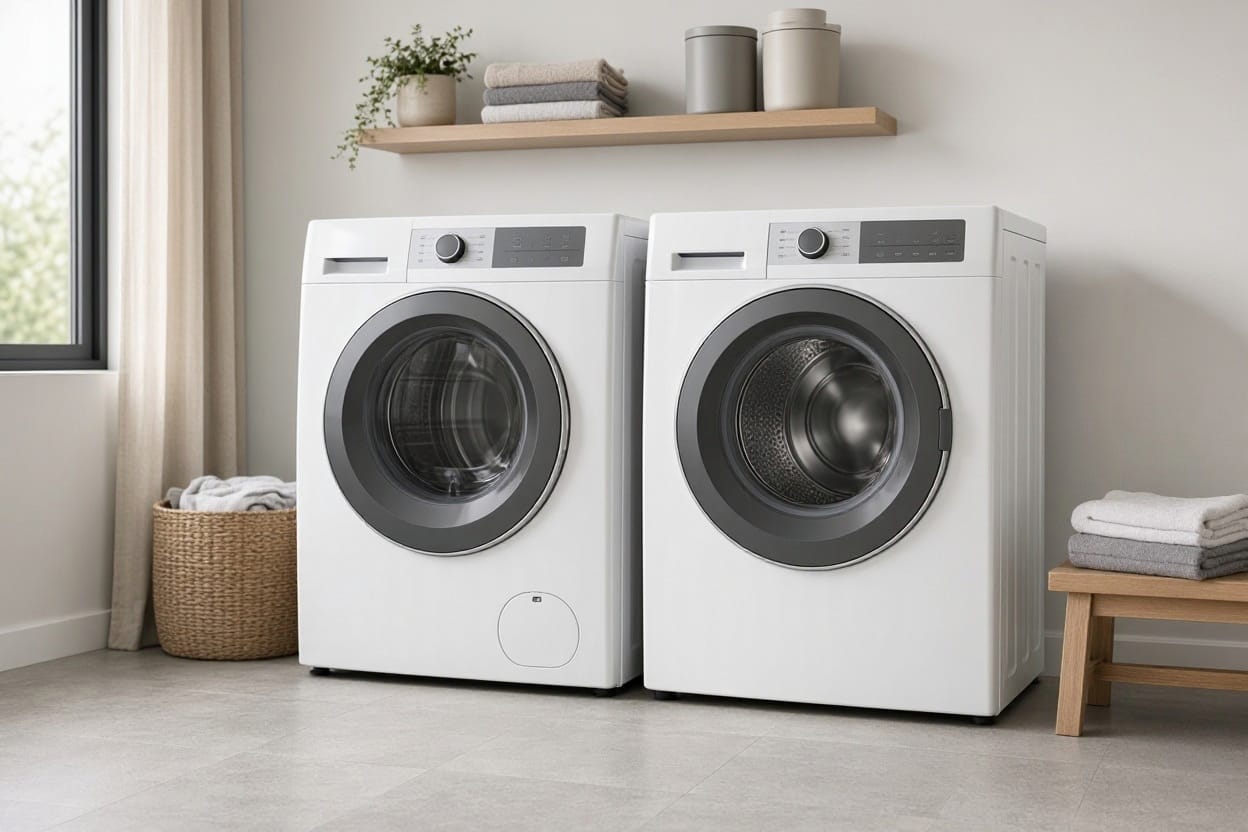
A tumble dryer is one of those appliances people buy without thinking much about noise, and then regret. The washing machine gets all the attention — the spin cycle, the shaking, the anti-vibration pads. The dryer sits quietly in the corner of the specification sheet, and then runs for two hours making a sound that follows you through the house.
The honest answer to whether they are loud is that it depends enormously on which type you buy, and the difference between the two main designs is bigger than most buyers realise. If noise matters to you, this is a decision worth making properly before purchase rather than trying to fix afterwards.
Why Dryers Make Noise At All
Three sources, and — unusually for appliances — the type of dryer decides which ones you get.
The drum and its bearings. A dryer rotates a large drum full of wet fabric, which is heavy and unbalanced by nature. The drum spins on bearings and is driven by a belt, and both contribute a continuous low rumble that changes character as the load tumbles.
The motor and belt. The drive motor produces its own hum, and the belt adds a faint whirring. On a well-maintained machine this is smooth and unremarkable.
The fan and airflow — and this is where the designs diverge. A dryer has to move a large volume of hot, damp air. How it does that determines the noise footprint, and it is the single biggest factor in what you will actually hear.
There is one more piece that matters acoustically and gets overlooked: the exhaust path. A vented dryer pushes air through a duct and often out through a wall. That duct is a rigid tube coupled to your building, and it will happily transmit vibration into the structure — the same mechanism we cover in what is flanking noise.
The Type Of Dryer Decides Almost Everything
| Type | Noise Character | Notes |
|---|---|---|
| Heat pump | Compressor hum plus fan, similar in character to a fridge. Generally the quietest type. | Also the most efficient. Runs cooler and longer, so the noise lasts longer per load. |
| Condenser | Fan and drum dominant, no compressor. Moderate noise, steady character. | No external duct, so no venting noise and no duct transmitting vibration outside. |
| Vented | Strong fan noise plus air rushing through a duct. Often the loudest. | The duct adds a second noise path into the building, and a long or kinked duct makes the fan work harder. |
The gap between dryer types is documented rather than anecdotal. A European Commission review study of household tumble dryers found the largest market share of heat pump models sits at a sound power level of 65 dB, while air-vented dryers are mostly measured above 66 dB or not declared at all. Review Study on Household Tumble Dryers, European Commission
The trade-off is worth being clear about. A heat pump dryer is the quietest type and the cheapest to run, but it dries at a lower temperature, which means longer cycles. You have swapped a shorter loud noise for a longer quiet one — which is usually the better trade for anyone who works from home or has a bedroom near the laundry, but it does mean the machine is running more of the day.
The compressor inside a heat pump dryer behaves acoustically like any other compressor: a low-frequency hum that travels through structure rather than air. That is the same physics as how to block low frequency noise — deep tones pass through floors and walls rather than being absorbed by them.
How Many Decibels Is A Tumble Dryer?
Domestic dryers generally sit somewhere between the mid 60s and low 70s dB, measured at around one metre — noticeably louder than a fridge or a dishwasher, and comparable to a normal conversation at close range.
| Level | What It Sounds Like |
|---|---|
| Mid 60s dB | Clearly audible throughout an open-plan home. Quietest end of the domestic range. |
| Low 70s dB | Loud enough to raise your voice over. Typical of vented machines under load. |
Acoustic research on heat pump dryers supports this: a study characterising a household heat pump tumble dryer identified the electric motor as a dominant internal source, and reduced overall sound power from 64.8 to 60.4 dBA by adding absorption near the motor and behind the rear cover — without affecting drying performance. Experimental Characterization of a Household Heat Pump Tumble Dryer Noise
Two caveats before you compare figures. First, check whether the rating was taken at one metre or three, because manufacturers quote whichever flatters the machine. Second, dryers vary their noise through the cycle — the start of a cycle with a heavy wet load is louder than the end. A single decibel figure describes the average, not the worst moment.
For calibration, our guide to what a decibel is explains why the scale is logarithmic — a 10 dB rise sounds roughly twice as loud, so the gap between a quiet heat pump dryer and a loud vented one is substantial rather than marginal.
What Usually Does Not Work
- Piling things on top of the dryer. A stacked washer-dryer needs the manufacturer’s stacking kit, and anything loose on top of a running appliance is a vibration risk and a safety one. Do not.
- Putting a soft mat underneath. Sponge, foam, a folded towel or a rug all compress under the weight, letting the machine rock and increasing transmitted vibration. Isolation needs firm, dense material rated for the load.
- Running a longer or kinked vent duct. This is the most common self-inflicted problem with a vented dryer. A long, crushed or lint-clogged duct increases airflow resistance, makes the fan work harder, and is a genuine fire risk as well as a noise one.
- Buying on the decibel rating alone. It tells you nothing about whether the drum is balanced, whether the machine sits level, or how much vibration reaches the floor — and those are what you actually notice.
- Overloading to finish faster. An overloaded drum is unbalanced, which produces more thumping and more vibration. Heavier and louder, not quicker.
How To Make Yours Quieter
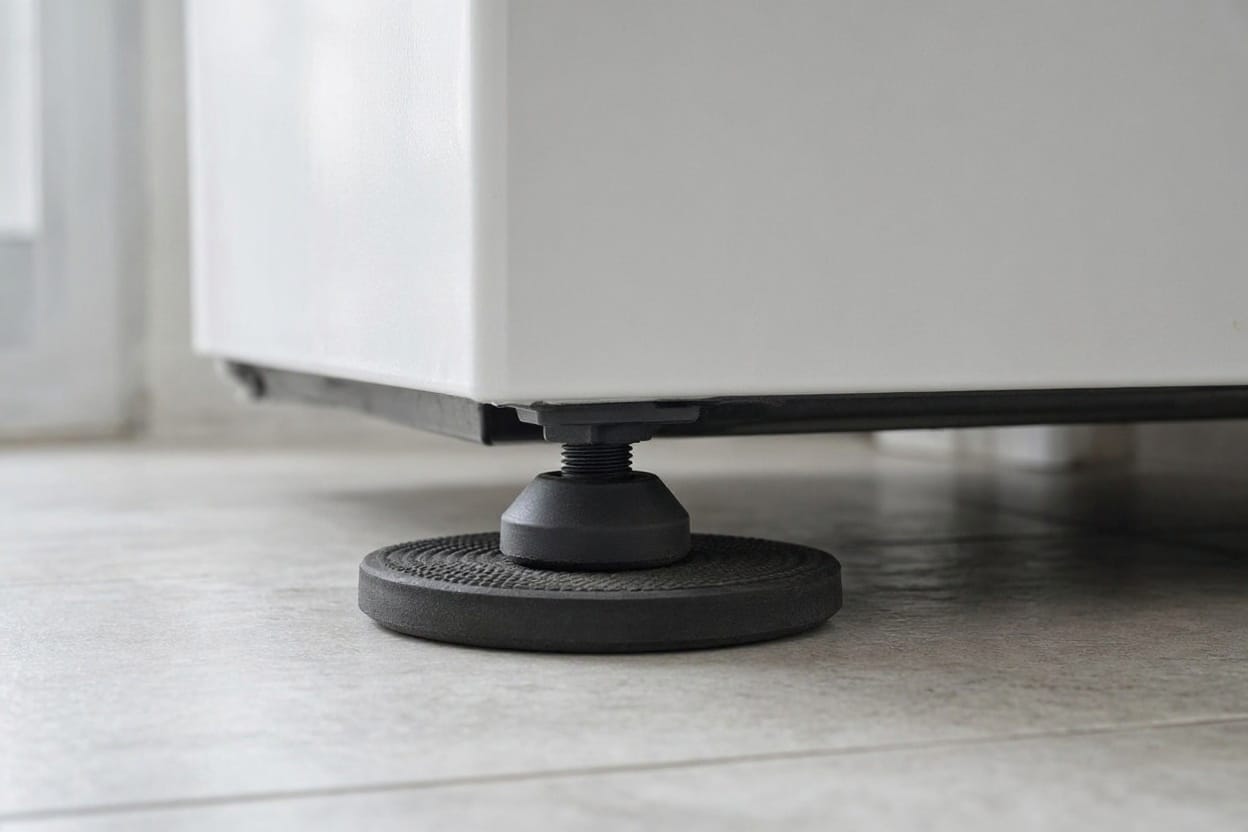
- Level the machine properly. A dryer that tilts rests unevenly on its feet, rocks slightly, and transmits more vibration. Use a spirit level on top and adjust the threaded feet until it sits firm with no movement.
- Give it the manufacturer’s clearance. Dryers need airflow around them. Pushing one tight into an alcove with no gap restricts ventilation and makes both the fan and the motor work harder.
- Decouple the feet from the floor. Firm, dense anti-vibration pads or purpose-made appliance isolators rated for the machine’s weight. This is the same fix as for a shaking washing machine — see how to stop a washing machine from shaking — and the underlying principle is explained in the 4 principles of soundproofing, with the damping half covered by Green Glue soundproofing.
- Check the vent duct if you have a vented model. Keep it short, straight, unobstructed and clean. Every kink and every gram of lint costs you airflow and adds noise. This matters more than any acoustic treatment you could apply.
- Load it sensibly. A balanced, moderately full drum tumbles more quietly than an overloaded or a very light one.
- Run it when it matters least. Free, and often the single most effective step. Drying overnight or while you are out removes the problem entirely rather than mitigating it.
Where You Put It Matters More Than What You Buy
A genuinely overlooked point: the same dryer is a nuisance in one home and a non-issue in another, and the difference is placement.
- Away from shared and bedroom walls. A dryer against a wall shared with a bedroom sends its vibration straight into that structure. Moving it to an internal wall, or a wall shared only with a hallway, often solves the problem for free.
- On a solid floor where possible. A concrete utility floor transmits far less than suspended timber boards, which behave like a drum.
- Not directly above a room you use. A dryer on the upper floor transmits through the joists into the ceiling below — the pathway we break down in what is flanking noise.
- Consider the door. A utility room door is often a hollow core panel doing nothing acoustically. Our guide to soundproofing a hollow core door covers what a solid replacement buys you.
If the dryer shares a wall with a room you sleep in, the practical fallback is masking rather than elimination. Pink or brown noise suits a low continuous rumble better than white — see pink noise vs. white noise for which character fits which noise — and a quiet bedroom fan does double duty if you want airflow too.
Buying A Quiet One
The specifications that actually matter, in order:
- Heat pump over vented, if noise is a priority and your budget stretches. Quieter, cheaper to run, and no duct to add a second noise path into the building.
- Noise figure with the measurement distance stated. A number without a distance is not a comparison.
- Drum balance and suspension design. Better suspension means less vibration reaching the floor, which is what you notice most in practice.
- Auto-sensing cycles. A dryer that stops when the load is dry runs less than one cycling on a fixed timer — less noise by simply running for less time.
- The realistic cycle length. Heat pump dryers take longer. Two hours of quiet can be better or worse than one hour of loud, depending on when you run it.
The Honest Caveat
A tumble dryer cannot be quiet in the way a fridge is quiet. It rotates a heavy drum of wet fabric and moves a large volume of hot air, and both produce sound for the full length of the cycle. What you can realistically achieve is a machine that does not intrude into the rest of the house — and in most cases that comes down to levelling, isolation, sensible loading, and running it when nobody is trying to sleep.
One thing worth saying plainly: if your dryer has become noticeably louder than it used to be, that is usually a mechanical signal rather than an acoustic one. A worn drum bearing, a stretched or slipping belt, a failing fan, or a lint-blocked duct all produce more noise — and a blocked duct is also a fire risk. Diagnose that before spending anything on sound treatment.
Frequently Asked Questions
Are Tumble Dryers Loud?
Generally yes, compared with most kitchen appliances — domestic dryers typically run in the mid 60s to low 70s decibels, which is louder than a fridge or dishwasher. But the type matters enormously: heat pump dryers are the quietest and vented dryers the loudest, and the gap between them is bigger than the gap between brands within a type.
Are Heat Pump Dryers Quieter than Vented Dryers?
Yes, and it is the most important noise decision in the category. A heat pump dryer has no exhaust duct and no high-velocity airflow pushed through a wall, so it avoids the fan roar and the duct-borne vibration that make vented dryers loud. The trade-off is a longer cycle, because heat pump dryers run at lower temperatures.
How Many Decibels is a Tumble Dryer?
Most domestic models fall between the mid 60s and low 70s dB at around one metre. Always check the measurement distance, because manufacturers quote whichever figure is more flattering, and remember that a dryer is louder at the start of a cycle with a heavy wet load than at the end.
Can I Put a Mat Under My Tumble Dryer to Reduce Noise?
Only a firm, dense anti-vibration pad or purpose-made appliance isolators rated for the machine’s weight. Soft materials — sponge, foam, a folded towel or a rug — compress under load, let the machine rock, and typically make transmitted vibration worse rather than better.
Why is My Tumble Dryer so Loud all of a Sudden?
An abrupt change usually means something mechanical. Likely causes are a worn drum bearing, a stretched or slipping belt, a failing fan, an unbalanced load in the drum, or a lint-blocked vent duct. The duct is worth checking first, because a blocked one restricts airflow and is a fire risk as well as a noise problem.
Does a Tumble Dryer Get Louder Over Time?
It can, and the usual reasons are mechanical wear and airflow restriction. Bearings and belts degrade, and vent ducts accumulate lint. A dryer that has gradually become noisier over months is usually signalling one of those rather than simply being a loud model.
Where Should I Put a Tumble Dryer so it Doesn’t Disturb Anyone?
Away from shared and bedroom walls, on a solid floor rather than suspended timber where possible, and not directly above a room you use. Placement matters more than model choice — the same dryer in an internal utility room is a non-issue and against a bedroom wall becomes a nuisance. Running it while you are out or asleep is the simplest solution of all.

Ememobong is the lead researcher and editor at Quiet Dwelling. As a professional technical writer, he specializes in breaking down complex acoustic engineering concepts into simple, actionable steps. His goal is to help people build distraction-free environments for better sleep and deep work.