
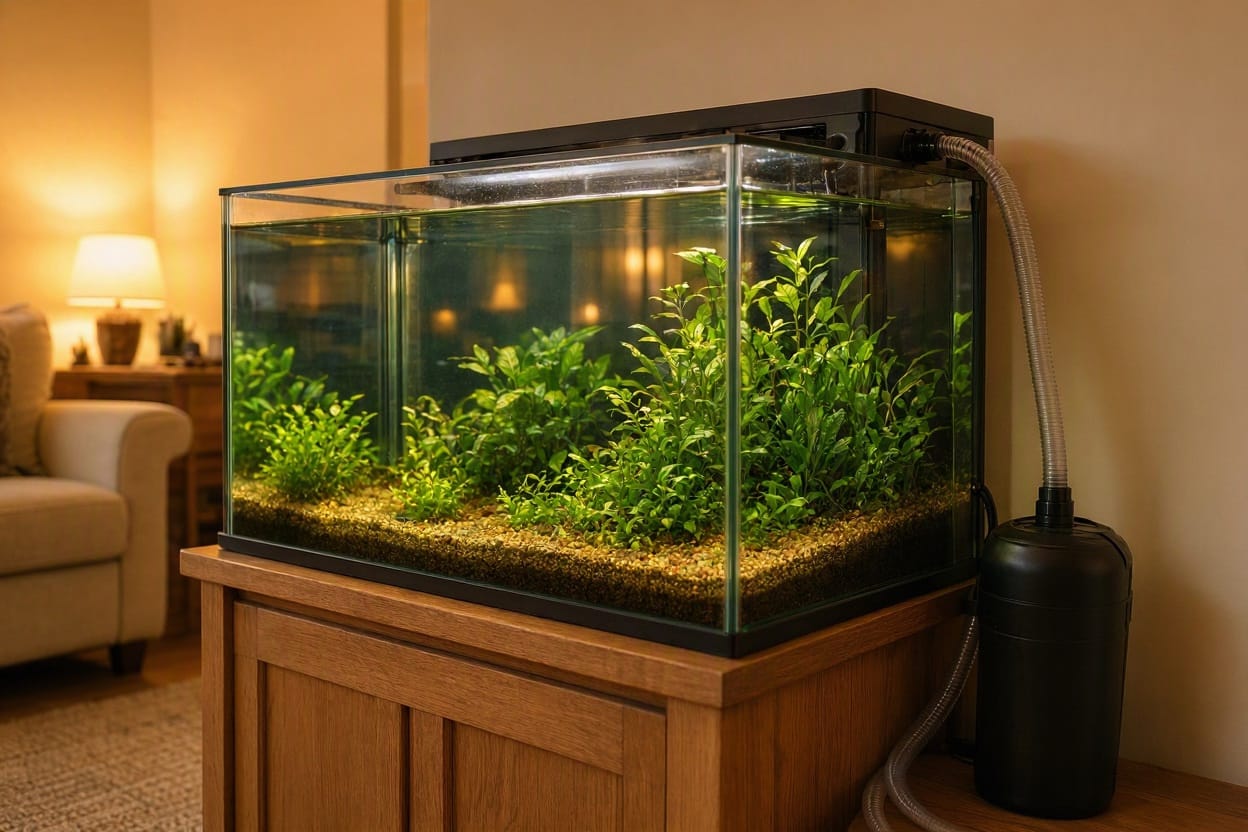
An aquarium is meant to be calming. That is half the reason people keep one — the gentle movement, the soft light, the idea of something quietly alive in the corner of a room. So there is a particular disappointment in discovering that the most soothing object in your home comes with a low, relentless hum that follows you to bed.
Almost every aquarium owner hits this eventually. The tank gets set up, the filter and air pump go on, and the sound is suddenly the loudest thing in the room. Then comes the frustrating part: you cannot switch it off overnight, because the living things inside depend on it running continuously.
That constraint is what makes aquarium noise a genuinely different problem from a noisy fridge or a rattling fan. You are not trying to stop the machine — you are trying to make an always-on system liveable. The good news is that almost all of it is solvable, and the biggest gains come from the same principle as every other noise problem in the home.
Why Aquariums Sound Louder Than the Equipment Suggests
Three things make a tank more intrusive than its individual components imply.
It runs 24 hours a day. A filter has to run continuously for the biological filtration inside it to survive. Air pumps, powerheads and heaters are the same story. There is no cycle you can wait out, and no window of an hour where it falls quiet. Continuous noise becomes background far more slowly than intermittent noise, which is why a tank is often more wearing than a louder appliance that switches off.
It combines several different sounds at once. A filter hum, an air pump buzz, the gurgle of returning water, the trickle of an overflow. Each is quiet on its own. Together they form a layered sound that is harder to ignore and much harder to mask, because no single masking tone covers all of them.
It couples into whatever it sits on. This is the dominant factor, and the one most owners never consider. The cabinet under the tank is usually a large, hollow, stiff panel construction — effectively a wooden drum. Vibration from the filter and pump travels into it and the whole cabinet radiates sound into the room. The equipment may be perfectly quiet; the furniture is doing the amplifying.
That mechanism is the same structure-borne pathway we cover in how to block low frequency noise — vibration travelling through solid material rather than through the air, which is why the noise can be louder in the room than right next to the tank.
There is a practical health reason to solve this rather than tolerate it — the World Health Organization identifies sleep disturbance as one of the established effects of chronic noise exposure, alongside cardiovascular and cognitive impacts. World Health Organization
The Sources Of Aquarium Noise, By Sound
Diagnose by ear. Each source has a different fix, and identifying yours saves both money and pointless purchases.
The steady hum — the filter motor
Canister and internal filters use a small electric impeller pump, and it produces a continuous low hum. This is the most common complaint and the source that responds best to isolation.
It is worth knowing that filter hum is often a cavitation or air-entrainment issue rather than a motor fault. Air trapped inside the canister, or a restricted intake, makes the impeller work against bubbles — which is much noisier than pumping water. That is why purging air from a canister filter can quiet it dramatically with no parts or money involved.
The buzz — the air pump
Air pumps are the classic aquarium noise nuisance, and they are usually the loudest single component. Inside is a diaphragm driven by an electromagnet vibrating rapidly — a design that inherently produces a buzzing, pulsing sound at mains frequency.
Air pumps are also extremely good at transmitting that vibration because they are small, light and rigid, and are often placed on hard surfaces or hung against a cabinet wall. They are normally the first thing worth isolating.
The rattle and chatter — a powerhead or impeller
A powerhead or wavemaker that rattles usually has debris in the impeller well, a worn impeller shaft, or a loose mounting. Unlike motor hum, this is a mechanical fault and is normally fixable by cleaning or replacing a small part.
The trickle, gurgle and splash — water, not machinery
Water returning to the tank, an overflow weir, or a filter outlet positioned above the water line all produce splashing and gurgling. This is entirely separate from machinery noise, and it is often the most annoying component because it is intermittent and constantly changing.
Many owners also find the gurgle is the hardest to mask, because it is broadband and unpredictable. If that behaviour is unfamiliar, our explainer on echo vs. reverberation covers how hard surfaces and enclosed spaces make water noise worse.
What Usually Does Not Work
- Turning the filter off at night. This is the single most damaging mistake. Your filter houses the beneficial bacteria that process fish waste. Switching it off stops the water flow and the oxygen supply to that bacteria, and repeated overnight shutdowns will crash your biological filtration and kill livestock. Never do this.
- Setting the pump on a sponge or a folded towel. Soft materials compress under load, let the equipment rock and shift, and often make vibration worse rather than better. Isolation needs a firm, dense material rated for the weight.
- Wrapping the air pump in fabric. This restricts its cooling airflow and is a genuine overheating and fire risk on a device running permanently. Do not.
- Piling books or foam on top of the cabinet. Mass on a resonant panel can damp certain frequencies, but it usually just shifts the problem and can compromise the cabinet’s structural safety. A tank of water is heavy — do not load the top of its support.
- Buying a “silent” air pump without isolating it. Air pumps are inherently buzzing devices. The quiet ones are quieter, but mounting remains the larger factor — a cheap pump on a proper isolation pad often beats an expensive pump sitting hard on a shelf.
The Best Order To Fix Aquarium Noise
Work down. The first three steps cost little and solve most bedroom-tank complaints.
Step 1 — Purge air and clear the intake
Free, and frequently dramatic. Air trapped in a canister filter, or an intake blocked by plant matter or a clogged sponge, makes the impeller cavitate — producing far more noise than normal operation.
- Tilt and rock a canister filter gently to release trapped air, then let it settle.
- Clean the intake strainer and pre-filter sponge.
- Check that the intake is not sucking air at the surface, which creates a constant stream of bubbles into the filter.
- Make sure the filter media is not packed so tightly that flow is restricted.
Do this first, every time, before spending anything.
Step 2 — Move the equipment off the cabinet
The highest-value structural fix, and the one that addresses the cabinet-as-drum problem directly.
Get the air pump off the furniture entirely. Hang it from a hook on the wall, or suspend it on a short loop of tubing so it hangs free in the air. An air pump that touches nothing rigid transmits almost nothing. This one change solves a surprising proportion of aquarium noise complaints outright, and it costs the price of a hook.
Move the canister filter to the floor if the cabinet has the space, or onto a separate solid surface rather than a resonant shelf.
Step 3 — Isolate what remains
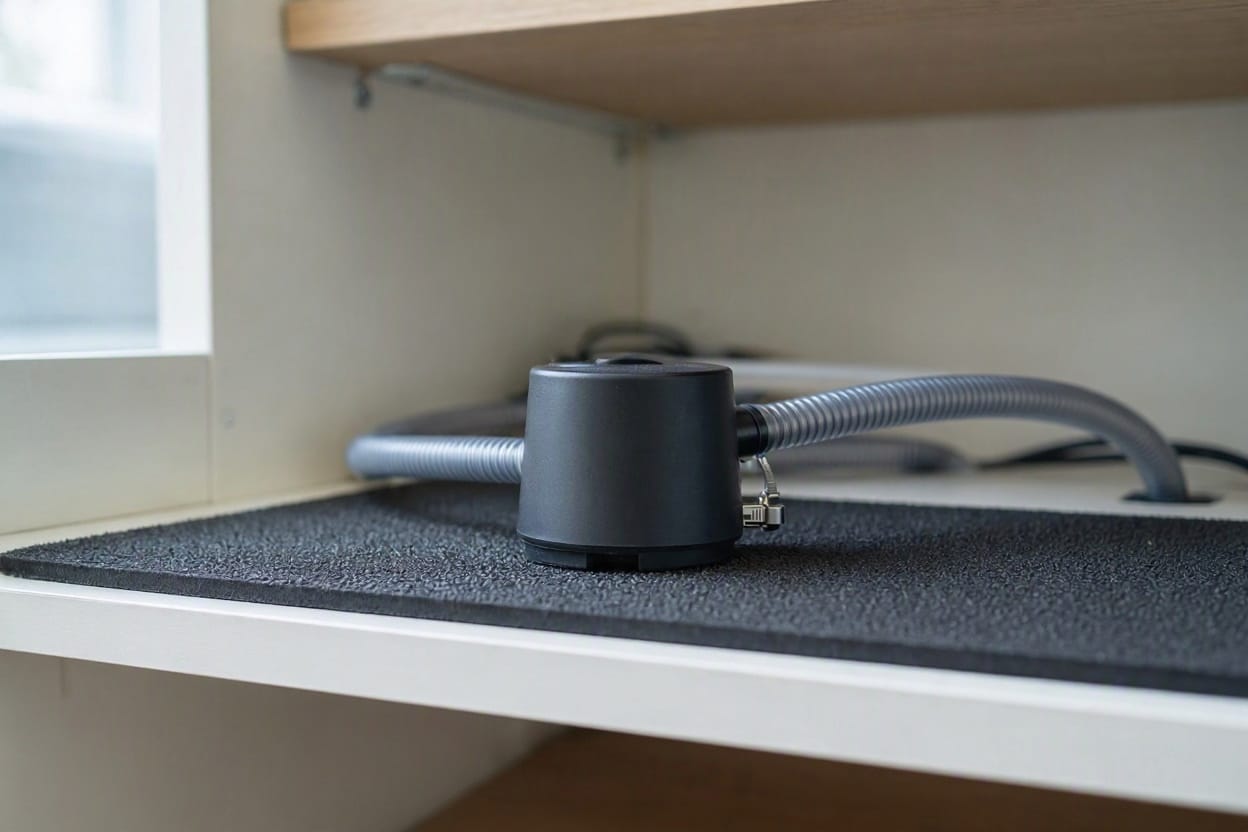
Where equipment must sit on a surface, put it on a firm, dense pad or purpose-made anti-vibration feet rated for its weight — dense rubber, not foam, not a folded towel.
The same principle governs every vibration problem in the home: break the mechanical path and the structure stops transmitting. Our explainer on the 4 principles of soundproofing covers how decoupling fits alongside mass and damping, and Green Glue soundproofing explains the damping half — converting vibration into a small amount of heat rather than letting it travel.
If you are isolating a filter inside a cabinet, check that flexible tubing runs from the filter without hard contact against the cabinet panels. A rigid hose pressed against a wooden side panel is a direct transmission path.
Step 4 — Deal with the water noise
Separate from the machinery, and often the last thing standing between you and a quiet room.
- Raise the water level. A filter outlet or return that splashes into the tank is a constant trickle. Bringing the water level closer to the outlet, or fitting an extension so it discharges below the surface, removes most of it.
- Reposition the outlet. Angle it so water returns quietly against the glass or a decor piece rather than falling through open air.
- Fit a pre-filter or a sponge over the overflow. Where a weir or overflow is gurgling, spreading the water over a wider surface rather than letting it fall in a column removes the gulping sound.
- Check the lid and hood. A loose lid vibrates and rattles, and a hard plastic hood under a light fixture can hum in sympathy with the filter.
Step 5 — Treat the cabinet
If the cabinet itself is radiating sound, damp it. Adding damping material to the inside faces of large flat panels reduces how much they resonate — the same viscoelastic principle used in walls. Ensure anything you add does not block ventilation around the filter, and does not sit where it can get wet.
A simpler version of the same idea: if the cabinet has doors, closing them genuinely helps contain the sound, provided the ventilation is adequate. Never seal a cabinet containing a filter that needs airflow.
Step 6 — Treat the room, and mask what remains
At this point you are managing residual noise rather than eliminating it. Surface area is your friend — soft furnishings, rugs, and textiles absorb the mid and high frequencies of water noise and trickle particularly well. This is the absorption side of the acoustic equation, and the distinction between absorption and blocking matters here: see soundproofing vs. sound absorption.
Masking is the final practical layer, and for a tank it works unusually well because the noise is steady. A gentle broadband sound raises the floor so your attention stops locking onto the hum — pink or brown noise generally suits a low motor hum better than white, as our comparison of pink noise vs. white noise explains. And if the tank is in a bedroom, a quiet bedroom fan does double duty: masking sound and air movement.
If You Are Setting Up A Tank In A Bedroom
Plan for noise before the water goes in, because the decisions that matter are all made at setup:
- Choose the filter type for your room. A canister filter placed inside a closed cabinet, or on the floor, is far quieter in practice than a hang-on-back filter churning at the water surface right beside your pillow.
- Prefer fewer air-driven devices. Air pumps are the loudest component class in the hobby. A setup that relies on filtration and circulation rather than air-driven ornaments and bubblers will be noticeably quieter.
- Consider a solid, heavy stand. A mass-loaded cabinet is harder to set into resonance than a hollow flat-pack unit. This is the same logic that makes a solid door quieter than a hollow one, which we explore in how to soundproof a hollow core door.
- Position it away from shared walls. A tank against a wall shared with another room sends its vibration into that structure. Distance and the right wall buy you real quiet, and the pathway is the same one we break down in what is flanking noise.
- Check the return path before filling. Set the filter running with the tank partly filled and listen from your bed. Finding a splash problem before the tank is stocked is far easier than fixing it afterwards.
The Honest Caveat
An aquarium cannot be silent. Water must move continuously, and biological filtration requires constant flow — that movement is the whole point of the system. What you can realistically achieve is a tank you stop noticing, and for most setups that comes down to getting the air pump off solid furniture and purging air from the filter.
One firm caveat worth repeating: if your filter or pump is making a grinding, screeching or chattering noise that it did not used to make, that is a mechanical fault. Clean the impeller and check the shaft. If it persists, replace the part — do not run a failing pump in a system your livestock depend on.
Frequently Asked Questions
Why is My Aquarium Filter So Loud?
Usually one of three things: air trapped inside the filter causing the impeller to cavitate, a restricted intake making the pump work harder, or vibration transmitting into the cabinet and being amplified by its panels. Purge the air and clean the intake first — it is free and frequently solves it. If it is still loud, isolate the filter from the furniture.
Can I Turn My Aquarium Filter Off at Night?
No. Your filter houses the beneficial bacteria that process fish waste, and those bacteria need a constant supply of oxygenated flowing water. Switching the filter off overnight starves them, and repeated cycles will crash your biological filtration and endanger your livestock. A filter must run continuously.
Why is My Air Pump So Noisy?
Air pumps work by vibrating a diaphragm electromagnetically, which inherently produces a pulsing buzz. They are also small, light and rigid, so they transmit vibration efficiently into whatever they touch. The single most effective fix is to get the pump off solid furniture altogether — hang it from a wall hook or suspend it on a loop of tubing so it touches nothing rigid.
How Do I Stop the Splashing and Gurgling Sound?
That is water noise rather than machinery, and it is usually fixable. Raise the water level so the outlet discharges below the surface, reposition the return so water flows quietly against glass or decor instead of falling through open air, and spread overflow water over a wider surface rather than letting it fall in a single column.
Can an Aquarium Be Kept in a Bedroom?
Yes, and many people do, but it needs planning. Choose a canister filter housed in a closed cabinet rather than a hang-on-back filter churning beside the bed, avoid air-driven ornaments and bubblers, place the tank away from shared walls, and purge air from the filter before you go to sleep. With those in place, most people find a lightly stocked tank inaudible overnight.
Is it Safe to Put the Filter on a Foam Pad?
No — use a firm, dense rubber pad or purpose-made anti-vibration feet rated for the weight. Foam and soft materials compress under load, allowing the filter to rock and shift, which typically increases vibration rather than reducing it. Isolation requires a material that stays firm under load.
Why Does My Filter Hum Louder in the Room than Next to the Tank?
Because it is structure-borne noise rather than airborne. Vibration from the filter travels through the cabinet panels and into the floor, and those large flat surfaces then radiate sound into the room. This is the same pathway that lets a washing machine be heard two floors away. Isolating the equipment from the furniture is the fix.

Ememobong is the lead researcher and editor at Quiet Dwelling. As a professional technical writer, he specializes in breaking down complex acoustic engineering concepts into simple, actionable steps. His goal is to help people build distraction-free environments for better sleep and deep work.