*This post contains affiliate links. If you use these links to buy something we may earn a commission at no extra cost to you.
If you live in a humid climate, have a damp basement, or struggle with condensation on your bedroom windows, a dehumidifier is not a luxury—it is a biological necessity. But trying to sleep in the same room as one is often an acoustic nightmare.
Most standard dehumidifiers are essentially giant, uninsulated refrigerators. When the built-in sensor detects too much moisture in the air, the machine kicks on with a violent, jarring CLUNK. For the next hour, a heavy metal compressor hums, rattles, and shakes its plastic casing, vibrating the floorboards until the room dries out. Just as you finally fall asleep, the cycle starts all over again.
According to the Environmental Protection Agency (EPA), indoor relative humidity must be kept between 30% and 50% to prevent the growth of toxic mold, dust mites, and mildew. You cannot simply turn the machine off at night, but you shouldn’t have to sacrifice your sleep to protect your lungs.
Thankfully, appliance technology has evolved. By moving away from cheap compressors and utilizing advanced desiccant and thermoelectric cooling, you can pull gallons of water out of your air in near-total silence. Here are the absolute best quiet dehumidifiers that will keep your home dry and peaceful.
The Science of Silence: Compressor vs. Desiccant vs. Peltier
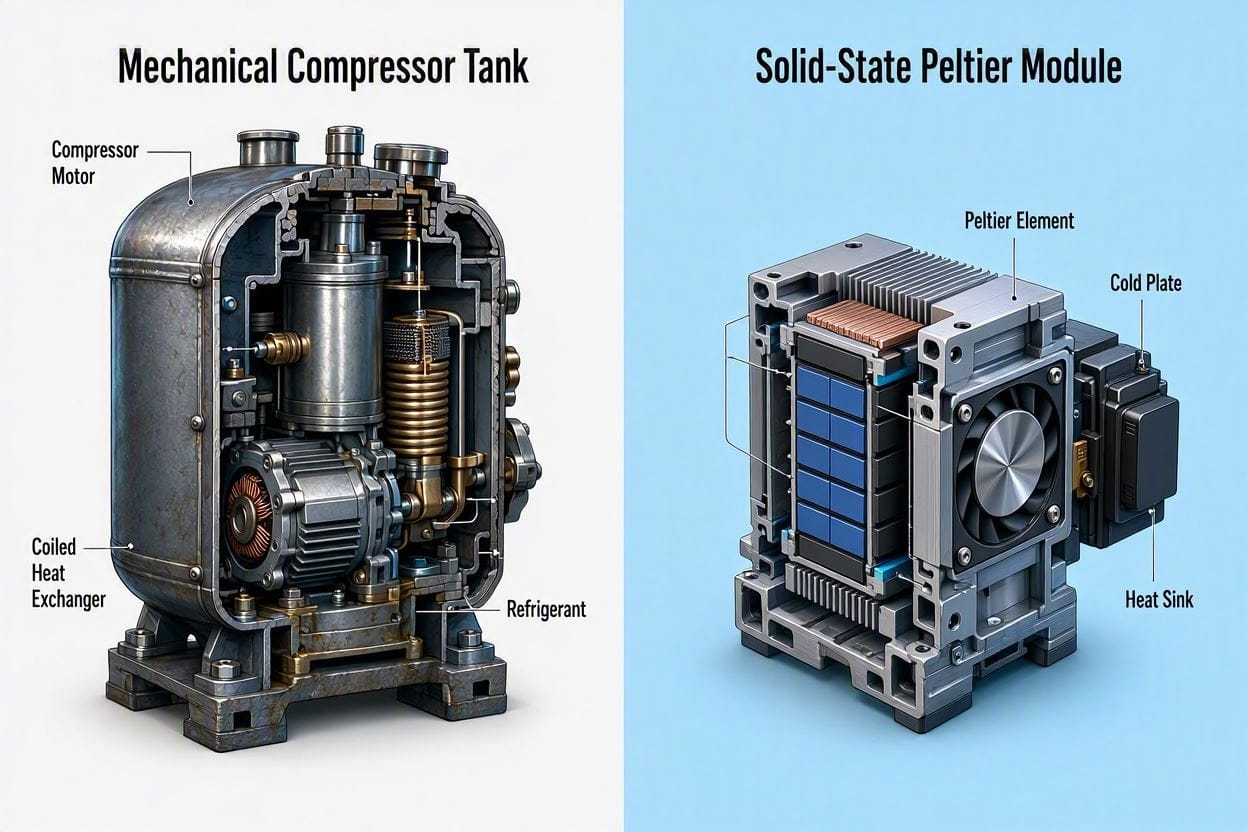
To buy a truly quiet dehumidifier, you have to understand how the machine extracts water from the air. There are three completely different types of technology on the market, and they sound drastically different.
1. Compressor Dehumidifiers (The Loudest)
This is the standard unit you buy at a hardware store. It uses a heavy, motorized pump to push chemical refrigerant through cooling coils. When warm, humid air hits the freezing coils, water condenses and drips into a bucket. Because there is a massive motor inside, they vibrate heavily and generate a loud mechanical buzzing (often exceeding 55 decibels).
2. Thermoelectric / Peltier (The Quietest)
Thermoelectric models do not have compressors. They use the “Peltier effect”—running electricity through two different types of metal to create a solid-state cold surface. Because there is absolutely zero mechanical pumping, there are no moving parts other than a tiny computer exhaust fan. They are whisper-silent, but they are only powerful enough to dry out very small spaces, like a single bedroom or a walk-in closet.
3. Desiccant Dehumidifiers (The Perfect Balance)
Desiccant machines use a rotating wheel filled with a moisture-absorbing material (like the little silica gel packets you find in new shoe boxes). A quiet fan blows air through the wheel, trapping the moisture, and a small internal heater releases the water into the bucket. There is no compressor, making them incredibly quiet. As a massive bonus, because they do not rely on freezing coils, they work flawlessly in freezing cold basements where standard compressor models ice over and fail.
1. Ivation 13-Pint Desiccant Dehumidifier (Best Overall)
If you want serious water extraction power without the violent shuddering of a traditional compressor, the Ivation Desiccant is an absolute masterpiece of acoustic engineering.
Because it uses a rotating silica wheel instead of a heavy refrigerant pump, the only noise you hear is the smooth, steady “whoosh” of the internal fan. On its lowest sleep setting, it operates at a barely perceptible 34 decibels. To understand how that translates to your sleep environment, you can reference our guide on safe decibel levels for bedrooms.
It also functions beautifully in the winter. Standard compressors freeze up if the room drops below 60 degrees. The Ivation uses internal heat to dry its wheel, meaning it happily pulls gallons of water out of cold, damp basements and drafty winter bedrooms.
The Pros
- No compressor = no loud clicking, rattling, or floor vibrations.
- Works flawlessly in cold temperatures (down to 33°F).
- Functions beautifully as a steady, soothing white noise machine.
The Cons
- The internal heater outputs warm air, which is great in winter but less ideal in a hot summer bedroom.
- Desiccant tech is generally more expensive upfront than cheap compressors.
2. Pro Breeze Electric Mini (Best for Small Bedrooms)
If you live in a small apartment, sleep in a compact master bedroom, or want to protect an enclosed closet from moldy clothing, you do not need an expensive desiccant machine. You need the Pro Breeze Mini.
This unit utilizes Peltier (thermoelectric) technology. Because there is no compressor and no rotating wheel, it is functionally solid-state. The only moving part is a tiny computer exhaust fan used to pull the air across the cold metal plate. The resulting sound is a whisper-soft, high-frequency hum that operates completely under 30 decibels.
It is incredibly small, energy-efficient, and practically invisible to your ears, making it the perfect nightstand companion for light sleepers.
The Pros
- The absolute quietest technology on the market (under 30 dB).
- Extremely compact; takes up almost no floor space.
- Highly affordable budget price point.
The Cons
- Only powerful enough for rooms up to 250 square feet.
- Takes much longer to extract a pint of water than a compressor model.
3. Midea Cube 50-Pint (Best Heavy Duty / Inverter Pick)
What if you have a massive, flooded 1,500-square-foot basement or a completely open-concept living space? A tiny Peltier unit won’t do anything. You are forced to buy a compressor unit for raw power. But you can still mitigate the noise.
The Midea Cube is a stroke of engineering genius. First, it utilizes the same Inverter technology we praised in our guide to quiet portable air conditioners. Instead of violently clicking on and off at 100% power, the motor hums continuously at variable, smoother speeds, keeping the decibel level down around 42 dB on low.
Second, the “Cube” design allows you to completely separate the motor head from the massive water bucket. The bucket can hold up to 3 times more water than standard models, meaning it requires far less maintenance while running in the background.
The Pros
- Inverter compressor is drastically smoother and quieter than cheap generic models.
- Massive 50-pint capacity can dry out entire basements.
- Smart app allows you to schedule it to run only when you aren’t home.
The Cons
- Because it is a 50-pint compressor, it is still louder than a desiccant or Peltier unit.
- The expandable bucket design can be slightly tricky to empty when completely full and heavy.
The Floor Hack: Stopping Impact Vibration
If you are forced to use a compressor dehumidifier and it sits on a hardwood floor, the plastic wheels and metal chassis are directly connected to your floor joists. Every vibration the motor creates transfers straight into the floorboards, turning your entire room into an acoustic amplifier.
This is known as Impact Noise. We cover the physics of this extensively in our master guide on Airborne vs. Impact Noise.
The 5-Minute Fix: You must apply structural decoupling. Buy a thick, heavy-duty vulcanized rubber mat (like the ones used for washing machines or heavy gym equipment). Place this mat underneath the dehumidifier. The dense rubber acts as a shock absorber, trapping the kinetic vibration before it ever reaches the hard wood. It will instantly silence the low-frequency rumble in your home.
Frequently Asked Questions (FAQ)
Do Dehumidifiers Cool the Room Down?
No, they actually do the opposite. Both compressor and desiccant dehumidifiers emit warm exhaust air as a byproduct of their moisture-extraction process. While they will slightly raise the actual temperature of the room by a degree or two, removing the sticky, suffocating humidity from the air makes the room feel significantly cooler and more comfortable to your skin.
Why Does My Dehumidifier Sound Like it Has Gravel Inside?
If your machine sounds like it is grinding rocks, you are experiencing ice buildup. If you run a standard compressor model in a room that is too cold (below 65°F), the condensation freezes on the internal coils before it can drip into the bucket. The fan then scrapes against the ice. You must turn the machine off, let it thaw, and switch to a Desiccant model for cold environments.
What is a Safe Humidity Level For a Bedroom?
For optimal sleep and respiratory health, the EPA recommends maintaining an indoor relative humidity between 30% and 50%. Anything over 60% drastically increases the risk of mold growth and dust mite proliferation, which can trigger severe asthma and allergies while you sleep.

Ememobong is the lead researcher and editor at Quiet Dwelling. As a professional technical writer, he specializes in breaking down complex acoustic engineering concepts into simple, actionable steps. His goal is to help people build distraction-free environments for better sleep and deep work.