*This post contains affiliate links. If you use these links to buy something we may earn a commission at no extra cost to you.
If you have ever used a standard “pancake” air compressor in your garage, you know the exact jump-scare I am talking about.
You are hunched over your workbench, deeply focused on measuring a cut or adjusting a tool. The garage is peaceful. Then, suddenly, the pressure drops and the compressor kicks on to refill the tank. It sounds like a jackhammer exploding inside a tin can. Your heart rate spikes, your ears start ringing, and anyone sleeping in the room above the garage is instantly jolted awake.
Garages are acoustic nightmares. They are essentially concrete and drywall echo chambers. When a standard 90-decibel air compressor fires up, the sound waves bounce violently off the hard walls, amplifying the auditory assault. For years, I just wore heavy earmuffs and accepted that DIY projects had to be deafening.
But tool engineering has completely changed. You no longer have to sacrifice your hearing (or your relationship with your neighbors) to use pneumatic tools. By utilizing larger, low-RPM motors, modern brands have dropped the decibel levels of compressors by over 30%. Here are the absolute best quiet air compressors that will let you work in total peace.
The Science of the Screech: High RPM vs. Low RPM
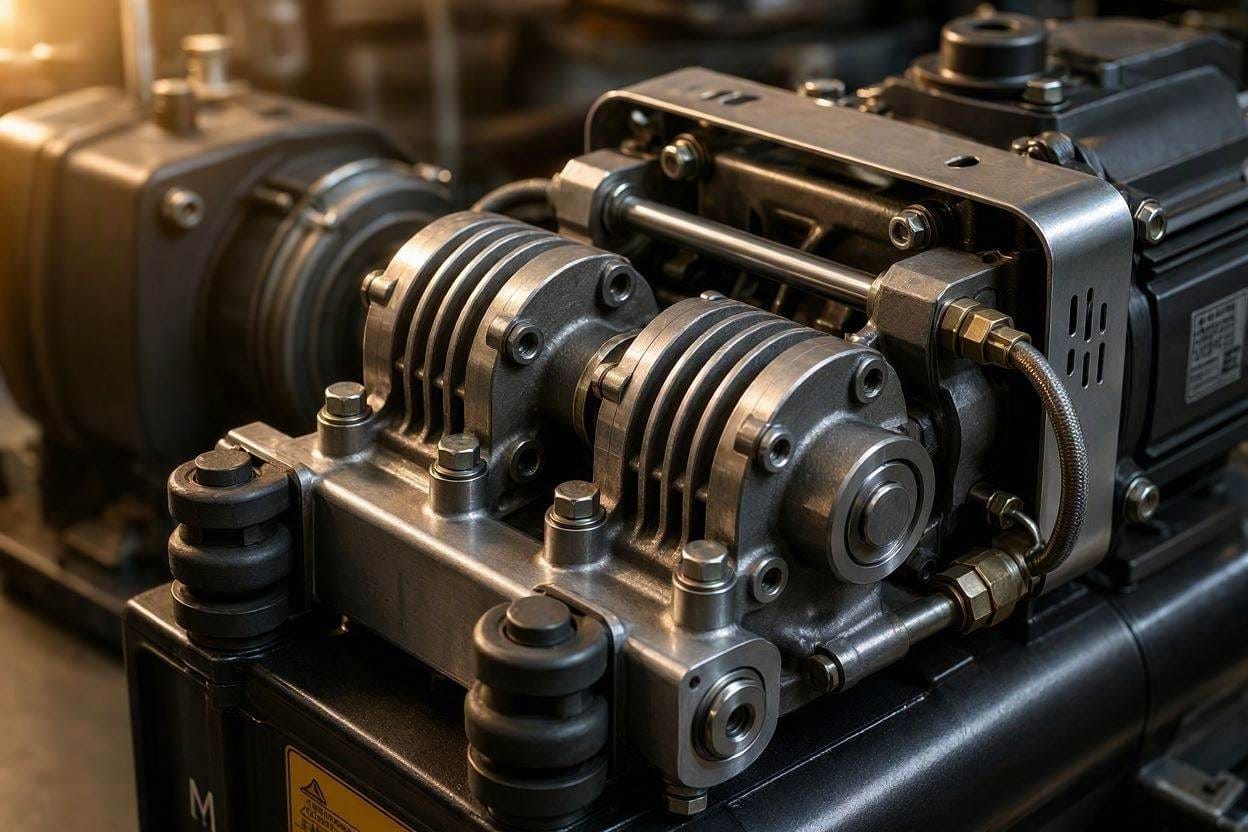
To understand why most air compressors are so loud, you have to look at the motor. Standard cheap compressors use what is called a “2-pole” motor. These motors are small, which means to pump enough air into the tank, they have to spin incredibly fast—usually around 3,400 RPM (Revolutions Per Minute).
Spinning a metal piston 3,400 times a minute creates massive mechanical friction and severe air turbulence. This results in a high-pitched, abrasive whine that easily registers at 90 decibels. According to occupational safety data from the CDC and NIOSH, prolonged exposure to 90 dB noise levels can cause permanent, irreversible hearing damage. As we explained in our guide to reading the decibel scale, you should never run machinery this loud in an enclosed space without heavy earmuffs.
The quiet compressors on this list solve this by using 4-pole, dual-piston motors. Because the motor has two pistons pumping air simultaneously, it only needs to spin at 1,750 RPM to achieve the same airflow.
Slower spinning means drastically less friction, less heat, and almost zero high-frequency whining. Instead of a screaming screech, these modern compressors produce a low, steady “chugging” hum (around 60 dB)—the volume of a normal human conversation.
1. California Air Tools 8010 (The Undisputed King)
If you ask any professional carpenter or serious DIYer what the quietest compressor is, they will instantly name California Air Tools (CAT). They practically invented the ultra-quiet category.
The 8010 model is an absolute masterpiece of acoustic engineering. It runs at exactly 60 decibels. I can stand two feet away from this compressor while it is filling the 8-gallon tank and hold a completely normal conversation without raising my voice.
Beyond the noise, the 8010 is oil-free, meaning you don’t have to deal with messy maintenance, and it performs beautifully in cold winter weather where oil-lubricated models usually choke and stall.
The Pros
- The gold standard for 60 dB whisper-quiet operation.
- Massive 8-gallon tank provides excellent run time before the motor kicks on.
- Oil-free dual-piston pump has a life cycle of 3000+ hours.
The Cons
- It is bulky. The vertical orientation makes it slightly top-heavy to wheel around.
- The air hose fittings are notoriously tight out of the box.
Check California Air Tools Price on Amazon
2. Makita MAC210Q Quiet Series (Premium Durability)
If you are a professional contractor or someone who tosses their tools into the back of a truck, California Air Tools might feel a bit delicate. You need job-site durability. Enter the Makita MAC210Q.
Makita built an absolute tank. It features a full roll-cage construction to protect the motor from being smashed by falling lumber. Despite the rugged build, Makita achieved a phenomenal 60 dB rating. It operates with a very low, throaty hum. It is a 2-gallon unit, making it the perfect “carry-in” compressor for indoor trim carpentry, framing, and baseboard work where you don’t want to deafen the homeowner.
The Pros
- Full roll-cage provides elite protection against drops and impacts.
- Incredibly low 60 dB noise output.
- Draws very low amps, so it won’t trip circuit breakers on older homes.
The Cons
- At 44 pounds, it is quite heavy for a small 2-gallon tank.
- Premium Makita price tag.
3. Stealth 1-Gallon Ultra Quiet (Best Budget/Portable)
If you just need a compressor to top off car tires, blow dust off your workbench, or run a 18-gauge brad nailer for small crafts, an 8-gallon unit is massive overkill. You need portability.
The Stealth 1-Gallon is a brilliant, highly affordable unit that looks like a briefcase. Because the tank is so small, it fills from 0 to 105 PSI in under 50 seconds. During those 50 seconds, it operates at a tested 59 decibels. It weighs less than 30 pounds and features a comfortable rubber carrying handle, meaning you can easily carry it around the house without pulling a muscle.
The Pros
- The quietest unit on the list (59 dB).
- Briefcase design and light weight makes it the ultimate portable unit.
- Highly affordable budget price point.
The Cons
- 1-Gallon tank empties extremely fast; the motor will cycle on frequently.
- Not enough CFM to run continuous tools like paint sprayers or sanders.
The Acoustic Floor Hack: Stopping Impact Vibration
Buying a 60 dB compressor solves the problem of airborne noise. The whine is gone. But if you put your new compressor directly onto a concrete garage floor or a wooden subfloor, you will still hear a deep, rumbling noise echoing through your house.
This is caused by Impact Noise. The heavy mechanical vibration of the pumping pistons transfers directly into the floorboards. The floor turns into a booming acoustic amplifier, telegraphing the bass vibration straight into the joists of your house. We explain the physics of this in our guide on Airborne vs. Impact Noise.
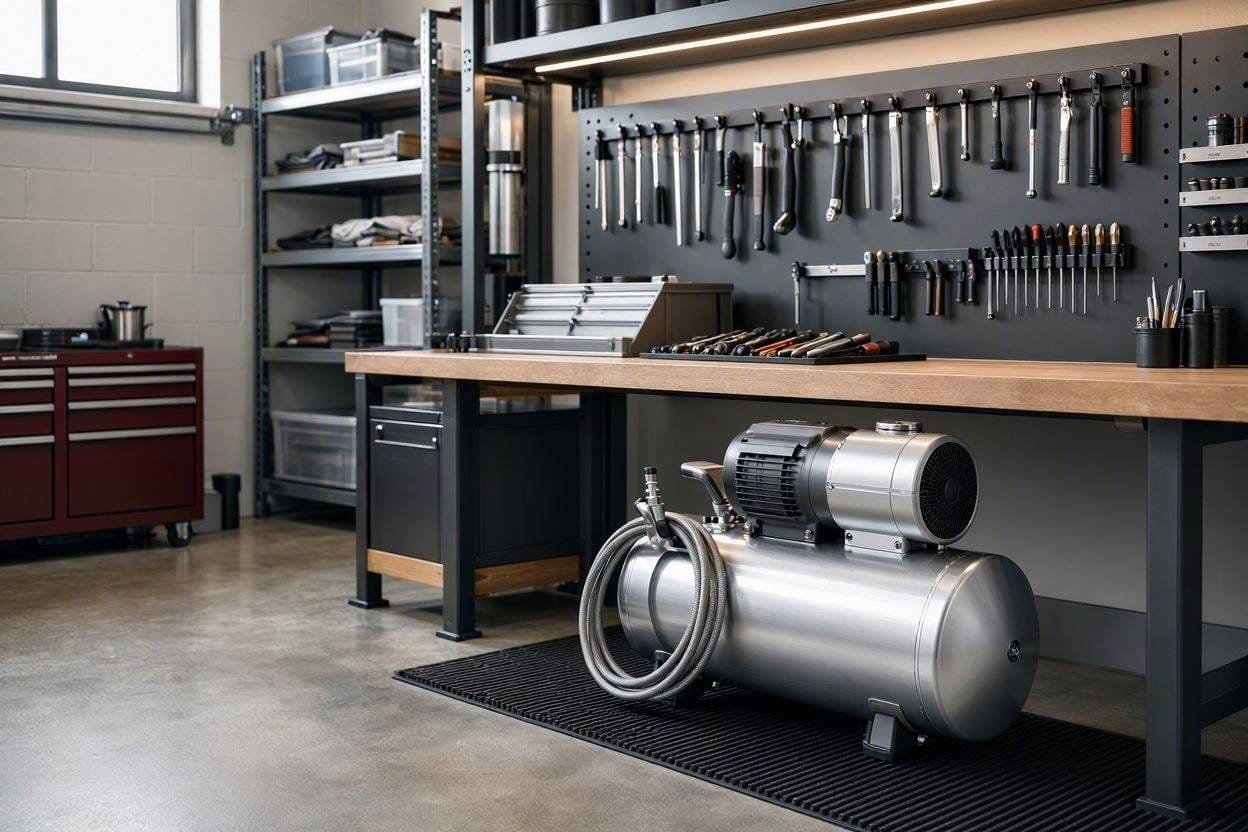
The 5-Minute Fix: You must decouple the compressor from the floor. Buy a thick, high-density vulcanized rubber mat (like the ones used in horse stalls or heavy gym equipment). Place this mat underneath the compressor. The dense rubber acts as a shock absorber, trapping the kinetic vibration before it ever reaches the floor. It instantly silences the low-frequency rumble in your home.
Complete Your Quiet Garage: A quiet compressor is a great start, but if your garage door still wakes the whole house up when it opens, check out our guide to the best quiet garage door openers to build the ultimate stealth workshop!
Frequently Asked Questions (FAQ)
Do Oil-Free Compressors Last as Long as Oiled Ones?
Historically, oil-lubricated compressors lasted much longer because the oil prevented the metal pistons from overheating and wearing down. However, modern ultra-quiet compressors use dual-piston systems coated with Teflon rings. Because they run at half the speed (1,750 RPM), they don’t generate the destructive heat of older models. A high-quality oil-free pump like California Air Tools is rated to last over 3,000 continuous hours before needing a rebuild.
Can a Quiet Compressor Run a Paint Sprayer or a Sander?
Noise level has nothing to do with power, but tank size does. Continuous tools (like paint sprayers, DA sanders, and grinders) require a massive, continuous volume of air (CFM). The 8-Gallon California Air Tools unit can run small HVLP sprayers for short bursts, but if you intend to sand or paint an entire car, you will need to upgrade to a massive 20+ gallon quiet compressor so the tank doesn’t run dry.
Can I Build a Soundproof Box to Put My Old Compressor Inside?
You can, but it is highly dangerous if not done correctly. Air compressors require massive amounts of cool intake air to prevent the motor from melting. If you build a sealed MDF “hush box” without installing heavy-duty exhaust and intake fans, the compressor will overheat, blow the thermal fuse, and potentially catch fire. Buying a factory-quiet unit is significantly safer.

Ememobong is the lead researcher and editor at Quiet Dwelling. As a professional technical writer, he specializes in breaking down complex acoustic engineering concepts into simple, actionable steps. His goal is to help people build distraction-free environments for better sleep and deep work.