*This post contains affiliate links. If you use these links to buy something we may earn a commission at no extra cost to you.
I see it happen in home renovations all the time. A homeowner decides they are finally going to silence their shared apartment wall or build a quiet home theater. They spend a fortune on materials. They break their back carrying 70-pound sheets of 5/8-inch drywall, applying viscoelastic damping compound, and hanging heavy mass loaded vinyl.
They finish the room, turn on a movie next door to test it out, and their heart sinks. They can still hear the dialogue perfectly.
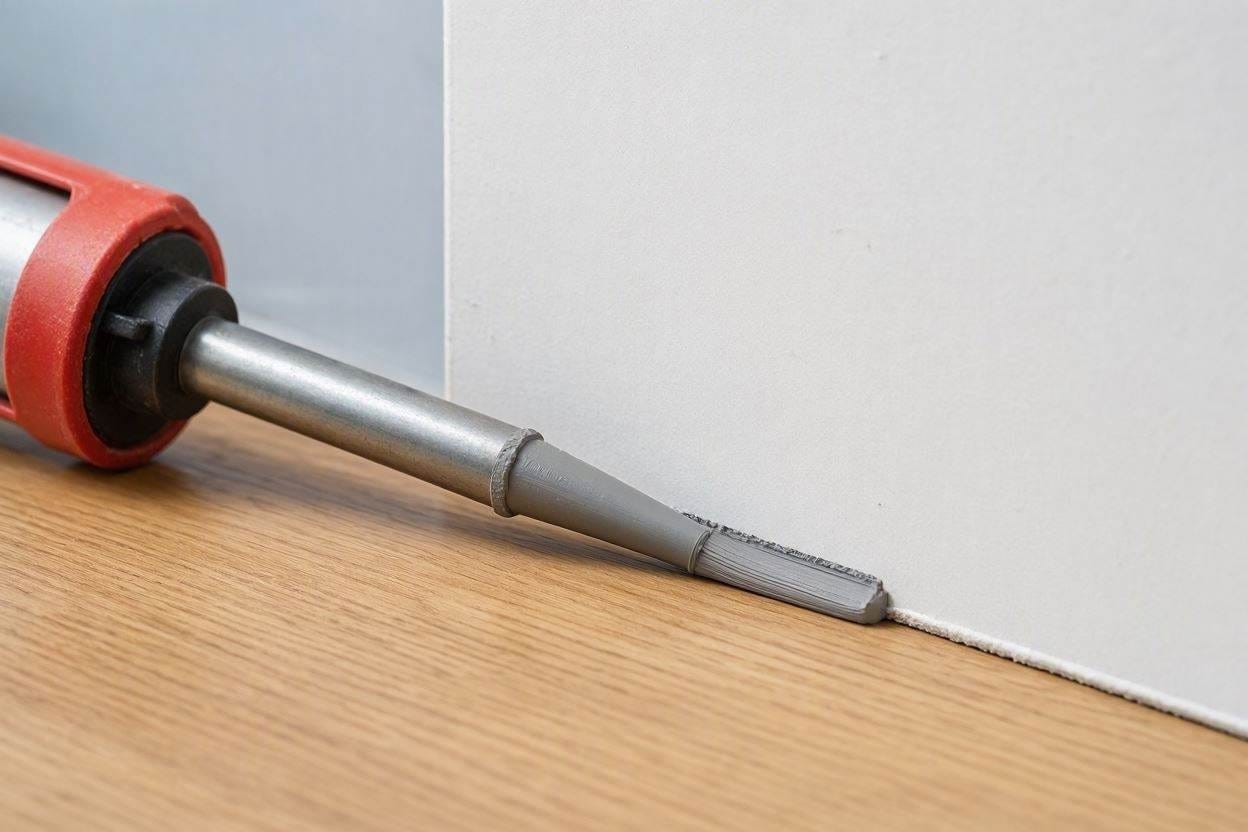
Why did it fail? Because they left a 1/4-inch unsealed gap where the drywall meets the floor, and covered it up with a decorative wooden baseboard. In the world of acoustics, a solid piece of wood trim does absolutely nothing to stop an airborne sound wave. The noise simply flowed under the baseboard, through the gap, and ruined thousands of dollars worth of construction.
The unsung hero of every single successful soundproofing project is a $10 tube of acoustic caulk (also known as acoustical sealant). In this guide, I will skip the marketing hype and show you exactly why standard painter’s caulk will ruin your walls, the physics of acoustic air leaks, and the exact sealants professionals use to make a room dead-quiet.
⏱️ The Quick Verdict
- The Overall Best: Green Glue Noiseproofing Sealant. The undisputed industry standard. It stays permanently flexible, paints easily, and stops sound leaks dead in their tracks.
- The Best Budget/Contractor Pick: OSI SC175 Draft & Acoustical Sound Sealant. Highly affordable if you need to buy it by the case for a massive, multi-room project.
- The Premium Studio Pick: Auralex Acoustics StopGap. Used in high-end recording studios to achieve maximum STC ratings in heavily decoupled walls.
1. The Overall Best: Green Glue Noiseproofing Sealant
Just to clear up a very common point of confusion: Green Glue makes two completely different products. They make the famous Damping Compound (which goes *between* sheets of drywall), and they make this Noiseproofing Sealant (which goes *around the edges* of the drywall). You need both.
The Green Glue Sealant is my top pick because of its incredible lifespan. Standard caulks dry out, get brittle, and eventually crack as your house expands and contracts with summer humidity and winter cold. Once a crack forms, sound leaks through. Green Glue sealant is formulated to remain highly rubbery and flexible for decades, ensuring your acoustic seal never snaps.
Pros
- Stays permanently flexible; will never dry out and crack.
- Can be painted over after 48 hours without peeling.
- Cleans up easily with soap and water while wet.
Cons
- Takes 48 hours to fully cure (longer than standard caulk).
- Slightly more expensive per tube than generic hardware store brands.
Green Glue Noiseproofing Sealant
The industry standard for sealing the perimeter of soundproof walls. Remains permanently flexible to prevent acoustic leaks as building materials settle.
2. The Best Bulk Value: OSI SC175 Draft & Acoustical Sealant
If you are building out an entire basement or a multi-room recording studio, buying single tubes of premium sealant will quickly drain your budget. You need to buy by the case. The OSI SC175 is the commercial contractor’s weapon of choice.
It is specifically engineered to meet strict ASTM C919 standards for use in acoustical applications. While it is heavily used to stop cold air drafts, its dense rubbery composition actively disrupts high-frequency sound waves trying to sneak under wall plates. It guns incredibly smoothly and bonds fiercely to drywall, wood studs, and concrete.
Pros
- Highly affordable for large-scale drywall projects.
- Meets official ASTM testing standards for acoustic seals.
- Excellent adhesion to porous concrete floors.
Cons
- Can be messy if you are an inexperienced caulker.
- Shrinks slightly more during the curing process than Green Glue.
OSI SC175 Draft & Acoustical Sealant
The professional contractor’s choice for bulk applications. Forms a tough, flexible seal that prevents airborne noise from diffracting through baseboard and ceiling gaps.
3. The Premium Pick: Auralex Acoustics StopGap
Auralex is a legendary brand in the professional audio and recording studio industry. StopGap is their proprietary acoustic sealant designed specifically to maximize STC (Sound Transmission Class) ratings in critical listening environments.
What makes StopGap exceptional is its density. It is highly viscous, meaning it won’t drip or run when you are trying to seal an awkward overhead gap at the ceiling junction. It is also designed to be completely non-hardening, ensuring that even if the foundation of the house shifts over the years, the seal stretching between the drywall and the floor joists remains perfectly intact.
Pros
- Studio-grade density explicitly formulated for high STC walls.
- Highly viscous; very easy to apply cleanly without dripping.
- Dries in a paintable, slightly off-white color.
Cons
- The most expensive option per ounce.
- Often sold out or hard to find outside of specialty audio retailers.
Auralex Acoustics StopGap
The premium choice for vocal booths, home theaters, and recording studios. Highly viscous and non-hardening to ensure a lifetime of perfect acoustic isolation.
The Science: The 1% Rule of Acoustic Leaks
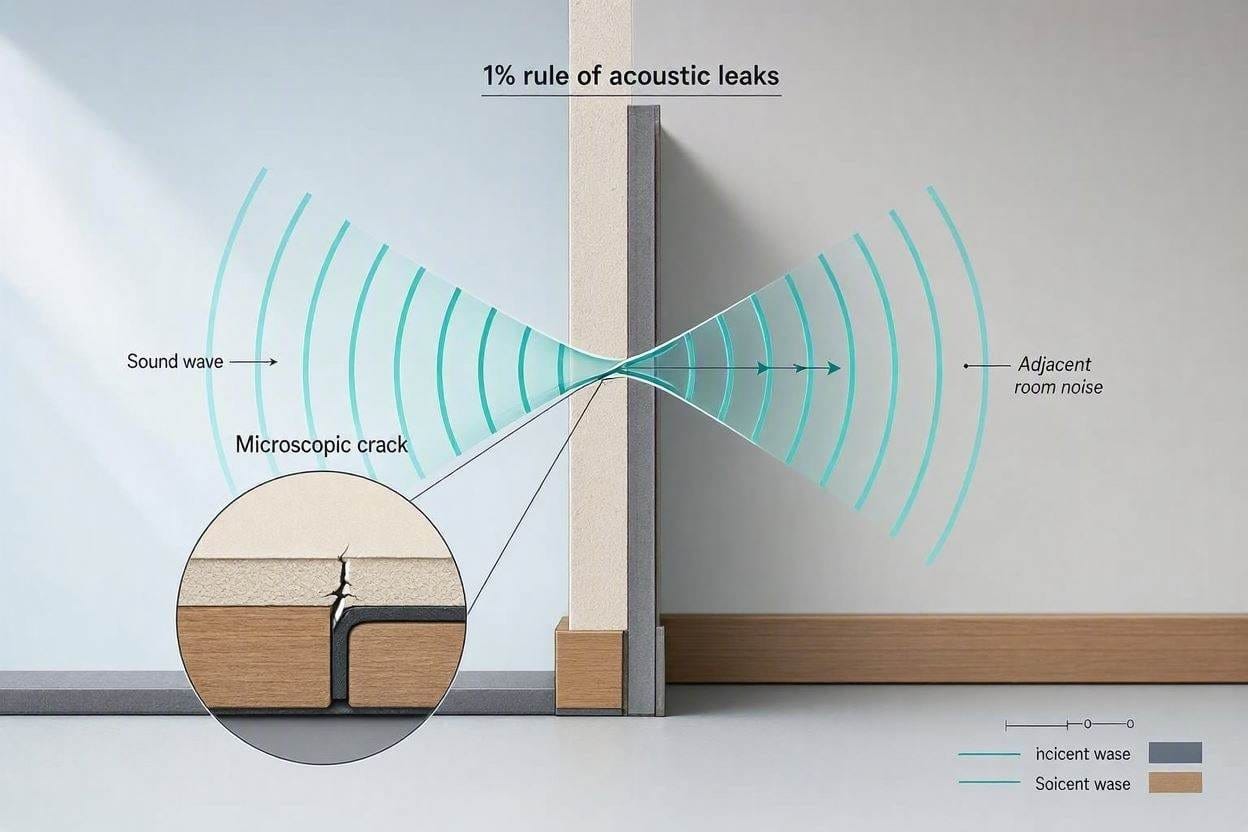
Why is caulking so important? It comes down to a principle of wave physics known as acoustic diffraction. According to researchers at the Acoustical Society of America, airborne sound waves behave exactly like water. They are pressurized waves of energy. If water can leak through a crack, sound can leak through it.
In the soundproofing industry, this is known as the 1% Rule. If your wall is built perfectly but has an open air gap that equals just 1% of the total surface area (like an unsealed 1/4-inch gap running along the floorboards), that tiny crack will allow up to 50% of the airborne sound to pass through. The kinetic energy squeezes through the gap and immediately expands to fill your room with noise. This phenomenon is known as flanking noise transmission.
How to Apply It: The Backer Rod Trick
Applying acoustic caulk is slightly different than applying bathroom silicone. To ensure your seal actually works, follow these professional rules:
- Leave a Gap: When hanging your drywall, do not let it touch the floor, the ceiling, or the adjacent walls. Always leave a 1/4-inch gap around the entire perimeter. If the drywall touches the floor, structural impact vibrations will travel right up into the wall. You must leave a gap, and fill that gap with caulk.
- Use Backer Rods for Deep Gaps: If you accidentally left a gap larger than 3/8 of an inch, do not just pump an entire tube of caulk into the hole. It will never cure properly. Instead, buy a cheap foam “backer rod” (a thin foam rope) from the hardware store, stuff it into the gap, and apply a 1/4-inch bead of acoustic caulk over the top of the foam.
- Seal the Electrical Boxes: Do not just caulk the floor. Take off your outlet covers and apply a heavy bead of acoustic caulk around the perimeter of every electrical box where the plastic meets the drywall. Outlet holes are massive acoustic leaks!
Who this is NOT for
Acoustic caulk is magic for airborne noise (like voices, TVs, and dogs barking). However, if your goal is to stop the heavy thud-thud-thud of an upstairs neighbor walking in heavy boots, a tube of caulk will not save you. That is impact noise, which travels directly through the structural wood framing of the house. To stop footsteps, you need heavy structural decoupling (like resilient channels), not just a sealed air gap.
Frequently Asked Questions (FAQ)
Can I Just Use 100% Silicone Instead of Acoustic Caulk?
Technically, yes, 100% silicone does remain flexible and forms an airtight seal. However, pure silicone cannot be painted. If you use it on your walls or baseboards, the paint will bead up and flake right off. Acoustic sealants are specifically formulated to remain rubbery *and* accept standard latex interior paint.
Can I Use Acoustic Caulk to Stick Acoustic Foam to My Walls?
No! This is a very common mistake. Acoustic caulk is incredibly dense, heavy, and takes a long time to cure. It is not an adhesive. If you use it to hang acoustic foam panels, they will slide right down your wall. You must use spray adhesive or double-sided mounting tape for lightweight foam.
Does Acoustic Caulk Smell Bad?
Most premium brands (like Green Glue and OSI) are low-VOC and water-based, meaning they have a very mild, non-offensive odor during application that dissipates completely once cured. They are perfectly safe to use indoors without heavy respirators.

Ememobong is the lead researcher and editor at Quiet Dwelling. As a professional technical writer, he specializes in breaking down complex acoustic engineering concepts into simple, actionable steps. His goal is to help people build distraction-free environments for better sleep and deep work.