
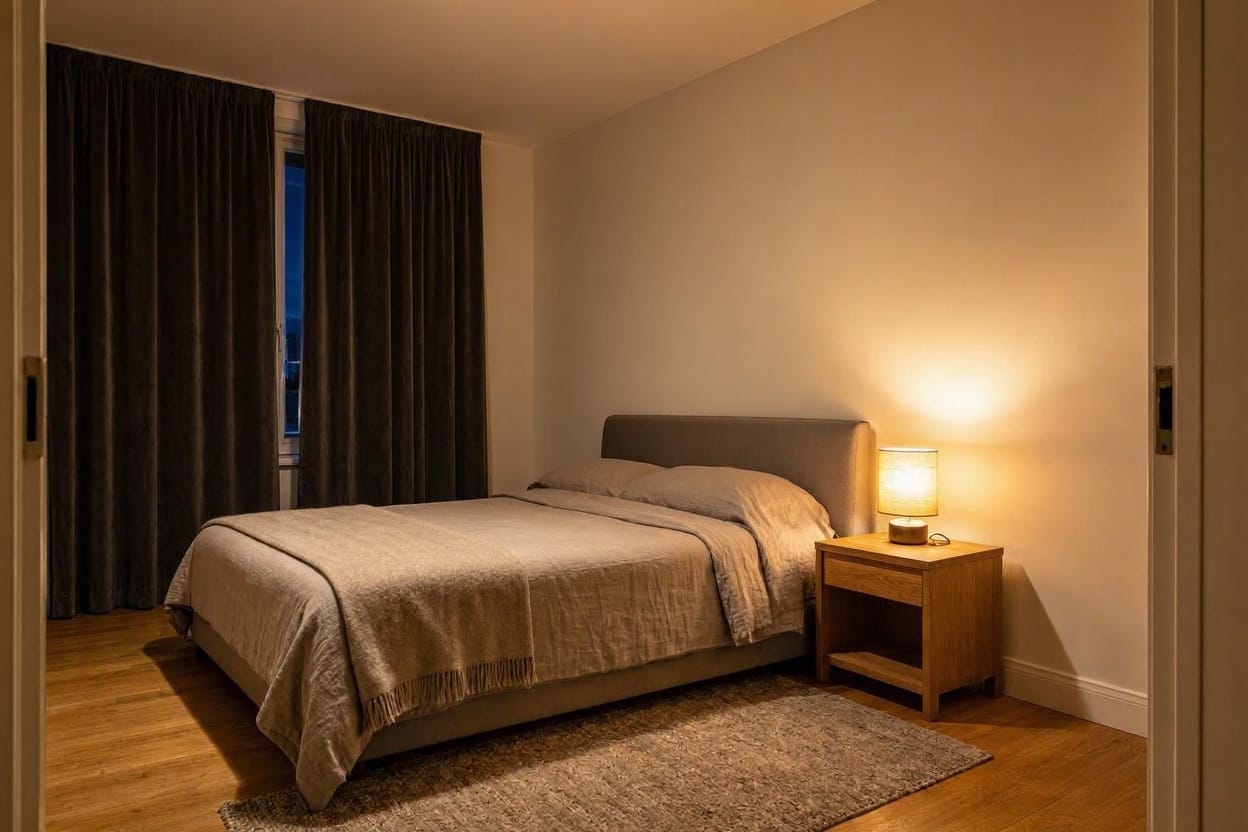
Almost everyone who tries to soundproof a bedroom starts in the wrong place. They buy acoustic panels, or heavy curtains, or a bulk pack of foam, and then discover that the noise waking them at three in the morning sounds exactly the same as before.
There is a reason for that, and it is not that those products are useless. It is that bedroom noise, when you are trying to sleep, comes down to a handful of specific pathways — and until you identify which one is affecting you, you are treating symptoms at random.
This guide is built around the order that actually works. It starts with diagnosis, moves through the fixes that cost the least and deliver the most, and ends with the serious structural work you only do if the cheap options are exhausted.
Start Here: Identify What Is Actually Waking You
Do not skip this. Thirty minutes of diagnosis saves hundreds on the wrong materials.
Name the sound precisely. “Noise” is not a diagnosis. Which of these is it?
- Neighbour’s bass or a deep engine rumble — low frequency, structural. The hardest to treat, and the one where soft materials do nothing at all.
- Voices, television, music — mid frequency, airborne. Very treatable.
- Footsteps, doors slamming, furniture dragging — impact noise, transmitted through the building structure.
- Traffic or aircraft — usually arriving through the window.
- A constant hum — from a fan, a fridge, a heat pump or the building’s plant. Steady and often more annoying than louder irregular sounds.
Then work out the direction. Stand in the room and listen. Is the sound coming through the window, through one specific wall, through the door, or through the floor? Put a hand flat against each surface and compare. Usually one pathway dominates, and fixing that one properly beats half-fixing all four.
The reason this matters is the distinction between airborne and structure-borne sound. They need different treatments, and the two are constantly confused. A £30 roll of foam blocks airborne mid-frequencies and does almost nothing for a bass line coming up through the joists. Our explainer on how to block low frequency noise covers why bass behaves like a structural problem rather than a wall-thickness problem.
There is also a pathway most people never consider: sound that sneaks around your soundproofing rather than through it. That is flanking noise, and it undoes more bedroom projects than any material choice.
The Best Order Of Operations
Work down this list. Each step is more expensive and more disruptive than the one above it, and the first two solve the majority of real sleep complaints.
Step 1 — Seal every gap (free to cheap, highest return)
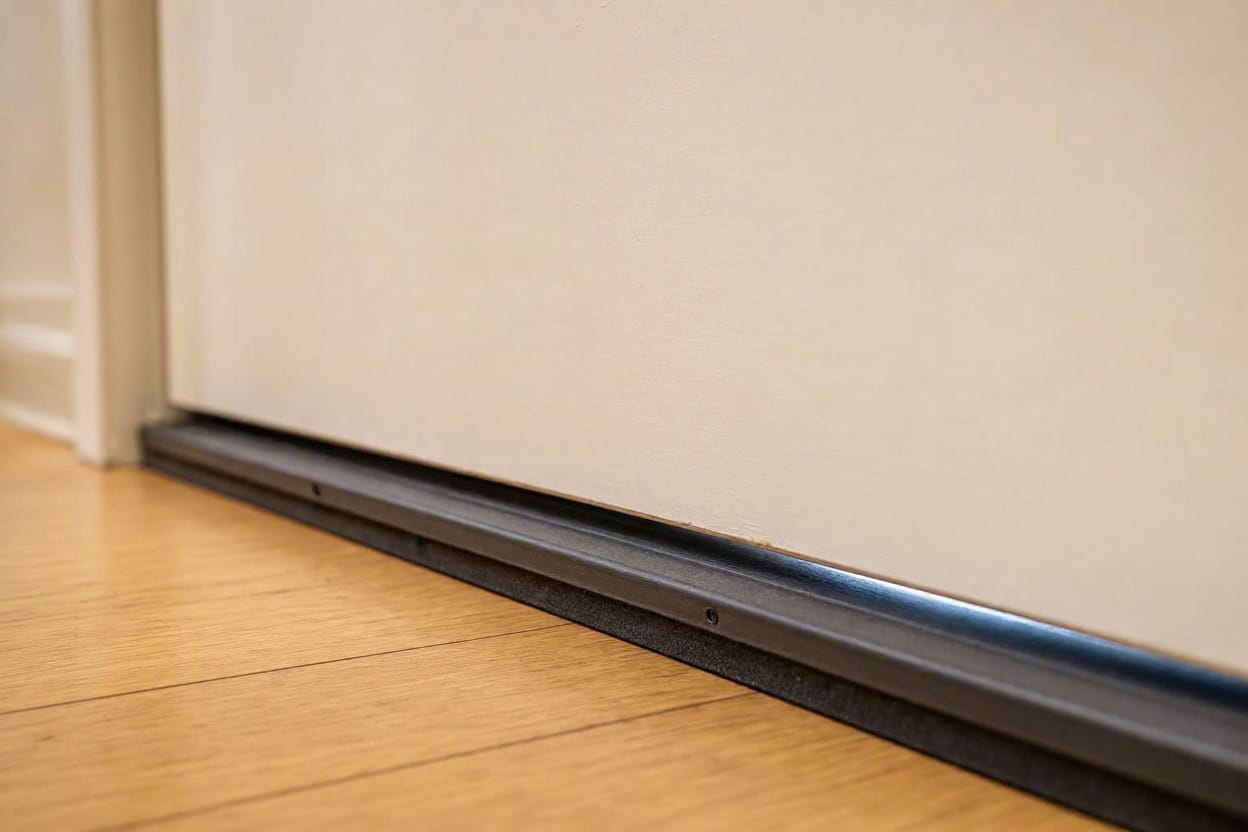
This is the single most underrated step in bedroom soundproofing, and the reason is simple: sound is air pressure, and air pressure escapes through gaps. A room with a two-centimetre gap under the door behaves, acoustically, as though the door is not there.
Walk the room and find the gaps:
- Under the door. Usually the worst offender in any bedroom. A door sweep or a brush seal closes it.
- Around the door frame. The perimeter needs acoustic sealant or weatherstripping, not just the bottom.
- Window edges. Check the seal where the window meets its frame, and any opening casement.
- Service penetrations. Where pipes, cables or TV aerials pass through walls.
- Sockets and switches. Back-to-back sockets on a shared wall are a genuine acoustic hole. Acoustic putty pads behind the faceplate cost pennies.
- Skirting boards and floor gaps. Particularly on older properties with suspended timber floors.
This is the same principle behind weatherstripping on any opening — see does weatherstripping block noise for the physics of air gaps. It is unglamorous, it is cheap, and it outperforms almost everything else on this list per pound spent.
Step 2 — Fix the door (cheap to moderate, huge return)
In most bedrooms, the door is the weakest element in the whole assembly. A hollow core internal door is a thin, undamped panel that transmits sound almost freely.
- Replace a hollow door with a solid one. A genuinely solid core door is dramatically heavier and blocks far more airborne noise. This is one of the best-value single upgrades in the whole room.
- If you cannot replace it, add mass and damping. A layer of mass loaded vinyl or a purpose-made acoustic door blanket fitted behind the door helps considerably. Our guide to mass loaded vinyl covers how the mass half of the acoustic equation works.
- Seal it properly. A heavy door with gaps performs worse than a light door without them. Sweep, perimeter seal and a good latch that pulls the door tight.
Our full guide to soundproofing a hollow core door takes this further if the door is your main pathway.
Step 3 — Deal with the window (moderate)
If traffic, aircraft or street noise is your problem, the window is almost certainly the route. Glass is thin, the frame is often a poor seal, and windows are frequently the largest single opening in the room.
- Seal the perimeter where the window meets the frame.
- Add a second layer — a secondary glazing panel or a well-fitted acoustic insert, creating an air gap between two panes.
- Use genuinely heavy curtains as a supporting measure, not a primary one. They help with mid and high frequencies and do very little for low-frequency traffic rumble.
Two important things to understand before spending: the air gap between panes matters more than the thickness of the glass, and an acoustically mismatched pair of panes (different thicknesses) performs better than two identical ones. Our guides to soundproofing a window and STC vs OITC ratings cover the reasoning, and do soundproof curtains work explains honestly what curtains can and cannot achieve.
Step 4 — Handle the shared wall (moderate to high)
If your neighbour’s television or conversation is the problem and it is arriving through one specific wall, you have two realistic options short of building work:
- Add mass. An extra layer of dense material on the wall increases the barrier. Mass loaded vinyl works well here.
- Add damping between layers. If you are adding a second layer of board, a viscoelastic compound between the layers converts vibration into heat rather than letting it pass — see Green Glue soundproofing.
What does not work on a shared wall is foam or thin acoustic panelling. Both absorb the high frequencies inside your room, which makes your room sound less echoey, and both are nearly transparent to the low frequencies coming through the wall. The distinction is explained properly in soundproofing vs. sound absorption.
Step 5 — The floor and ceiling, if the pathway is vertical
If noise arrives from below or above — footsteps, bass from a downstairs flat, or a washing machine on the floor above — you are dealing with impact and structure-borne noise, and no amount of wall treatment will help.
- For a floor above you: a ceiling treatment means decoupling a new ceiling from the existing structure, then adding mass and absorption. It is genuinely disruptive work and worth professional advice.
- For noise from your own floor: a thick underlay with acoustic mass beneath a carpet helps meaningfully with impact noise. Our guide to rug pads for soundproofing covers where they help and where the claims are overstated.
Step 6 — Your own room’s sound (free, and often overlooked)
Everything above stops sound getting in. This step changes how the room behaves for the sound already inside it, and it is the cheapest comfort win available.
- Soften the surfaces. A bare room with hard floors, plain walls and no textiles is an echo chamber — which makes every incoming noise sound sharper and more intrusive, and makes your own room feel louder than it is.
- Add a rug, soft furnishings, textiles. Curtains, throws, cushions and a rug all absorb mid and high frequencies and reduce the harshness of the room.
- Break up hard parallel surfaces where you can — a bookcase on one wall, a fabric headboard, artwork with some depth.
This does not stop your neighbour’s bass. It does make the room noticeably more restful, and unlike structural work it costs almost nothing.
This is not a trivial comfort issue. The World Health Organization identifies sleep disturbance as one of the established effects of chronic noise exposure, alongside cardiovascular and cognitive impacts. World Health Organization
Step 7 — Mask what you cannot block
The honest final layer, and the one that works when everything else has done its best. Masking does not remove noise — it raises the floor around it so your brain stops attending to it, which for sleep is often the same thing in practice.
Match the character of the masking sound to the noise you are fighting. A steady low hum is best masked by something with low-frequency energy of its own: pink or brown noise. A sharper, more intermittent noise suits a broader mask. Our comparison of pink noise vs. white noise explains which suits which.
A second consideration for bedrooms specifically: many people find a white noise source easier to sleep beside than a fan, because it is steadier and does not push air. Our guide to quiet bedroom fans covers the alternative if you want airflow as well as masking, and white noise machines for deep sleep covers dedicated devices.
What Usually Does Not Work
Before you spend anything, cross these off. Each is widely recommended and each is a poor use of money for bedroom noise.
- Egg cartons. A persistent internet myth. They are a fire risk and acoustically almost inert. Our guide to whether egg cartons work explains what they actually do.
- Thin foam acoustic panels. These absorb mid and high frequencies inside the room. They do not block sound from outside, and they do not touch low-frequency noise at all.
- Soundproofing paint. The physics is simply not there — a paint layer is far too thin to add meaningful mass. See the truth about soundproofing paint.
- Blankets over windows as a primary fix. A genuinely heavy acoustic blanket behind a door helps. A duvet taped over a window does very little and looks like what it is.
- Tackling everything at once. Half-finishing four pathways is worse value than properly finishing the one that is actually waking you up.
If You Rent
Renters cannot do structural work, but the highest-value steps on this list are all renter-friendly — which is a happy accident of where the returns actually lie.
- Door sweep and perimeter seal. Reversible, cheap, removable when you leave.
- Window sealing and a removable secondary panel. Many acoustic window inserts are designed to be fitted and removed without damage.
- Heavy curtains on a proper track. Take them with you.
- Rugs and soft furnishings. Yours, and portable.
- Masking sound. Entirely yours.
Our guide to soundproofing a rented apartment goes through the renter-specific options in more detail, including what to ask a landlord for and what is genuinely worth pushing on.
The Honest Caveat
Bedroom soundproofing is a mitigation exercise, not a cure. There is no product that makes a shared-wall flat silent, and anyone selling you one is overselling. What you can realistically achieve is a room where the noise is below the threshold that wakes you — and that is a much more attainable target than silence.
Set expectations by pathway. Airborne noise through gaps and thin doors is genuinely beatable, and often dramatically so. Structure-borne bass from a neighbour through a solid wall is the hardest problem in domestic acoustics, and the honest answer there is a combination of mitigation and masking rather than elimination.
And if sleep disruption is becoming a health issue rather than an irritation, that is worth taking seriously. Chronic noise exposure has documented effects on sleep, cardiovascular health and cognition — which is the reason this is worth doing properly rather than half-heartedly.
Frequently Asked Questions
What is the Cheapest Way to Soundproof a Bedroom?
Sealing gaps, starting with the door. A door sweep, perimeter sealant around the frame, and acoustic putty pads behind any sockets on a shared wall cost very little and deliver more than almost anything else. Sound travels through air, and gaps are the path of least resistance — closing them is the highest-return step available.
Do Acoustic Foam Panels Soundproof a Bedroom?
No. They absorb mid and high frequencies inside the room, which reduces echo and makes the room sound calmer, but they do not block sound coming through walls, doors or windows and they do not affect low-frequency noise at all. They are a treatment for how a room sounds, not a barrier against noise entering it.
What Should I Soundproof First in a Bedroom?
Diagnose first, then follow the order: seal gaps, then the door, then the window, then the shared wall, then the floor or ceiling, then your own room’s soft furnishings, and finally masking sound. Fix the single pathway that is actually waking you rather than half-treating all of them.
Can I Soundproof a Bedroom as a Renter?
Yes — and usefully, because the highest-value steps are the renter-friendly ones. A door sweep, perimeter seals, a removable secondary window panel, heavy curtains, rugs and masking sound are all reversible and do most of the work. Structural work is where the returns trail off, not where they are.
Why Can I Still Hear My Neighbour’s Bass after Soundproofing?
Because low-frequency sound is structure-borne rather than airborne. A bass line travels through the building’s frame — joists, studs, masonry — and arrives as vibration rather than as air pressure. Soft materials and thin panels do almost nothing to it. The realistic options are adding mass and damping to the affected surface, and masking the residual with pink or brown noise.
Does Soundproofing a Bedroom Actually Work?
It works well against airborne noise arriving through gaps, doors and windows — that is very treatable and the improvement can be striking. It works less well against structure-borne low-frequency noise from neighbours, where mitigation and masking are more realistic than elimination. Setting expectations by pathway is the key to not being disappointed.
Is it Better to Soundproof the Wall or Use a White Noise Machine?
They solve different problems, and the best answer is usually both. Wall treatment reduces how much noise enters. Masking raises the floor so your brain stops attending to what remains. If you can only do one, mask — it is cheap, immediate and works regardless of which pathway the noise is using.

Ememobong is the lead researcher and editor at Quiet Dwelling. As a professional technical writer, he specializes in breaking down complex acoustic engineering concepts into simple, actionable steps. His goal is to help people build distraction-free environments for better sleep and deep work.